

On this page
When an object is in static equilibrium—meaning it is neither moving nor starting to rotate—the net torque on it must be zero. Because it is not rotating, this rule holds true no matter where you place your imaginary pivot point.
But while the physics is the same everywhere, the algebra is not. A poor choice of axis will leave you wrestling with multiple simultaneous equations. A clever choice will collapse the problem into a single line.
Which point to take torque about in equilibrium problems?
The standard rule for picking a pivot is to use the principle of elimination. According to the textbook *University Physics* published by OpenStax, "the guiding principle is that the best choice will simplify as much as possible the calculation of the net torque along the rotation axis" 1.
This usually means choosing a point through which the lines of action of unknown forces pass. This choice eliminates these unknown forces from the torque equation because their lever arms are zero.
If you are dealing with a beam resting on two supports, and you only know the weight of the beam, choosing one support as your pivot completely removes its unknown upward force from the calculation. This leaves only one unknown in the equation (the force of the other support), allowing you to solve for it immediately.
Why does the chosen pivot point eliminate forces?
Torque is the turning effect of a force. It is calculated by multiplying the force by its lever arm (the perpendicular distance from the pivot point to the line of action of the force). You can read more about calculating Torque as r × F using vectors if the forces are in three dimensions.
If a force acts exactly at the pivot point, its distance from the pivot is zero. Multiplying any force by zero gives zero torque. By actively choosing to place your pivot where an unknown, unwanted force acts, you "kill" that force in the math.
If you struggle with spotting these shortcuts across different mechanics problems, Fermi Concept Library can help you trace how the rules of rotational equilibrium apply from simple seesaws up to complex rigid bodies.
How do you solve a ladder problem step by step?
The classic ladder leaning against a wall is a perfect example of this elimination strategy in action.
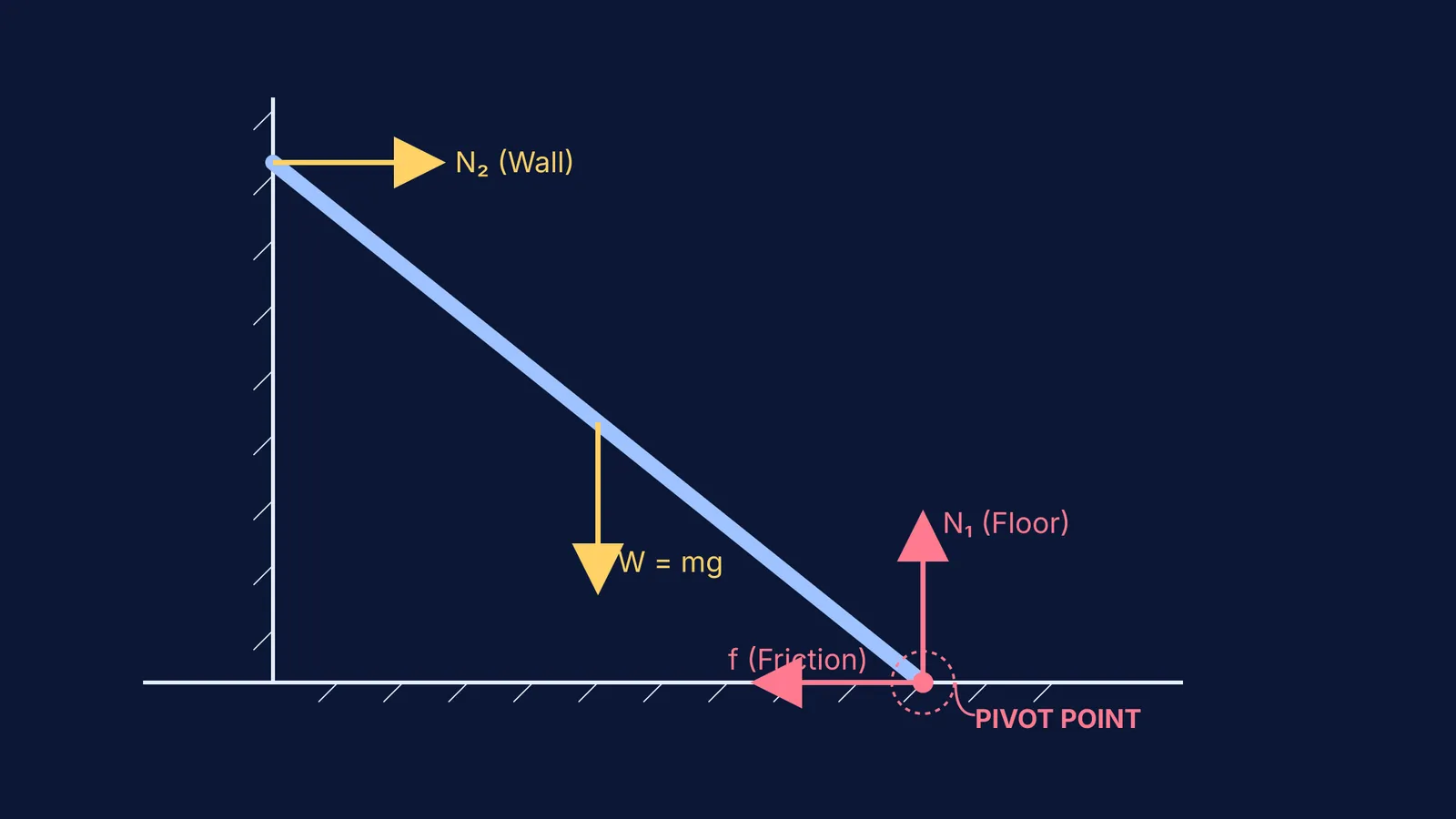
Imagine a uniform ladder leaning against a smooth wall (frictionless) and resting on a rough floor. You need to find the normal force from the wall. There are four forces acting on the ladder:
Its weight (acting downwards from the middle).
The normal force from the wall (acting horizontally away from the wall).
The normal force from the floor (acting vertically upwards).
The friction from the floor (acting horizontally towards the wall).
You know the weight, but the other three forces are unknown. If you use the principle of moments and take the torque about the middle of the ladder, you will have to juggle equations containing all three unknowns.
Instead, place your pivot at the bottom of the ladder (where it touches the floor).
Because the floor's normal force and the floor's friction both act through this bottom point, their distance from the pivot is zero. They produce no torque. Your equation now only contains the known weight and the one unknown you actually want: the normal force from the wall. You can now set the sum of torques to zero and solve it in one step.
If you are working through your textbook and keep getting stuck setting up these equations, the Fermi Problem Library provides a step-by-step solver that explains the reasoning behind each choice of pivot rather than just printing an answer.
A checklist for rigid body problems
Next time you face a static equilibrium question, follow this sequence:
Draw every force: Sketch a free-body diagram showing where every force touches the object.
Identify your goal: Circle the specific unknown force the question asks you to find.
Locate the "junk" forces: Spot the unknown forces you do not need to find (often reaction forces at hinges or friction at the ground).
Plant the pivot: Set your axis of rotation exactly on top of those unwanted forces.
Calculate: Write your torque equation. The junk forces will multiply by zero and vanish.


