On this page
Add phenolphthalein to a borax solution and it turns pink. Borax is a salt, not an alkali, yet its solution is clearly basic. The reason is hydrolysis, and the same reaction is why borax turns up in the titration lab as the substance you weigh out to find the exact strength of hydrochloric acid.
Why is borax solution basic?
Borax is sodium tetraborate decahydrate, Na2B4O7·10H2O, with a molar mass of 381.4 g/mol (PubChem, sodium tetraborate decahydrate). In the crystal, the boron sits in a ring ion written more exactly as [B4O5(OH)4]2−, which re-equilibrates to boric acid, B(OH)3, when it dissolves (LibreTexts, Chemistry of the Main Group Elements). Our post on the structure of borax and the borax bead test draws the ring out.
The textbook hydrolysis equation is Na2B4O7 + 7H2O → 2NaOH + 4H3BO3 (Unacademy, chemical reactivity of borax). Check it yourself: 14 hydrogens and 14 oxygens on each side.
The two products have very unequal strengths. NaOH is a strong base and is fully ionised. Boric acid is very weak: its pKa is 9.24 at 25 °C (PubChem, boric acid). It does not even give up its own proton; it accepts OH− from water, B(OH)3 + 2H2O ⇌ B(OH)4− + H3O+ (LibreTexts, above). That is why it counts as monobasic, explained in why boric acid is a monobasic Lewis acid.
A strong base plus a very weak acid leaves hydroxide in excess. Measured at 20 °C, borax solution has a pH of 9.3 at 0.1% and 9.2 at 1% (PubChem, citing Patty's Toxicology).
Why is borax a primary standard for HCl?
A primary standard is a substance pure and stable enough that weighing it tells you exactly how many moles you have. Then you can use it to find the concentration of a solution you cannot weigh, such as HCl. Borax qualifies for three reasons.
It reacts cleanly with acid: Na2B4O7 + 2HCl + 5H2O → 4H3BO3 + 2NaCl (titrations.info, standardising acid-base titrants). The acid neutralises the NaOH that hydrolysis releases.
Its molar mass is large. NPTEL's chemistry lab notes say borax "is preferable as a primary standard because of its higher equivalent weight" (NPTEL, Experiments in Chemistry). A heavier sample means the same small weighing error is a smaller fraction of what you weigh.
The by-product stays out of the way. "Boric acid is so weak, that its presence doesn't interfere with end point detection" (titrations.info, above).
Sodium hydroxide fails the same test, for reasons set out in why sodium hydroxide cannot be used as a primary standard.
How do you standardise HCl with borax?
Use PubChem's molar mass of 381.4 g/mol for the decahydrate (PubChem). NPTEL's method dissolves about 1 g in 100 mL; this worked example uses a round number of moles.
Weigh 1.9070 g of borax, dissolve it in distilled water and make it up to 100.0 mL. Moles = 1.9070 ÷ 381.4 = 0.005000 mol, so the solution is 0.05000 M.
Pipette 10.00 mL into the flask: 5.000 × 10⁻⁴ mol of borax.
Each borax needs 2 HCl, so the flask needs 1.000 × 10⁻³ mol of HCl.
Say your concordant titre is 9.80 mL. Then the HCl is 1.000 × 10⁻³ ÷ 0.00980 L = 0.1020 M.
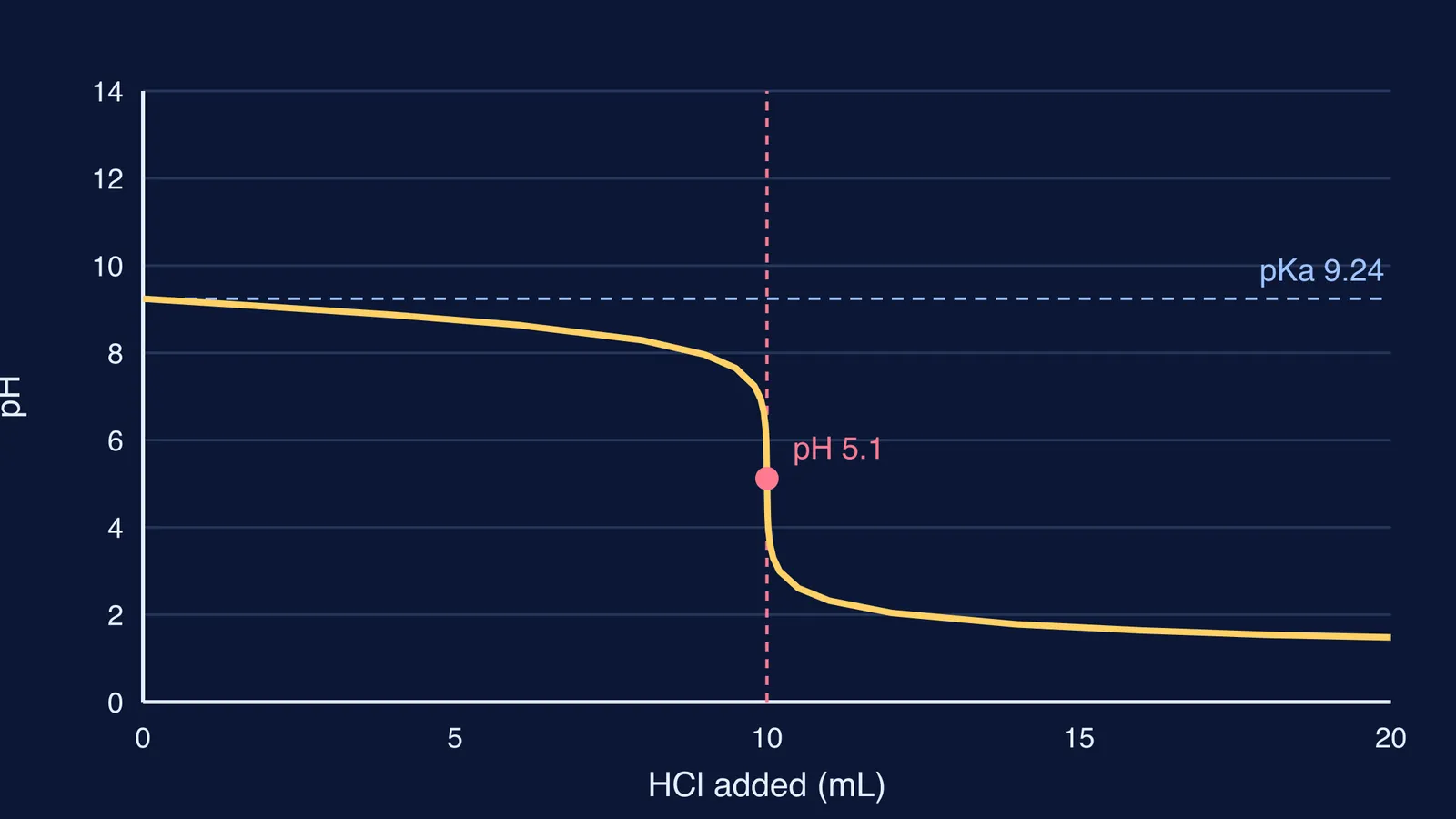
Now check where the end point falls. At equivalence the flask holds only NaCl and boric acid. For 0.1 M acid, that is 4 × 5.000 × 10⁻⁴ = 2.000 × 10⁻³ mol of boric acid in about 20 mL, or 0.10 M. For a weak acid, pH = ½(pKa − log C), and with boric acid's pKa of 9.24 (PubChem, boric acid) that is ½(9.24 + 1.00) = 5.1.
Which indicator should you use with borax and HCl?
The end point sits in the acid range, so use an indicator that changes there: titrations.info uses methyl red and NPTEL uses methyl orange (both linked above). Phenolphthalein loses its pink near pH 8.2, while the solution is still weakly alkaline and roughly a sixth of the borate has not yet reacted, so it would give you a titre that is too small.
If your answer keeps coming out half or double what it should be, the Fermi Problem Library has a step-by-step solver that explains the reasoning, so you can see which mole ratio went wrong. For the ideas underneath, salt hydrolysis and buffers, the Fermi Concept Library covers every concept in chemistry, physics, biology, mathematics and computing.
Next time you weigh borax, write the 1:2 ratio at the top of your page before you touch the burette.