

On this page
Boric acid shows up in every p-block chapter with the same puzzle. It has three hydrogens, yet it is monobasic, and you cannot titrate it properly with NaOH until someone adds glycerol. Both facts come from one idea: boron is short of electrons, so the acid takes something in rather than giving a proton away.
What makes boric acid a Lewis acid and not a proton donor?
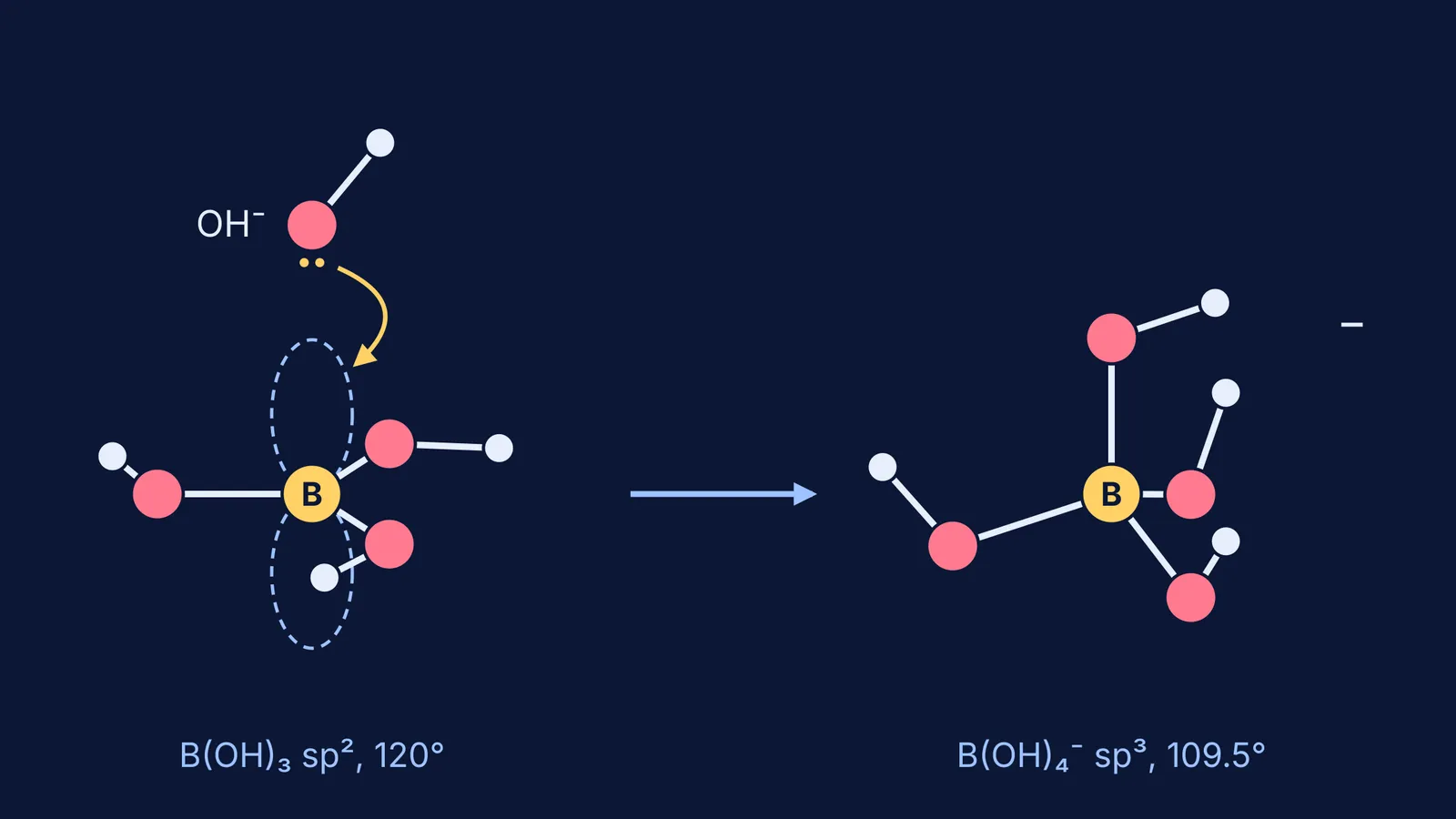
The boron in B(OH)₃ has only six valence electrons: three B–O bonds and an empty p orbital at right angles to the flat molecule. A Lewis acid is an electron-pair acceptor, and that empty orbital is where the pair goes. If the three acid definitions blur together, our guide to Arrhenius, Bronsted-Lowry and Lewis acids sorts them out.
A review in the Journal of Pharmaceutical Sciences calls boric acid "a Lewis acid with a pKa of 8.92-9.24", sensitive to temperature, ionic strength and concentration (Lopalco et al., 2020). The commonly quoted value is pKa 9.24, Ka = 5.8 × 10⁻¹⁰ at 25 °C (PubChem, boric acid).
In water, the empty orbital takes a hydroxide from a water molecule, and that water's leftover proton is what makes the solution acidic:
B(OH)₃ + 2H₂O ⇌ B(OH)₄⁻ + H₃O⁺
Wikipedia describes this as "Lewis acidity of boron toward HO⁻, rather than as Brønsted acidity" (Wikipedia, Boric acid). The same electron shortage makes BF₃ and BCl₃ Lewis acids, as our post on Lewis acidity of boron trihalides and back bonding explains.
Why is boric acid monobasic if it has three hydrogens?
Basicity counts how many H⁺ one molecule can deliver, not how many hydrogens it carries. Boron has one empty orbital, so it takes only one OH⁻. Once it becomes B(OH)₄⁻, its octet is complete. One OH⁻ accepted means one H⁺ released from water: monobasic.
Phosphorous acid, H₃PO₃, is dibasic for a different reason, covered in our guide to oxoacids of phosphorus and sulphur and their basicity.
Why is boric acid titrated with glycerol?
A pKa above 9 makes boric acid too weak to give a sharp end point with NaOH. Phenolphthalein solutions are "colorless to pH 8.5; pink to deep-red, above pH 9" (PubChem, phenolphthalein). Taking pKa 9.24 and pH = pKa + log([borate]/[acid]), the solution reaches pH 9 when only about 36% of the boric acid is neutralised. The pink arrives about a third of the way to equivalence.
Glycerol fixes this. Boric acid "reacts reversibly with alcohols, especially 1,2-diols", and these esters "are also Lewis acids with lower pKa values" (Lopalco et al., 2020). Neighbouring OH groups on glycerol or mannitol close a ring around boron, removing borate from the equilibrium and pulling it to the right. With enough mannitol the pKa drops from about 9 to below 4 (Wikipedia, Boric acid).
How does the pharmacopoeia assay show it is monobasic?
The US Pharmacopeia assay dissolves about 2 g of boric acid in neutralised glycerin and water, titrates with 1 N NaOH, discharges the pink by adding 50 mL more neutralised glycerin, and continues until the pink returns (USP 35, Boric Acid). It states that each mL of 1 N NaOH equals 61.83 mg of H₃BO₃, and lists the molar mass as 61.83.
1 mL of 1 N NaOH contains 1 mmol of OH⁻.
61.83 mg of H₃BO₃ is 1 mmol, so the ratio is 1:1. Monobasic.
A 2.000 g sample needs 2000 ÷ 61.83 = 32.35 mL.
If boric acid were tribasic, it would need 3 × 32.35 = 97.0 mL.
What does the borate ion look like?
B(OH)₃ is flat: its three oxygens form a trigonal planar arrangement around boron, with B–O bonds of 136 pm (Wikipedia, Boric acid).
In B(OH)₄⁻, boron is sp³ and tetrahedral. A crystal structure of NaB(OH)₄ found B–O bonds of 1.464–1.485 Å and O–B–O angles of 107.9°–111.4°, "close to the tetrahedral angles" (Lapshin et al., 2009). The bonds lengthen from 1.36 Å to an average of about 1.48 Å as boron goes from three oxygen neighbours to four.
How do you answer this in an exam?
Use this checklist for a give-reason or 3-mark question:
Boron in B(OH)₃ is electron deficient: six valence electrons and an empty p orbital.
It accepts OH⁻ from water (Lewis acid) instead of donating H⁺.
Write B(OH)₃ + 2H₂O ⇌ B(OH)₄⁻ + H₃O⁺.
One OH⁻ accepted gives one H⁺, so it is monobasic.
It is weak (pKa about 9.2), so glycerol or mannitol is added before titrating with NaOH and phenolphthalein.
Geometry changes from trigonal planar (sp²) to tetrahedral (sp³).
If reasoning questions like this cost you marks, the Fermi Problem Library has worked problems with a step-by-step solver that explains the reasoning rather than printing an answer. If the gap is further back, such as hybridisation, the Fermi Concept Library gives each concept its own lesson.
Next time you meet B(OH)₃, ask what boron takes in before asking what it gives away.


