

On this page
Borax is a staple of inorganic chemistry, often introduced early in the syllabus and tested frequently in competitive exams. While it appears on reagent bottles as a simple decahydrate, its molecular reality is a complex bicyclic structure. Understanding this structure is the key to explaining how borax behaves when heated, and why it forms the basis of the classic bead test for transition metals.
In the laboratory, the borax bead test provides a quick, visual way to identify unknown metal ions. For exams, knowing the structure of the borate anion and the specific colours of the metaborates it forms is a reliable way to secure marks.
What is the true structure of borax?
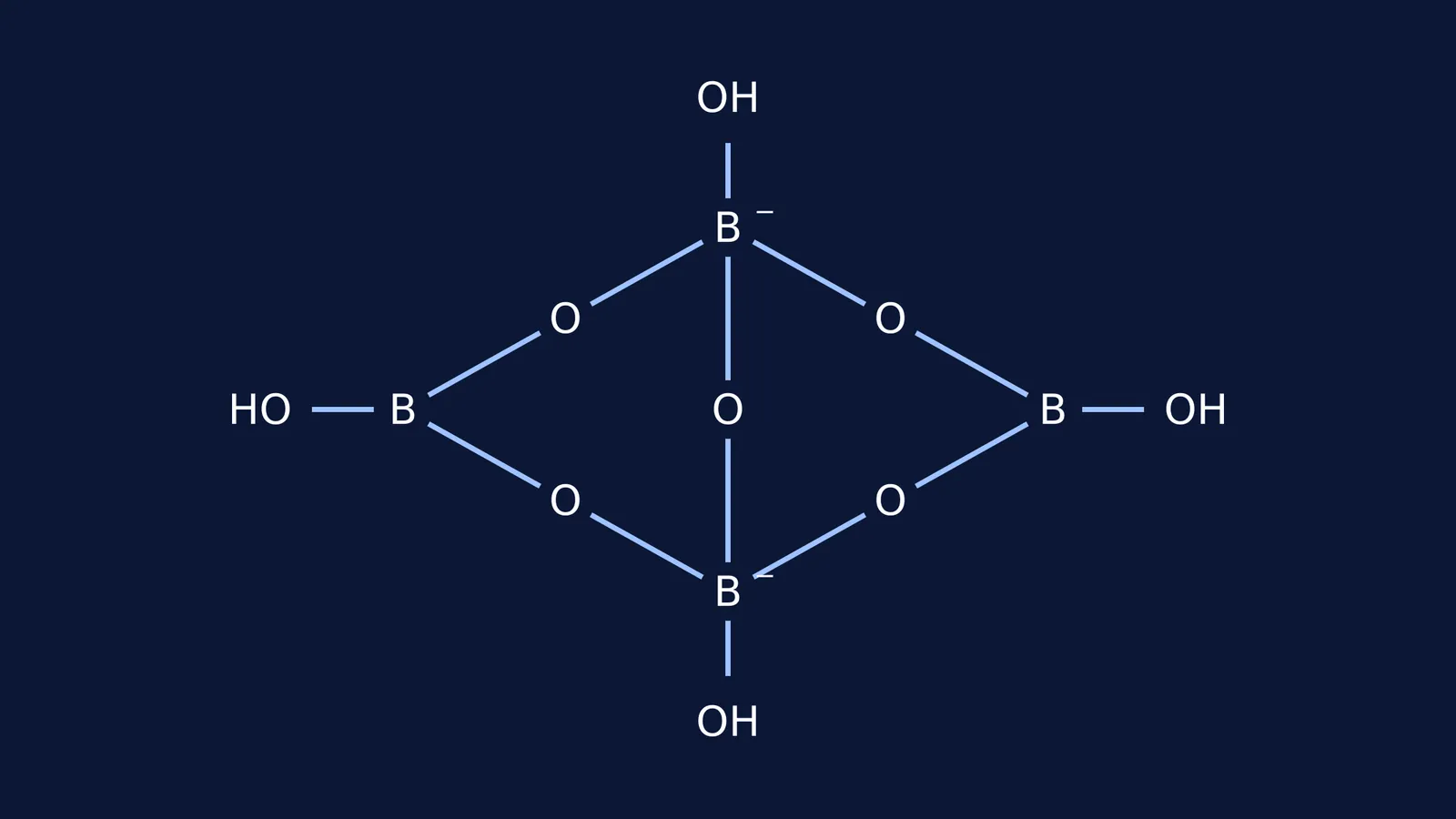
Textbooks often write the formula of borax as Na₂B₄O₇·10H₂O. However, X-ray crystallography reveals that borax is actually a salt of the tetranuclear [B₄O₅(OH)₄]²⁻ anion, making its [true formula Na₂[B₄O₅(OH)₄]·8H₂O](https://en.wikipedia.org/wiki/Borax).
The structure of the [B₄O₅(OH)₄]²⁻ unit is built around four boron atoms connected by five bridging oxygen atoms, forming two fused six-membered rings:
Boron coordination: Two of the boron atoms are bonded to four oxygen atoms, making them four-coordinate. The other two boron atoms are bonded to three oxygen atoms, making them three-coordinate.
Hydroxyl groups: Each of the four boron atoms is attached to one terminal hydroxyl (−OH) group.
Water of crystallisation: The remaining eight water molecules sit outside the complex ion, coordinating with the sodium ions and forming a network of hydrogen bonds.
This mixed coordination is a favourite target for examiners, much like the bonding seen in the Lewis acidity of boron trihalides.
How does the borax bead test work?
When you heat borax on a platinum wire loop, it undergoes a physical and chemical transformation. First, it loses its water of crystallisation and puffs up into a white, opaque mass. As heating continues, it melts and shrinks into a clear, transparent drop known as a glassy bead.
This glassy bead is a mixture of sodium metaborate (NaBO₂) and boric anhydride (B₂O₃). The boric anhydride acts as a powerful flux. When you touch the hot bead to a tiny speck of a transition metal salt and place it back in the flame, the boric anhydride reacts with the metal oxide to form a coloured metal metaborate.
For copper(II) oxide, the reaction is: CuO + B₂O₃ → Cu(BO₂)₂
The resulting copper(II) metaborate gives the bead a distinct blue colour. Because transition metals have partially filled d-orbitals, their metaborates absorb specific wavelengths of visible light, a property you can also trace when predicting oxidation numbers from structure.
If you are working through inorganic reactions and need to trace where the electrons go, the Fermi Concept Library has every concept in physics, chemistry, biology, mathematics and computing, each with its own lesson and its place in the map.
What are the borax bead test colours?
The colour a metal metaborate produces depends on two factors: the metal ion itself, and the type of flame used.
A Bunsen burner has an outer, hotter oxidising flame (where oxygen is plentiful) and an inner, cooler reducing flame (rich in unburnt carbon gas). Heating the bead in different parts of the flame changes the oxidation state of the metal, which in turn changes the colour.
Here are the key colours for common transition metals:
Cobalt (Co): Deep blue in both the oxidising and reducing flames.
Chromium (Cr): Green in both the oxidising and reducing flames.
Copper (Cu): Sky blue in the oxidising flame, but opaque red in the reducing flame (as it reduces to Cu₂O or metallic copper).
Iron (Fe): Yellow in the oxidising flame, turning bottle-green in the reducing flame.
Manganese (Mn): Pink in the oxidising flame, but completely colourless in the reducing flame.
A practical framework for exam questions
When you face a multiple-choice question on the borax bead test, trying to recall the whole table can be stressful. Instead, use this categorisation to eliminate wrong answers quickly:
The Constants: Cobalt (blue) and Chromium (green) do not change colour. If the question mentions a colour shift between flames, you can immediately cross these two off your list.
The Fading Metal: Manganese is the only common ion that goes from highly coloured (pink) to completely colourless when moved to a reducing flame.
The Switchers: Iron and Copper both undergo distinct colour changes. Copper is the only one that turns an opaque red, making it easy to spot.
By grouping the metals into constants, faders and switchers, you can navigate inorganic qualitative analysis questions without second-guessing your memory.


