

On this page
What makes a substance an analytical primary standard?
In quantitative chemical analysis, preparing a solution of accurately known concentration is essential for reliable titration results. According to analytical chemistry principles documented in David Harvey's Analytical Chemistry 2.1 on LibreTexts/05%3A_Standardizing_Analytical_Methods/5.01%3A_Analytical_Signals), an analytical primary standard is a reagent that can be used to dispense an accurately known amount of analyte. To qualify, a substance must possess a known stoichiometry, have an accurately established purity (or assay), remain stable during long-term storage, and maintain a fixed, predictable hydration state.
A high molar mass is equally vital. A large equivalent weight means weighing out a given number of moles requires a larger physical mass, sharply reducing the relative weighing error of an analytical balance. Well-known primary standards include potassium hydrogen phthalate, catalogued by the National Institute of Standards and Technology as NIST SRM 84l with a certified acidimetric assay exceeding 99.99%, and anhydrous sodium carbonate. Because these compounds do not gain or lose mass in air, you can weigh them directly, dissolve them to volume, and immediately calculate the exact molarity. Any reagent that absorbs moisture or air gases cannot serve as a primary standard and is classified as a secondary standard instead.
Why does sodium hydroxide absorb moisture and carbon dioxide?
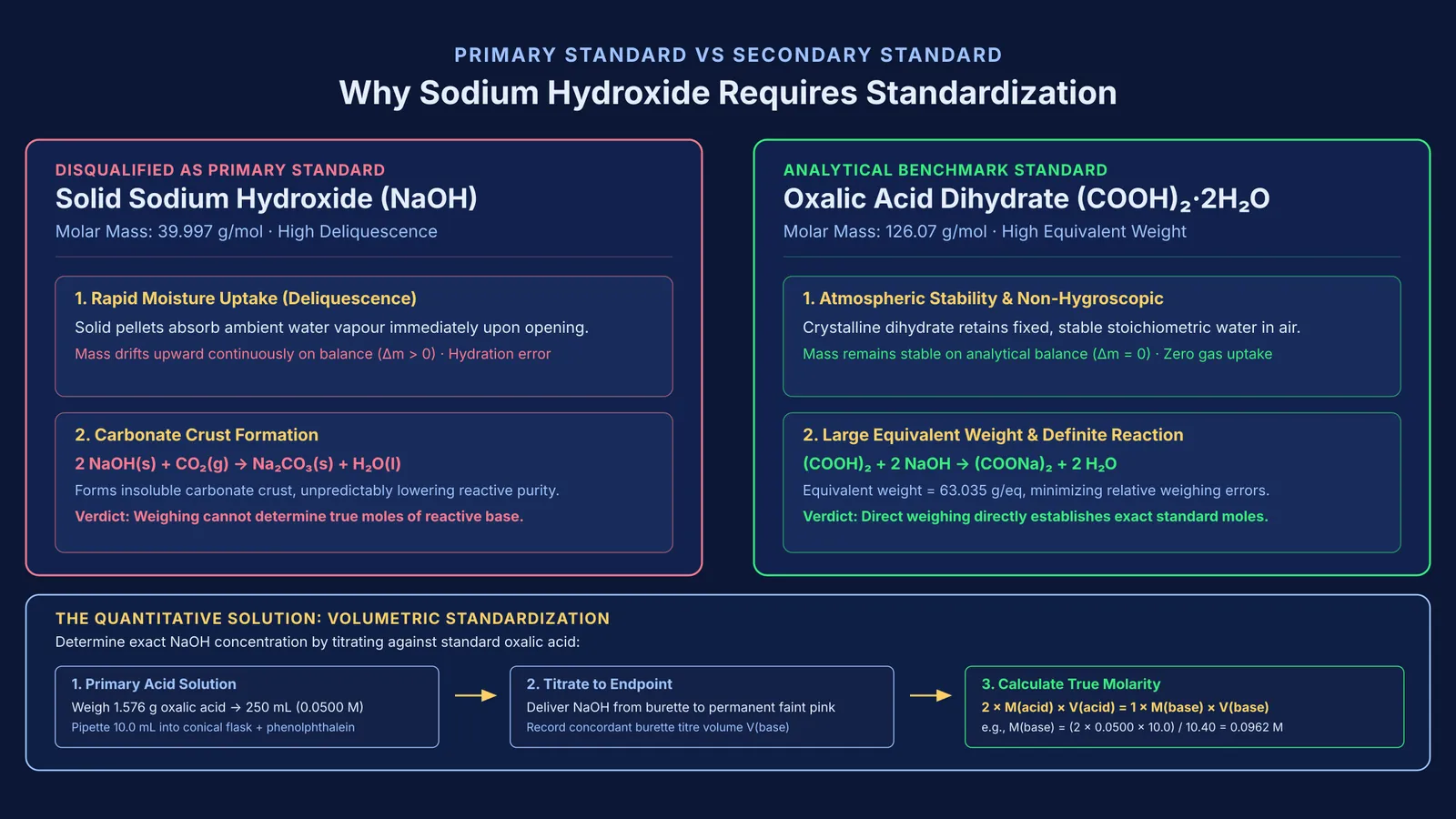
Sodium hydroxide fails the criteria of a primary standard due to its physical and chemical instability. As noted in the PubChem compound record for Sodium Hydroxide, solid sodium hydroxide has a molar mass of 39.997 g/mol and is highly hygroscopic and deliquescent. When exposed to air, dry sodium hydroxide pellets absorb water vapour immediately. Within minutes, pellet surfaces become wet and dissolve into a concentrated liquid film. On a balance pan, the mass reading drifts upward continuously, so the recorded weight reflects an unknown mix of hydroxide and water.
Chemical reaction with air introduces further error. Ambient carbon dioxide reacts spontaneously with solid sodium hydroxide:
2 NaOH(s) + CO₂(g) → Na₂CO₃(s) + H₂O(l)
This reaction coats the pellets with an insoluble crust of sodium carbonate. Because every opening of a reagent bottle admits fresh moisture and carbon dioxide, the effective purity drops unpredictably, making exact mass calculation impossible.
How is sodium hydroxide standardised against oxalic acid?
Because direct weighing is inaccurate, chemists prepare an approximate sodium hydroxide solution and standardise it against a stable acid. In student laboratories, the primary standard of choice is crystalline oxalic acid dihydrate. As catalogued in the PubChem compound record for Oxalic Acid, oxalic acid dihydrate has a molar mass of 126.07 g/mol, compared with 90.03 g/mol for the anhydrous form. It is non-hygroscopic, crystalline, and stable in air.
Prescribed in the CBSE Senior Secondary Curriculum for Class 11 practicals, the standardisation procedure follows five steps:
Calculate the mass needed for 250 mL of a 0.0500 M solution: 0.0500 mol/L × 0.250 L × 126.07 g/mol = 1.576 g.
Weigh 1.576 g of oxalic acid dihydrate, transfer it to a 250 mL volumetric flask, and dilute to the mark with distilled water.
Pipette 10.0 mL of this solution into a conical flask and add 1 to 2 drops of phenolphthalein.
Titrate with the sodium hydroxide solution from a burette until the liquid turns a permanent faint pink.
Record the titre volume and repeat for concordant readings.
The neutralisation reaction is:
(COOH)₂ + 2 NaOH → (COONa)₂ + 2 H₂O
Because 1 mole of diprotic oxalic acid neutralises 2 moles of sodium hydroxide, the relationship is:
2 × M(acid) × V(acid) = 1 × M(base) × V(base)
If 10.0 mL of 0.0500 M oxalic acid requires 10.40 mL of sodium hydroxide, the molarity is:
M(base) = (2 × 0.0500 mol/L × 10.0 mL) / 10.40 mL = 0.0962 M
The mass concentration is 0.0962 mol/L × 39.997 g/mol = 3.85 g/L. For related calculations, review our guides on converting between molarity, molality, and mole fraction and titrating oxalic acid with potassium permanganate. When working through stoichiometry, the Fermi Problem Library provides worked problems with a step-by-step solver that explains the reasoning rather than printing an answer.
What is the carbonate error during phenolphthalein titration?
Even after standardisation, dissolved atmospheric carbon dioxide can cause a systematic analytical error. In research published in the *Journal of Chemical Education*, Crossno and colleagues showed that carbon dioxide dissolves in aqueous sodium hydroxide to yield carbonate ions:
2 OH⁻(aq) + CO₂(g) → CO₃²⁻(aq) + H₂O(l)
This replaces two hydroxide ions with one carbonate ion. Phenolphthalein changes colour between pH 8.2 and 10.0, where carbonate is neutralised only to bicarbonate (HCO₃⁻), consuming one proton instead of two. Half the neutralising capacity of the original hydroxide is lost at the endpoint.
To prevent this error, prepare solutions using freshly boiled, cooled distilled water and store them in airtight polyethylene bottles. For guidance on equivalence points, see our review of acid-base titration curves and indicator selection. The Fermi Concept Library maps every concept in physics, chemistry, biology, mathematics and computing, each with its own lesson and its place in the map.


