

On this page
When studying optimization in calculus, students often rely on a single rule: differentiate the function, set the derivative to zero, and solve for x. For smooth curves, this procedural shortcut works. However, treating stationary points and critical points as identical creates a serious blind spot on CBSE Class 12 exams and JEE.
What is the difference between a stationary point and a critical point?
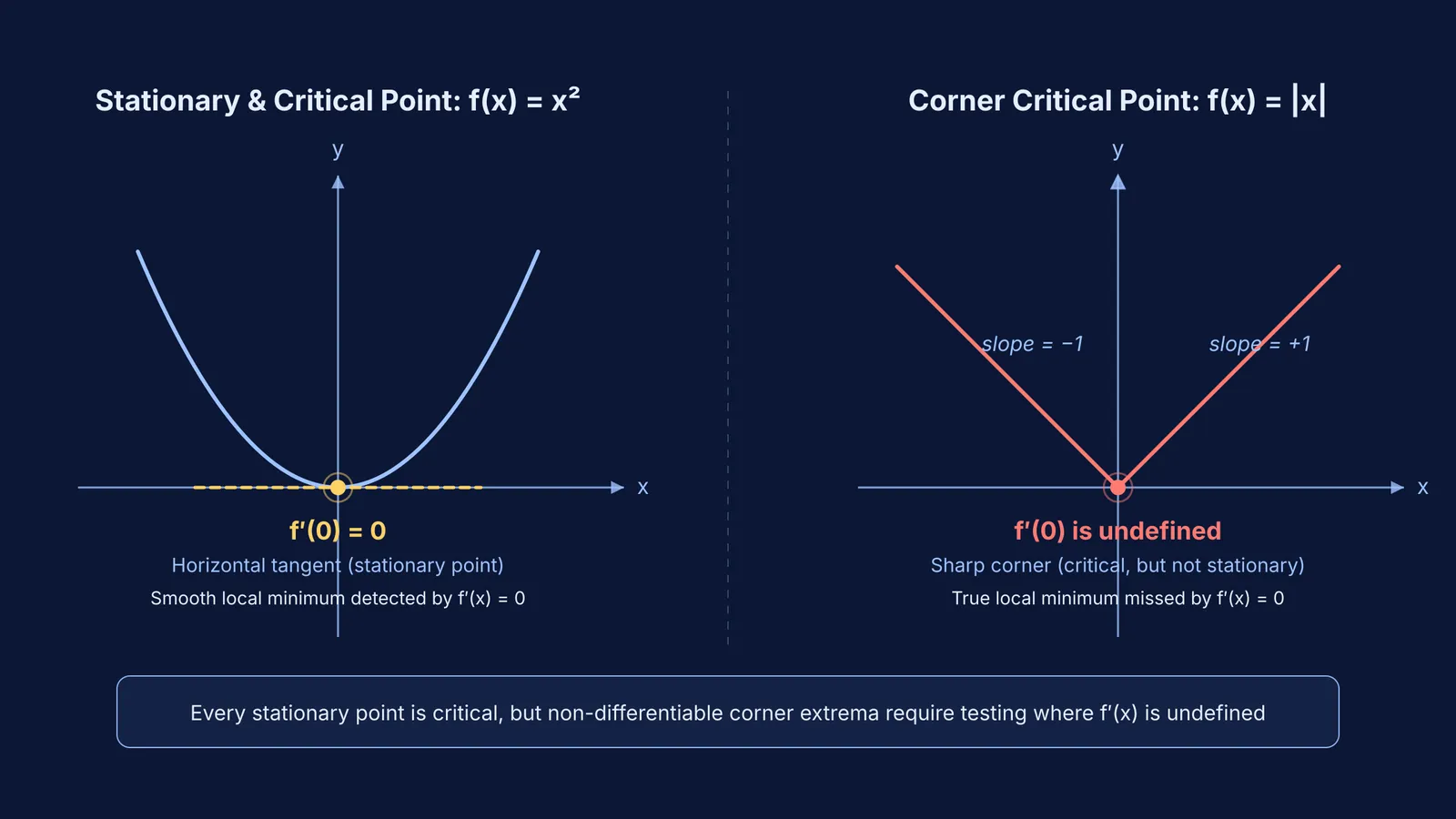
A stationary point is an interior point c in the domain of a function f where the derivative equals zero: f′(c) = 0. Geometrically, the tangent line at (c, f(c)) is completely horizontal. The term comes from kinematics: if f(t) describes position, f′(t) = 0 indicates that velocity is zero, so the object is momentarily at rest.
By contrast, as defined in OpenStax Calculus Volume 1, a critical point is any interior point c in the domain of f where either f′(c) = 0 or f′(c) is undefined.
Stationary points are therefore a subset of critical points. Every stationary point is a critical point, but critical points also include corners, cusps, and vertical tangents where no finite slope exists.
Why does setting f′(x) = 0 miss extrema at sharp corners?
Fermat's Theorem states that if f has a local extremum at an interior point c and f is differentiable at c, then f′(c) = 0. Students frequently misunderstand this theorem, assuming local extrema can only occur where the derivative exists and vanishes.
This assumption fails whenever a function forms a sharp corner. Consider f(x) = |x|. Its V-shaped graph has a clear global minimum at the origin (0, 0). Yet for x < 0, f′(x) = −1, and for x > 0, f′(x) = +1. At x = 0, the left-hand and right-hand slopes disagree, so f′(0) does not exist.
Searching only for roots of f′(x) = 0 yields no solutions, incorrectly suggesting that |x| has no minimum. The origin is a critical point precisely because the derivative is undefined there. Similar corner extrema occur in functions with fractional powers, such as f(x) = x^(2/3), where f′(0) is undefined.
In a 1983 study of 110 mathematics students published in *Educational Studies in Mathematics*, Anthony Orton demonstrated that students routinely treat differentiation as a mechanical routine of setting f′(x) = 0, confusing stationary points with turning points and missing non-standard critical points.
The Fermi Problem Library has worked problems with a step-by-step solver that explains the reasoning rather than printing an answer, helping students catch non-differentiable points before calculating.
Can a point be stationary without being a maximum or minimum?
Just as extrema can occur without being stationary, stationary points can exist without being extrema. Solving f′(x) = 0 finds candidate points, but a flat tangent does not guarantee a peak or valley.
For f(x) = x³, f′(x) = 3x² equals zero at x = 0. The graph has a horizontal tangent at the origin, making it a stationary point. Yet f′(x) is positive for all non-zero x, meaning the function climbs continuously. The origin is a stationary point of inflection, not a local extremum.
To classify critical points, OpenStax Calculus Volume 1 details the First Derivative Test:
Local maximum: f′(x) switches from positive to negative across c.
Local minimum: f′(x) switches from negative to positive across c.
Neither: f′(x) keeps the same sign on both sides of c.
This test applies to both smooth stationary points and non-differentiable corners. For f(x) = |x|, f′(x) shifts from −1 to +1 across x = 0, proving a local minimum even though the second derivative test is unusable because f″(0) does not exist.
How should you check for extrema on school and competitive exams?
Curriculum guidelines from the NCERT Mathematics Class 12 textbook expect students to test every possible candidate:
Find stationary points: Solve f′(x) = 0 within the domain.
Find singular critical points: Identify where f′(x) is undefined, such as vanishing denominators or piecewise transitions.
Check interval boundaries: On a closed interval [a, b], test f(a) and f(b). While not interior critical points, endpoints often host global extrema, as explained in our guide on finding absolute maximum and minimum values on a closed interval.
Classify candidates: Use the First Derivative Test to determine nature, connecting findings to applications of derivatives for maxima and minima and geometric tangents and normals using derivatives.
To explore foundational definitions, visit the Fermi Concept Library, which covers every concept in physics, chemistry, biology, mathematics and computing, each with its own lesson and its place in the map.


