

On this page
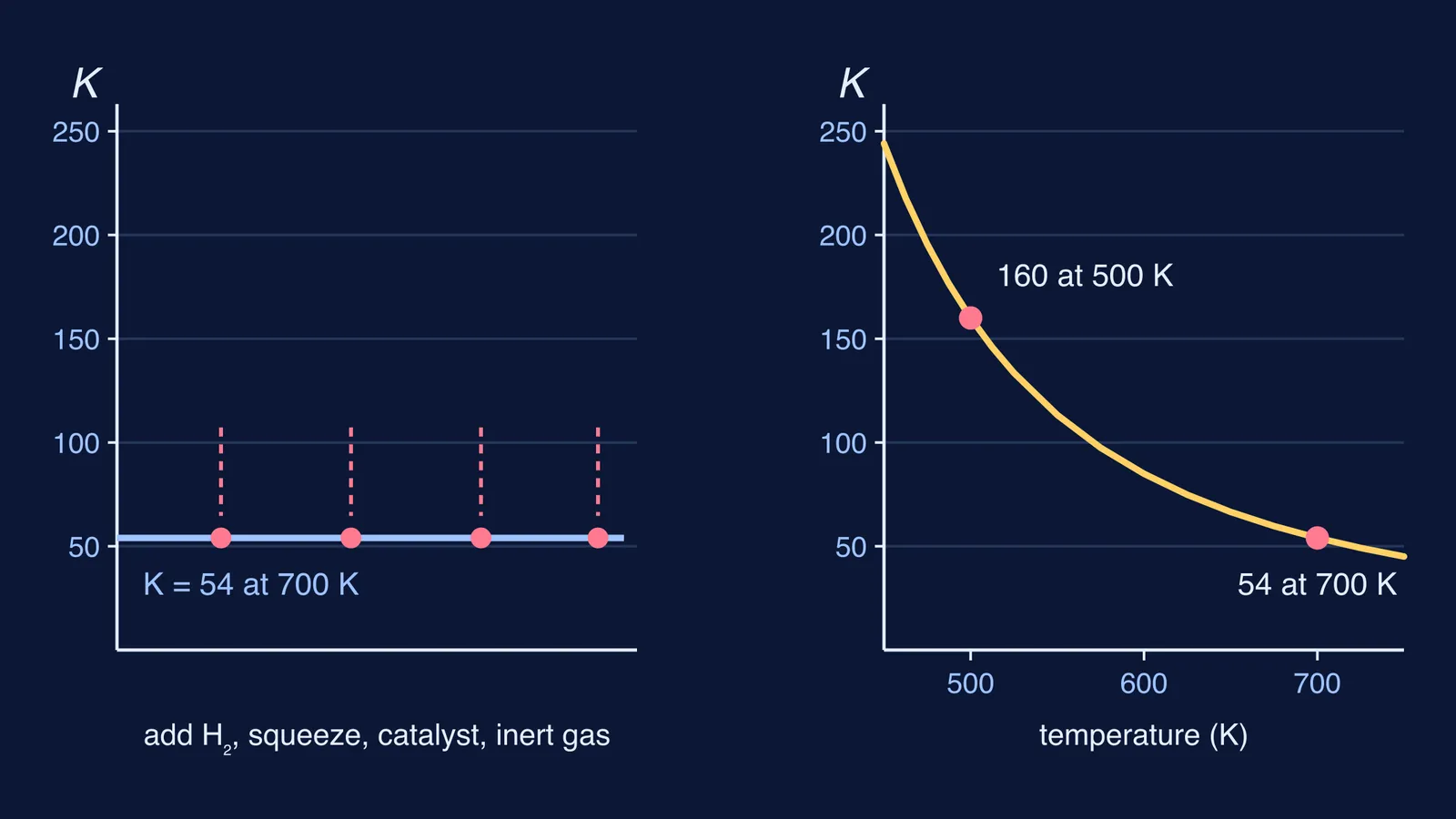
Add more hydrogen to a flask at equilibrium and the textbook says the reaction "shifts right". So did K go up? No. This Class 11 mix-up is a common exam trap. The rule fits in one line: for a given balanced equation, only temperature changes the value of K. Everything else changes where the mixture settles, or how fast it gets there.
Does the equilibrium constant change with concentration?
No. The OpenStax Chemistry 2e textbook states that an equilibrium stressed by a change in concentration shifts to re-establish equilibrium without any change in the value of K.
The trick is to compare two numbers. K is the fixed target. Q, the reaction quotient, uses the same formula but plugs in the concentrations or partial pressures you have right now. Add a reactant and Q falls below K, so the forward reaction runs until Q climbs back up to K. The mixture changes; the target does not.
Does pressure change the equilibrium constant?
No again. Chemguide states that equilibrium constants aren't changed if you change the pressure of the system. Squeezing a gas mixture changes Q, not K.
Try it with N₂O₄ ⇌ 2NO₂, where Kp = p(NO₂)² ÷ p(N₂O₄). Halve the volume and every partial pressure doubles. The top of the fraction grows four times, the bottom only two times, so Q becomes 2K. Q is now bigger than K, so the reaction runs backwards, towards N₂O₄, the side with fewer gas molecules. That is Le Chatelier's principle falling out of plain algebra, with K untouched. When both sides have the same number of gas moles, the doubling cancels and nothing shifts. For converting between the two forms, see our post on deriving Kp = Kc(RT)^Δn.
Does a catalyst or an inert gas change K?
A catalyst changes speed only. Chemguide explains that a catalyst speeds up the forward and back reaction to the same extent, so equilibrium arrives sooner but in the same place. OpenStax agrees: equilibrium is achieved more quickly but without a change in the equilibrium constant. Our post on why a catalyst leaves the equilibrium constant alone goes further.
With an inert gas such as argon, ask what is held fixed:
Constant volume: total pressure rises, but each reacting gas keeps its own partial pressure, so neither the position of equilibrium nor K changes.
Constant pressure: the container must expand, so every reacting partial pressure drops, just as if you increased the volume. The position shifts towards the side with more gas moles. K still stays the same.
Both cases are worked through with numbers in adding an inert gas at constant volume vs constant pressure.
Why does temperature change K?
Temperature changes the rate constants of the forward and backward reactions, so the equilibrium constant varies with temperature too. Chemguide gives the rule: for an exothermic forward reaction, raising the temperature decreases K; for an endothermic forward reaction, raising the temperature increases K. For H₂ + I₂ ⇌ 2HI, Chemguide gives Kp = 160 at 500 K and Kp = 54 at 700 K. Same equation, new temperature, new constant.
Worked example: one flask, four changes
Take H₂ + I₂ ⇌ 2HI at 700 K, where Kp = 54 (Chemguide). Both sides have 2 moles of gas, so Kp = Kc here. Suppose the flask settles with p(H₂) = p(I₂) = 0.20 bar. Then p(HI)² = 54 × 0.20 × 0.20 = 2.16, so p(HI) is about 1.47 bar. Start from this flask each time:
Add H₂ until p(H₂) = 0.40 bar. Q = 2.16 ÷ (0.40 × 0.20) = 27. Q is less than 54, so more HI forms. K stays 54.
Halve the volume. Every pressure doubles: Q = 8.64 ÷ (0.40 × 0.40) = 54. Q still equals K, so nothing shifts.
Add a catalyst. Q and K are unchanged; only future shifts get faster.
Cool to 500 K. Now K = 160 while Q is still 54, so more HI forms. This is the only step where K itself moved.
A quick exam check
Did the temperature change? If yes, K changes; use the sign of ΔH to say which way.
If not, K is fixed. Work out what happened to Q.
Q less than K: forward. Q greater than K: backward. Q equal to K: no shift.
Catalyst: no shift, only faster.
Inert gas: check whether volume or pressure is held constant.
If you get the direction right but the reasoning wrong, try equilibrium questions in the Fermi Problem Library, where a step-by-step solver explains the reasoning rather than printing an answer. To revisit Q, K and Le Chatelier's principle from the start, each concept has its own lesson in the Fermi Concept Library.


