

On this page
An equilibrium constant belongs to one particular written equation at one temperature. Flip the equation, halve it or add another step, and the number changes in a fixed way. Learn three rules and one check for Kp, and a whole family of Class 11 MCQs becomes quick to answer. The NCERT Class 11 unit on equilibrium makes the same point: always say which balanced equation a value belongs to. We use that chapter's own data below.
What happens to Kc when you reverse a reaction?
For the reverse reaction, the equilibrium constant is the inverse of the forward constant: K′ = 1/K (NCERT Class 11 Chemistry, Unit 6).
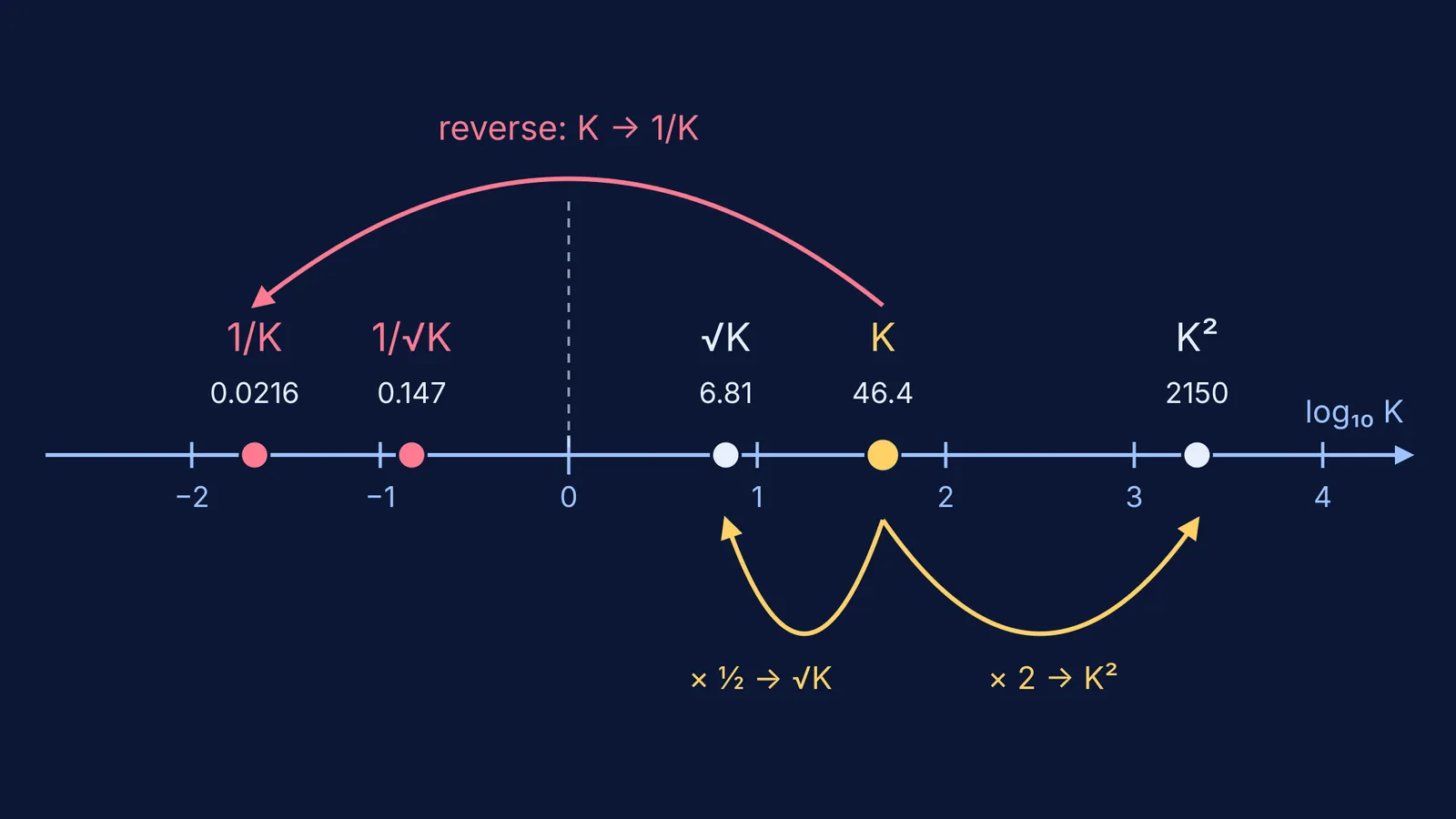
The products become the reactants, so the fraction turns upside down. Six experiments on H₂(g) + I₂(g) ⇌ 2HI(g) at 731 K give [HI]²/[H₂][I₂] values between 46.4 and 47.6, and three of them give 46.4 (NCERT Table 6.3). We use 46.4. So for 2HI(g) ⇌ H₂(g) + I₂(g), Kc = 1/46.4 ≈ 0.0216.
What happens to Kc when you multiply or divide an equation?
Multiply every coefficient by n and the new constant is Kⁿ. Halving the equation means n = ½, which gives the square root (NCERT equations 6.9–6.11 and Table 6.4). Each coefficient is an exponent in the K expression, so scaling the coefficients scales every exponent by the same amount.
Here is the HI system worked through, all at 731 K:
H₂ + I₂ ⇌ 2HI: Kc = 46.4
½H₂ + ½I₂ ⇌ HI: Kc = 46.4^½ ≈ 6.81
2H₂ + 2I₂ ⇌ 4HI: Kc = 46.4² ≈ 2150
HI ⇌ ½H₂ + ½I₂: Kc = (1/46.4)^½ ≈ 0.147
What is K when you add two reactions?
Adding two or more equilibrium equations gives an overall equation whose constant is the product of the individual constants: K = K₁ × K₂ (OpenStax Chemistry 2e, section 13.2). If a target equation is one step minus another, that is the same as adding the reversed step, so you divide.
A made-up example: suppose A ⇌ B has K₁ = 4 and B ⇌ C has K₂ = 0.5 at the same temperature. Then A ⇌ C has K = 4 × 0.5 = 2, not 4.5.
Do the same rules work for Kp?
Yes. Kp follows the same rules, and you can check your answer with Kp = Kc(RT)^Δn. Here Δn is the moles of gaseous products minus the moles of gaseous reactants, and with pressure in bar, R = 0.0831 bar L mol⁻¹ K⁻¹ (NCERT Class 11 Chemistry, section 6.4.1). When Δn = 0, as for the HI reaction, Kp = Kc.
NCERT lists Kp = 3.6 × 10⁻² for N₂ + 3H₂ ⇌ 2NH₃ at 500 K (NCERT Table 6.5). Here is the check, step by step:
Forward: Δn = 2 − 4 = −2 and RT = 0.0831 × 500 = 41.55, so Kc = Kp × (RT)² = 0.036 × 1726 ≈ 62.2.
Reversed (2NH₃ ⇌ N₂ + 3H₂): Kp = 1/0.036 ≈ 27.8, and now Δn = +2.
Check: Kc = 27.8 ÷ 1726 ≈ 0.0161, which equals 1/62.2. The two routes agree.
The rules hold because Δn changes along with the equation. Reversing flips its sign, and multiplying by n multiplies it by n.
Which Kc questions trip students up in exams?
Reversing and scaling at once. HI ⇌ ½H₂ + ½I₂ needs K^(−½), which is 0.147 here. It is not 1/(2K) and not K/2.
Adding Ks. Combining equations multiplies the constants. Subtracting an equation divides by its constant.
Counting solids and liquids in Δn. Pure solids and liquids are left out of the K expression (NCERT section 6.5), so for CaCO₃(s) ⇌ CaO(s) + CO₂(g), Kp is just the pressure of CO₂, and Δn counts gas moles only.
Using the wrong R. If Kp is in bar and Kc is in mol/L, use 0.0831. If an answer is off by a power of ten or more, check R first.
Forgetting the temperature. These rules only connect constants measured at the same temperature. You cannot combine a constant at 500 K with one at 700 K.
If the rules feel like tricks, remember that K is a fraction and the coefficients are its exponents. The Fe³⁺ and SCN⁻ colour practical shows what equilibrium looks like in a test tube. Our guide to finding Ka from the pH of a weak acid uses the same constant-writing skills on ionic equilibria. To see why coefficients matter so much, read what a balanced chemical equation does and does not tell you.
For practice, the Fermi Problem Library has worked problems with a step-by-step solver that explains the reasoning rather than printing an answer. If Δn or the law of mass action itself is the shaky part, the Fermi Concept Library gives each chemistry concept its own lesson and its place in the map.


