

On this page
A chemical equation is a shorthand way to write down a chemical change. By looking at a balanced equation, you can see what you are starting with, what you will make, and exactly how much of each substance you need.
But an equation is only a summary. It leaves out the practical details of how to actually make the reaction happen in a lab.
What information does a balanced chemical equation give?
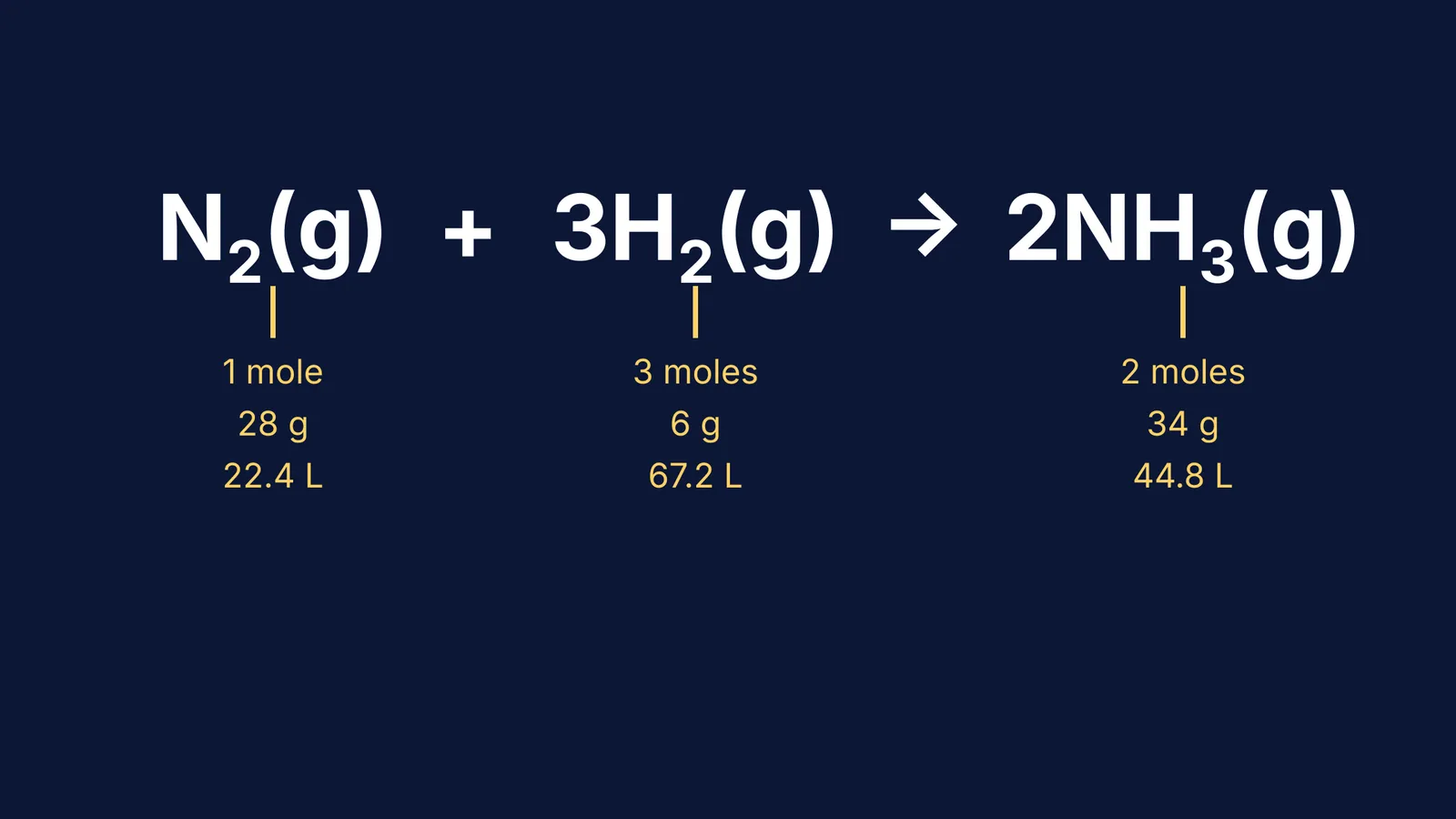
When you look at an equation like the synthesis of ammonia (N₂ + 3H₂ → 2NH₃), it provides three key pieces of information, starting with the conservation of mass (LibreTexts/07%3A_Chemical_Reactions/7.04%3A_How_to_Write_Balanced_Chemical_Equations)).
First, it gives the chemical identities. The chemical formulas tell you that nitrogen gas reacts with hydrogen gas to form ammonia. The state symbols — (s) for solid, (l) for liquid, (g) for gas, and (aq) for aqueous — tell you what physical form each substance takes.
Second, it shows conservation of mass. A balanced equation has the same number of atoms of each element on both sides of the arrow. This demonstrates that atoms are neither created nor destroyed, only rearranged.
Third, and most usefully for problem-solving, it provides stoichiometric ratios. The coefficients — the numbers written in front of the formulas — tell you the proportions in which the substances react. These numbers act as a recipe. In the ammonia example, the coefficients (1, 3, and 2) mean that one mole of nitrogen reacts with three moles of hydrogen to produce two moles of ammonia. Because you know the molar ratios, you can calculate the exact mass or volume required based on the laws of combination and formulae.
The Fermi Concept Library maps out every concept in chemistry so you can see where stoichiometry fits in and build a solid mental map of these relationships.
What are the limitations of a balanced chemical equation?
While a balanced equation is mathematically perfect, it tells you very little about the physical reality of the reaction (LibreTexts/07%3A_Chemical_Reactions/7.04%3A_How_to_Write_Balanced_Chemical_Equations)).
It does not tell you the rate of reaction. The equation shows you the start and the end, but it gives no clue about how fast the reaction happens. A reaction might take a fraction of a second, like an explosion, or many years, like iron rusting.
It does not show the reaction mechanism. An equation is a summary of the overall change. It does not show the intermediate steps, the bonds breaking, or the temporary molecules that form and disappear along the way.
It does not list the required conditions. Unless specific details are written above the arrow, the equation does not tell you what temperature or pressure is needed, or if a catalyst must be present. Just because a reaction can be balanced on paper does not mean it will happen simply by mixing the chemicals in a beaker at room temperature.
It does not tell you if the reaction goes to completion. A single arrow (→) suggests the reaction uses up all the reactants to make products. In reality, many reactions are reversible and reach an equilibrium where both reactants and products are present. It also assumes perfect conditions, whereas real reactions are often restricted by a limiting reagent.
How do you use equations in exam problems?
When you face a stoichiometry problem in an exam, start by writing down what you know and what you need to find.
Check that the equation is balanced. If it is not, balance it first; the mole ratios are useless otherwise.
Convert your given information (grams, litres, or particles) into moles.
Use the coefficients from the balanced equation to find the moles of your target substance.
Convert those moles back into the required unit (mass or volume).
It is easy to make mistakes with the mole concept if you try to skip steps. If you are stuck on setting up the ratios, Fermi's AI tutor can work through a problem alongside you, writing the conversions on a virtual board and checking your reasoning as you go.


