

On this page
Le Chatelier's principle states that if you disturb a system at equilibrium, it will shift in a direction that counteracts the change. One of the most striking ways to see this principle in action in a chemistry lab is the reaction between pale yellow ferric ions and colourless thiocyanate ions, which combine to form a vibrant, blood-red complex.
This experiment is a staple in Class 11 chemistry curricula and remains a frequent topic in competitive exams like JEE and NEET. By deliberately adding or removing specific ions, you can push the equilibrium back and forth, watching the colour of the solution change in real time. It is a powerful visual demonstration of how chemical reactions are rarely just a one-way street, but rather a dynamic balance.
What is the shift in equilibrium between ferric ions and thiocyanate ions?
When you mix an aqueous solution of ferric chloride (FeCl₃) with potassium thiocyanate (KSCN), the ions react and establish a dynamic equilibrium:
Fe³⁺(aq) + SCN⁻(aq) ⇌ [Fe(SCN)]²⁺(aq)
In this mixture, the Fe³⁺ ion is pale yellow, the SCN⁻ ion is completely colourless, and the resulting [Fe(SCN)]²⁺ complex is an intense blood red. At room temperature and moderate ionic strength, the equilibrium constant for this formation is 138, according to Frank and Oswalt's 1947 study. This relatively large value means the forward reaction is highly favoured, so even dilute solutions will immediately show a strong red colour.
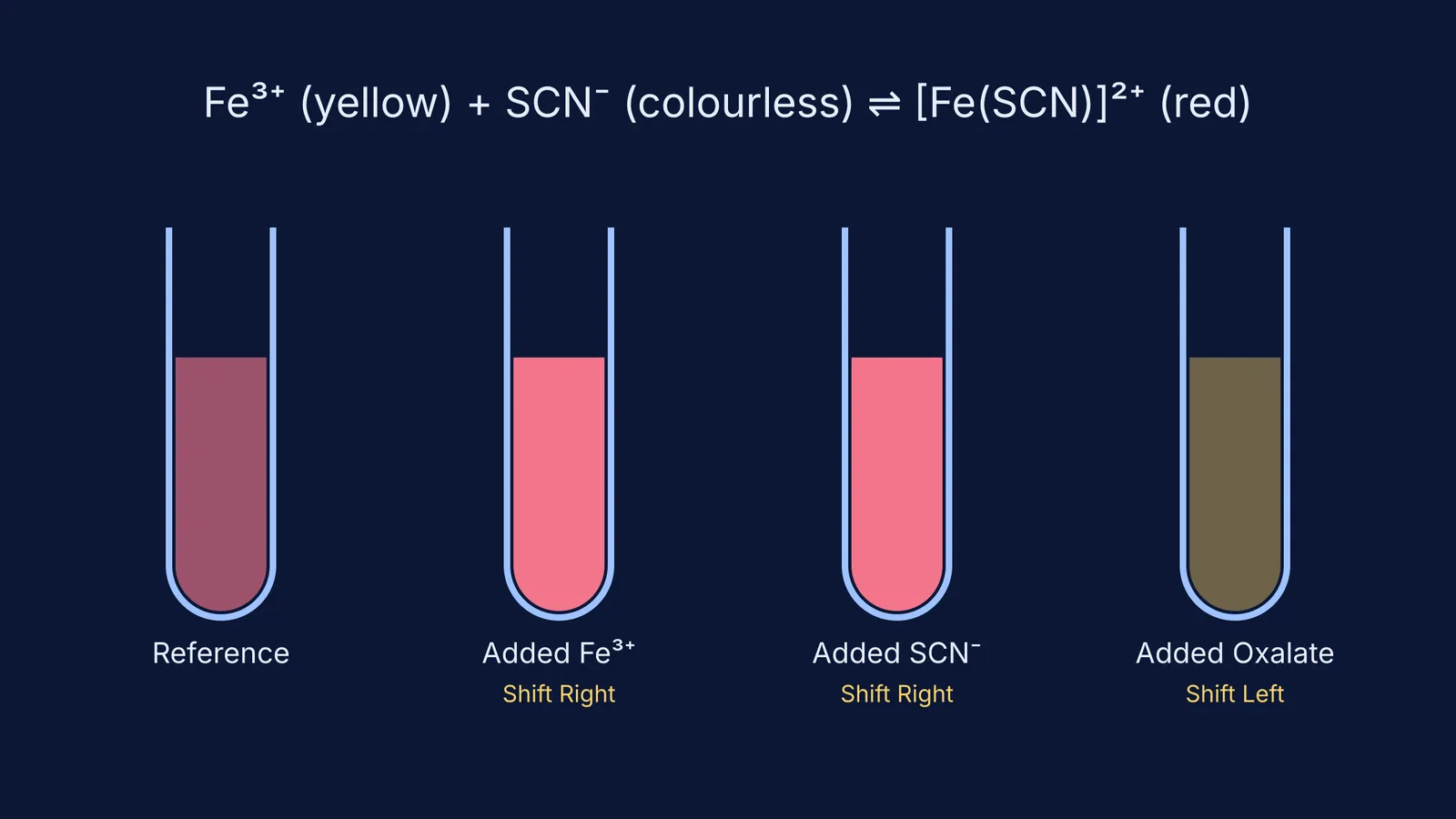
Because the colour intensity depends directly on the concentration of the [Fe(SCN)]²⁺ complex, you can use it as a real-time visual gauge of the reaction quotient Q. If the solution turns a darker, deeper red, the equilibrium has shifted to the right. If it fades to pale yellow, it has shifted to the left, favouring the reactants.
How does Le Chatelier's principle explain the colour changes?
According to Le Chatelier, adding more of a reactant to a system at equilibrium forces the system to consume that excess reactant by making more product.
If you take a reference test tube of the equilibrium mixture and add a few drops of concentrated FeCl₃ solution, you are artificially increasing the concentration of Fe³⁺. The system immediately responds by shifting to the right, creating more of the [Fe(SCN)]²⁺ complex to balance the stress, and the solution turns a noticeably deeper red. The exact same shift happens if you add extra KSCN instead, because increasing the SCN⁻ concentration also pushes the reaction forward.
How do you remove ions to shift the equilibrium left?
To shift the equilibrium backwards, you must remove one of the reactants from the solution. Since you cannot easily pick them out physically, you must use competing chemical reactions that bind the ions tightly and remove them from the primary equilibrium pool.
If you add a few crystals of solid oxalic acid (H₂C₂O₄) to the red mixture, the oxalate ions bind strongly with the ferric ions to form a stable, colourless complex: [Fe(C₂O₄)₃]³⁻. This drastically drops the free Fe³⁺ concentration in the water. The main equilibrium must then shift to the left to replace the lost Fe³⁺, breaking down the red [Fe(SCN)]²⁺ complex and turning the solution back to a pale yellow.
You can achieve the same fading effect by adding mercuric chloride (HgCl₂). The Hg²⁺ ions react aggressively with SCN⁻ to form the highly stable [Hg(SCN)₄]²⁻ complex, effectively removing thiocyanate from the main equilibrium. Once again, the system shifts left, and the red colour disappears.
If you are struggling to picture how these competing equilibria interact within the same beaker, the Fermi Concept Library maps out exactly how Le Chatelier's principle applies to different complex ions.
How do you control the shift in the lab?
When performing this experiment, you should always keep a reference tube untouched in your rack so you can clearly compare the before-and-after colour shifts.
To shift right (darker red): Add a few drops of a dilute FeCl₃ or KSCN solution.
To shift left (lighter or pale yellow): Add oxalic acid, sodium fluoride (because fluoride binds strongly to Fe³⁺), or HgCl₂.
To check for temperature effects: Place one tube in a hot water bath and another in an ice bath. The formation of the ferric thiocyanate complex is an exothermic reaction, meaning it releases heat as it forms. Heating the solution stresses the system with excess heat, so it shifts the equilibrium left to absorb it (fading the red). Conversely, cooling it shifts the equilibrium right to replace the lost heat (deepening the red).
Understanding these shifts is not just about memorising lab colours; it is about predicting how chemical systems behave when stressed under different conditions. If you want to test your understanding of predicting shifts—like adding an inert gas to an equilibrium or using the reaction quotient Q vs K—the Fermi Problem Library has worked examples that walk you through the math step by step.


