On this page
In the winter of 1910, a mysterious illness was killing people in Fuchiatien, the Chinese sector of Harbin in north-east China. A telegram summoned a young doctor named Wu Lien-teh to the Qing government's Foreign Ministry and sent him to investigate. According to the National Library Board of Singapore's BiblioAsia profile, Wu was born in Penang on 10 March 1879, studied at Emmanuel College, Cambridge, and arrived in Harbin with his assistant on Christmas Eve, 1910.
How did Wu Lien-teh show the plague spread through the air?
On his third day in Harbin, Wu carried out a preliminary post-mortem and found the plague bacterium *Yersinia pestis*, with evidence that this was pneumonic plague, spread through the air by human hosts (BiblioAsia). A 2016 profile in *Protein & Cell* says the epidemic was pneumonic plague, which could be transmitted by human breath or sputum.
That mattered because plague was usually pictured as a disease of rats and their fleas (how Paul-Louis Simond found that rat fleas spread plague). If this plague jumped from lung to lung, killing rats would not stop it.
The World Health Organization still describes the same split today: bubonic plague comes from the bite of an infected flea, while a person with pneumonic plague may transmit it through respiratory particles. The same WHO page says pneumonic plague can be fatal within 18 to 24 hours of onset if left untreated, and that common antibiotics can cure it if they are given early.
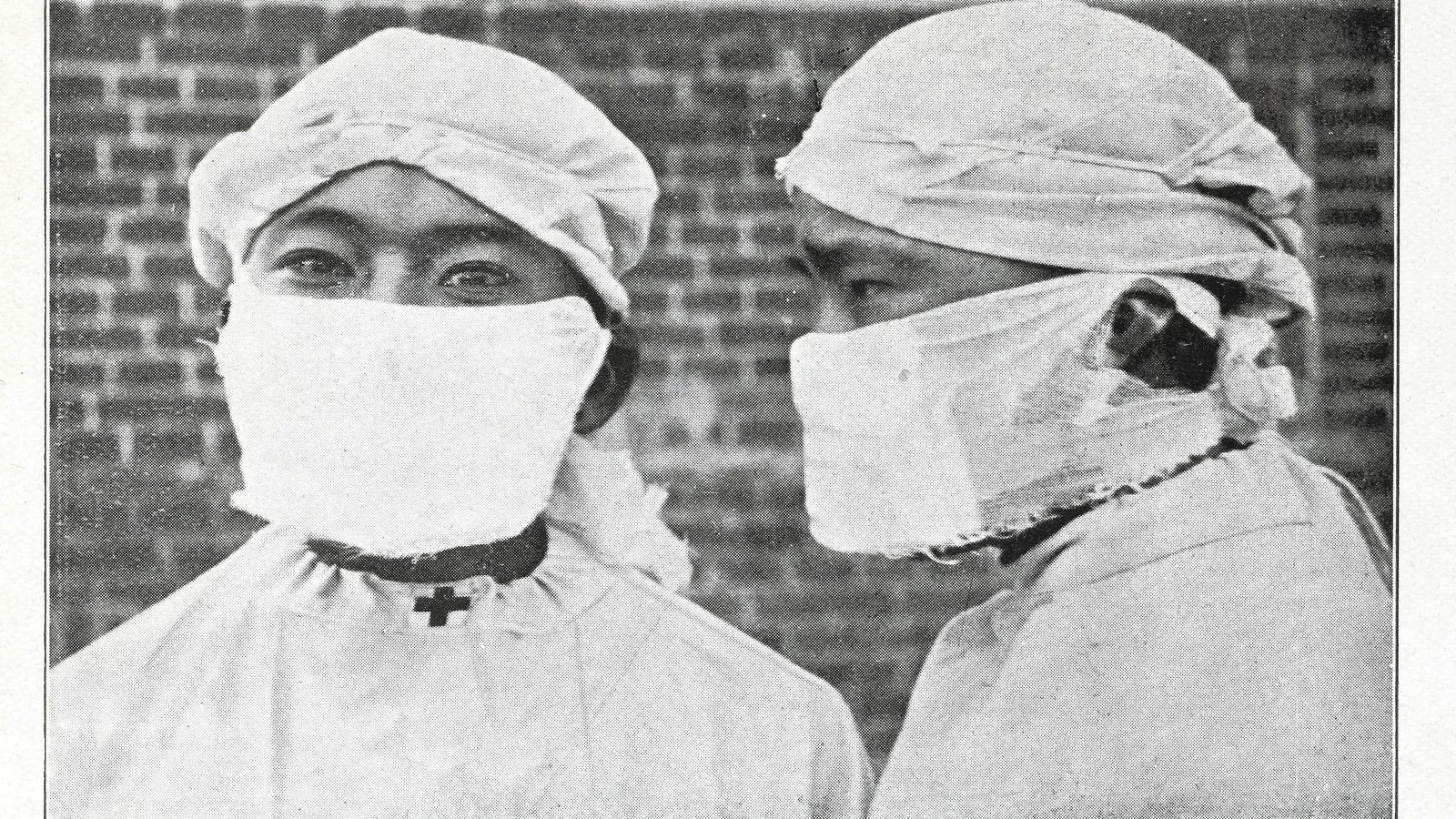
What was the Wu mask made of?
A history from the University of Hong Kong's medical museum describes it as two layers of gauze enclosing a flat oblong piece of absorbent cotton, 6 inches by 4 inches, with tails tied around the head.
The 1911 International Plague Conference in Mukden backed it. The HKU history quotes the conference's verdict: "The best form of mask is a simple, three-tailed, gauze and cotton-wool pad, which should be destroyed, or disinfected, after each tour of duty." That conference ran from 3 to 28 April 1911, drew scientists from 11 countries, and elected Wu its president (Protein & Cell).
The mask carries Wu's name, but the HKU museum notes that at the conference a Chinese medical officer, Fang Qin, presented it as the collective work of the Harbin plague-control team. Wu's part, in the BiblioAsia account, was the evidence of airborne spread and the recommendation that people wear face masks to protect themselves and others. The *Protein & Cell* profile records that a French doctor, Mesny, died of pneumonic plague after refusing to wear gauze and a mask.
What else stopped the 1910-11 plague?
Masks were one tool among several. Disused schools, warehouses and even train cars became isolation facilities, and on 31 January 1911, the second day of the Lunar New Year, what is believed to be the first mass cremation in Chinese history was carried out in Harbin (BiblioAsia). Wu had sent a petition to sanction it, and some 3,000 corpses and coffins were cremated (Protein & Cell).
Even so, the epidemic lasted seven months and claimed some 60,000 lives (BiblioAsia). A 2020 review in *Virologica Sinica* lists correct wearing of a cotton mask, environmental cleaning, disinfection and bathing for medical workers among the measures used, alongside special hospitals with isolation wards, and concludes that inhalation was a main route of spread and proper mask wearing may be effective.
Is the Wu mask the ancestor of today's masks?
In idea, it is an early one. Anthropologist Christos Lynteris places the invention of face-worn anti-epidemic equipment in the 1910-11 Manchurian plague outbreak. The idea Wu's team used was simple: put layers of material between each breath and the air, and destroy or disinfect the pad after each tour of duty.
In technology, no: a gauze pad is not a modern certified respirator.
How can you reason like Wu?
Wu did not start with the mask. He started with "how does this get from one person to the next?" Use the same four steps on any infection in your biology syllabus:
Pattern: who is getting sick, and where? BiblioAsia notes that the first victims were marmot trappers and fur traders, and that the disease spread among workers huddled together in unventilated inns.
Agent: what does the evidence show? The post-mortem found *Yersinia pestis* and signs of pneumonic plague.
Route: flea bite, water, food, touch or air? Here, breath and sputum.
Defence: match the barrier to the route. Air route, so masks, isolation and disinfection; a flea route would have called for rat and flea control instead.
Try it on cholera or malaria, one line per step. If a step stalls because a concept is fuzzy, the Fermi Concept Library covers every concept in biology, chemistry, physics, mathematics and computing.
Wu's story sits beside other scientists who made the invisible visible, such as how Shibasaburo Kitasato grew a pure tetanus culture and how June Almeida first imaged a coronavirus. If you want a plan for working through these topics, Fermi's AI tutor can work out what you already know and build a plan for the session.