On this page
Cell notation is a one-line shorthand for a whole galvanic cell: two electrodes, two solutions and the salt bridge between them. Four fixed rules write it, and run backwards they recover the reactions.
How do you write cell notation for a galvanic cell?
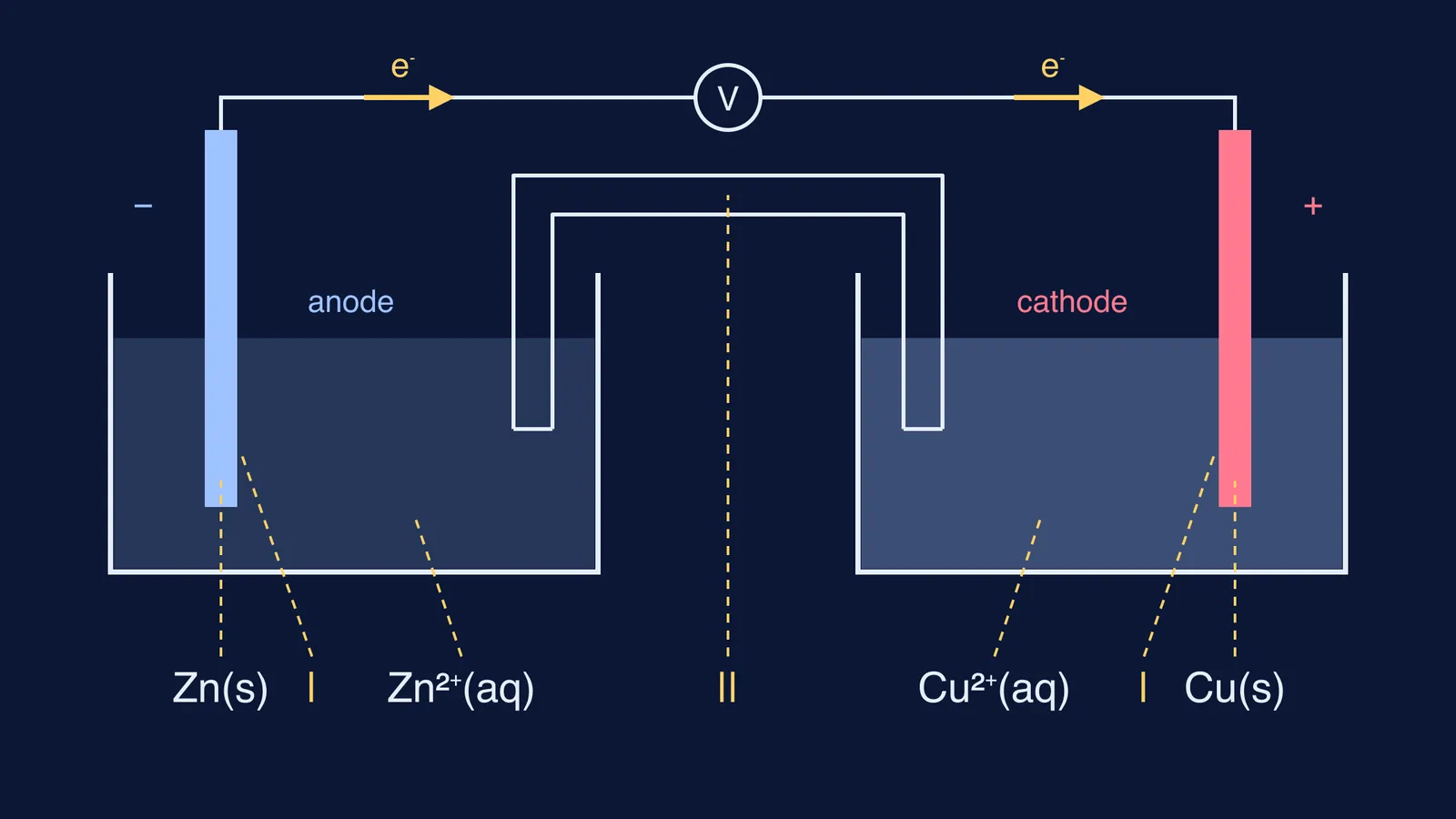
NCERT's Class 12 chemistry text sets the convention (NCERT Class 12 Chemistry, Unit 2: Electrochemistry): anode on the left, cathode on the right, a vertical line between a metal and its electrolyte, and a double vertical line for the salt bridge. Chemistry LibreTexts adds commas between species in the same phase, and a platinum electrode when both species of a couple are in solution (Chemistry LibreTexts: Cell Notation and Conventions/17:_Electrochemical_Cells/17.09:_Cell_Notation_and_Conventions)).
So the four rules are:
Anode (oxidation) on the left, cathode (reduction) on the right. A comes before C, as in the alphabet.
A single line | for every phase boundary, such as solid zinc meeting zinc sulphate solution.
A double line || for the salt bridge, once, in the middle.
A comma between species in the same phase, such as Fe²⁺(aq), Fe³⁺(aq), with an inert electrode such as Pt(s) at the outer end when no metal of the couple can carry the electrons.
For the Daniell cell, NCERT gives the reaction Zn(s) + Cu²⁺(aq) → Zn²⁺(aq) + Cu(s). Zinc is oxidised, so it goes on the left: Zn(s) | Zn²⁺(aq) || Cu²⁺(aq) | Cu(s).
NCERT's table of standard electrode potentials at 298 K lists +0.34 V for Cu²⁺/Cu and −0.76 V for Zn²⁺/Zn, so the Daniell cell gives 0.34 − (−0.76) = 1.10 V (NCERT, Table 2.1). Why only the sign changes between a reduction and an oxidation potential is explained in reduction vs oxidation potential: why only the sign changes.
Worked example: from a reaction to the notation
Write the cell for Zn(s) + 2H⁺(aq) → Zn²⁺(aq) + H₂(g), using the E° values from NCERT's Table 2.1.
Split it. Oxidation: Zn(s) → Zn²⁺(aq) + 2e⁻. Reduction: 2H⁺(aq) + 2e⁻ → H₂(g).
Left half, the anode: Zn(s) | Zn²⁺(aq).
Right half, the cathode: hydrogen gas cannot carry electrons into a wire, so it needs platinum. NCERT writes the hydrogen electrode as Pt(s) | H₂(g) | H⁺(aq); on the right of the bridge it reads outwards: H⁺(aq) | H₂(g) | Pt(s).
Join them: Zn(s) | Zn²⁺(aq) || H⁺(aq) | H₂(g) | Pt(s).
Check: E°cell = 0.00 − (−0.76) = +0.76 V. Positive, so under standard conditions the cell runs as written.
Why platinum suits that job is covered in why platinum is used as an inert electrode.
How do you turn cell notation back into reactions?
Read it left to right, and let the double line split it.
Everything left of || is the anode. Write its change as an oxidation, electrons on the right.
Everything right of || is the cathode. Write its change as a reduction, electrons on the left.
Drop the inert electrode and the bars; they describe phases, not chemistry.
Multiply so both halves carry the same number of electrons, then add.
Find E°cell = E°right − E°left from a table.
Try it on Pt(s) | Fe²⁺(aq), Fe³⁺(aq) || Ag⁺(aq) | Ag(s), with NCERT's values of 0.80 V for Ag⁺/Ag and 0.77 V for Fe³⁺/Fe²⁺ (NCERT, Table 2.1).
Left (anode, oxidation): Fe²⁺(aq) → Fe³⁺(aq) + e⁻
Right (cathode, reduction): Ag⁺(aq) + e⁻ → Ag(s)
Overall: Fe²⁺(aq) + Ag⁺(aq) → Fe³⁺(aq) + Ag(s)
E°cell = 0.80 − 0.77 = +0.03 V
Small, but positive, so the reaction goes forward under standard conditions. Written the other way round, the cell gives −0.03 V.
What mistakes cost marks in cell notation?
A single line where the salt bridge goes, or a double line between a metal and its own ions.
Writing Zn²⁺(aq) | Zn(s) on the left: the electrode always sits at the outer end.
Forgetting Pt(s) when both species of a couple are ions, or one is a gas.
Dropping the states (s), (aq) and (g), or the concentrations a question gives.
Doubling E° when you double a half-reaction. E° does not change when you multiply a half-reaction; the electron count n matters later, in the Nernst equation.
The salt bridge itself, and why potassium chloride is the usual filling, is explained in why a galvanic cell needs a salt bridge.
Where can you practise cell notation?
Write five cells from five reactions, read five notations back into reactions, and check every E°cell sign. The Fermi Problem Library has worked problems with a step-by-step solver that explains the reasoning rather than printing an answer, so you can write your own cell first and then compare each step. If the gap is electrode potential itself, the Fermi Concept Library gives every chemistry concept its own lesson.