On this page
A congruence proof does three jobs. It shows three pairs of equal parts, each with a reason. It names the rule that turns those pairs into congruence. And it writes the two triangles so that each vertex sits opposite its partner.
What do you need to prove two triangles congruent?
Two triangles are congruent when one fits exactly on the other, so every side and every angle matches its partner. You never need all six pairs. Three well-chosen pairs are enough, and the rules that say which three are the congruence criteria:
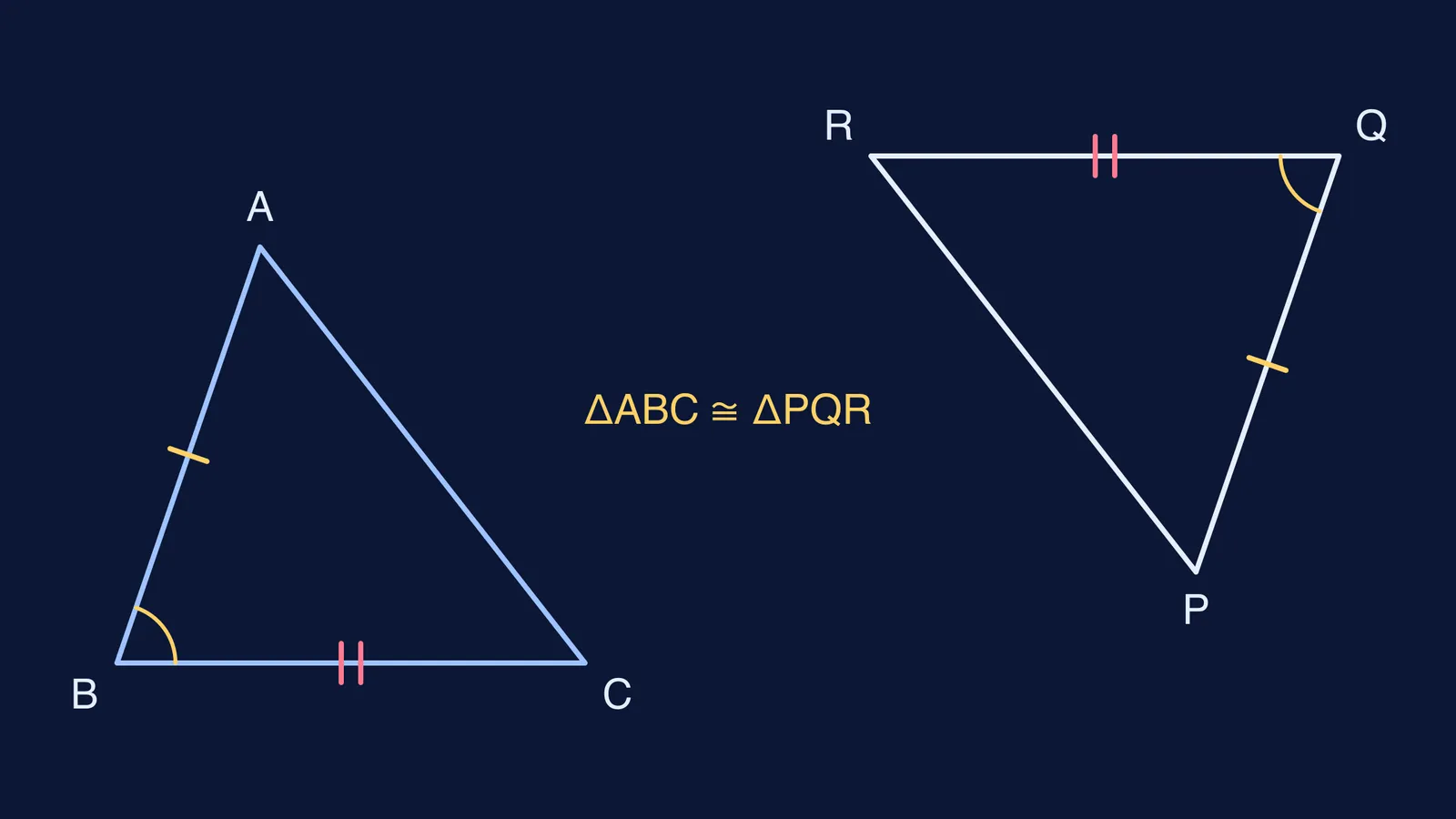
SAS: two sides and the angle between them. Euclid states it as Book I, Proposition 4 of the Elements: the equal angles must be the ones "contained by the equal straight lines".
SSS: all three sides, which is the result Euclid builds in Book I, Proposition 8.
ASA and AAS: two angles and one side. Book I, Proposition 26 covers both cases, the side "adjoining the equal angles, or that opposite one of the equal angles".
RHS: for right triangles only, the hypotenuse and one other side.
If you want the criteria with their figures first, start with our guide to SAS, ASA, SSS and RHS in Class 9. Two tempting combinations are not on the list: SSA and AAA. Here is why SSA and AAA do not prove congruence.
How do you write a congruence proof in statement-reason form?
Write one fact per line, and give every fact a reason you could defend: given, common side, vertically opposite angles, alternate angles, or a result already proved. Here is a full example.
Question. In triangle ABC, AB = AC, and AD bisects angle BAC, with D on BC. Prove that triangle ABD is congruent to triangle ACD, and that BD = CD.
AB = AC (given)
∠BAD = ∠CAD (given: AD bisects ∠BAC)
AD = AD (common side)
ΔABD ≅ ΔACD (SAS, from 1, 2 and 3)
BD = CD (CPCT)
Check line 4 against SAS: the angle at A sits between AB and AD in one triangle and between AC and AD in the other, so it is the included angle. Line 5 uses CPCT (corresponding parts of congruent triangles), allowed only after congruence is proved. Our explainer on what CPCT means and when you can use it covers this step.
This structure is worth practising because proof writing is hard. In a study of 1,520 US students, Sharon Senk found that only 30% of those in a full-year geometry course that covered proof reached a 75% mastery level of proof writing (Senk, 1985, as summarised by Cirillo and May, 2020). One of her suggestions was to pay special attention to teaching students to start a chain of reasoning. Michelle Cirillo and Henry May later tested lessons that introduce proof through separate sub-goals, one at a time, in a study of more than 1,000 secondary students, and report a positive, statistically significant effect on a proof-focused post-test.
Why does the order of vertices matter in a congruence statement?
The statement ΔABD ≅ ΔACD is a promise about pairs: A goes with A, B with C, D with D. Every pair of letters in the same positions then names equal parts. AB = AC, BD = CD, AD = AD, and ∠B = ∠C.
Write ΔABD ≅ ΔADC instead and you have claimed AB = AD, AD = AC and ∠ABD = ∠ADC, which nothing in the question gives you. The triangles are still congruent; your statement is not.
A quick way to get the order right: start from the equal angle or the vertex both triangles share, write it first in both names, then follow the equal sides round.
What are the most common mistakes in congruence proofs?
Using SSA, where the angle is not between the two sides.
Calling SAS when the angle is not the included one.
Writing CPCT before the congruence line.
Using a fact the figure only looks like it shows, such as a right angle that is not marked or given.
Leaving out the reason for a common side or a vertically opposite angle.
A five-step routine for any congruence question
Mark every given fact on the figure with ticks and arcs.
Pick the two triangles that contain the parts you must prove equal.
Find three pairs of equal parts and decide which criterion they fit.
Write the statement-reason lines, ending with the criterion and the line numbers it uses.
Run the three-pair check, then use CPCT for anything still to prove.
If you want to check a proof line by line, the Fermi Problem Library has worked problems with a step-by-step solver that explains the reasoning rather than printing an answer. If a criterion itself is the gap, the Fermi Concept Library gives each mathematics concept its own lesson.
Try the routine on the next three congruence questions in your exercise set.