

On this page
When you learn how to prove two triangles are congruent, you usually start with four standard rules: SSS (Side-Side-Side), SAS (Side-Angle-Side), ASA (Angle-Side-Angle), and AAS (Angle-Angle-Side). These criteria act like rigid blueprints. Once you lock in those specific three measurements, the rest of the triangle can only be built one way, similar to how you can uniquely define a circle through three given points.
Because three pieces of information work so consistently, it is tempting to assume that *any* three matching parts will lock a triangle into a single shape and size. However, geometry has two major exceptions that break this pattern: AAA (Angle-Angle-Angle) and SSA (Side-Side-Angle).
Why does AAA not prove triangles congruent?
The AAA condition occurs when all three corresponding angles of two triangles are equal.
While equal angles dictate how a triangle is proportioned, they say nothing about its scale. Think of zooming in on a digital drawing or using the enlarge function on a photocopier. The angles between the lines stay exactly the same, but the side lengths grow. Because of this, AAA guarantees that two triangles are similar—meaning they have the identical shape—but it cannot prove they are congruent.
For a concrete example, consider two equilateral triangles of different sizes. In both triangles, every angle is exactly the same. They perfectly satisfy the AAA condition, but one is larger than the other. To lock in the physical size of a triangle, you must know the length of at least one of its sides.
Why does SSA not prove triangles congruent?
The SSA combination—two sides and an angle that is not placed between them—is known as the "ambiguous case" in trigonometry and geometry.
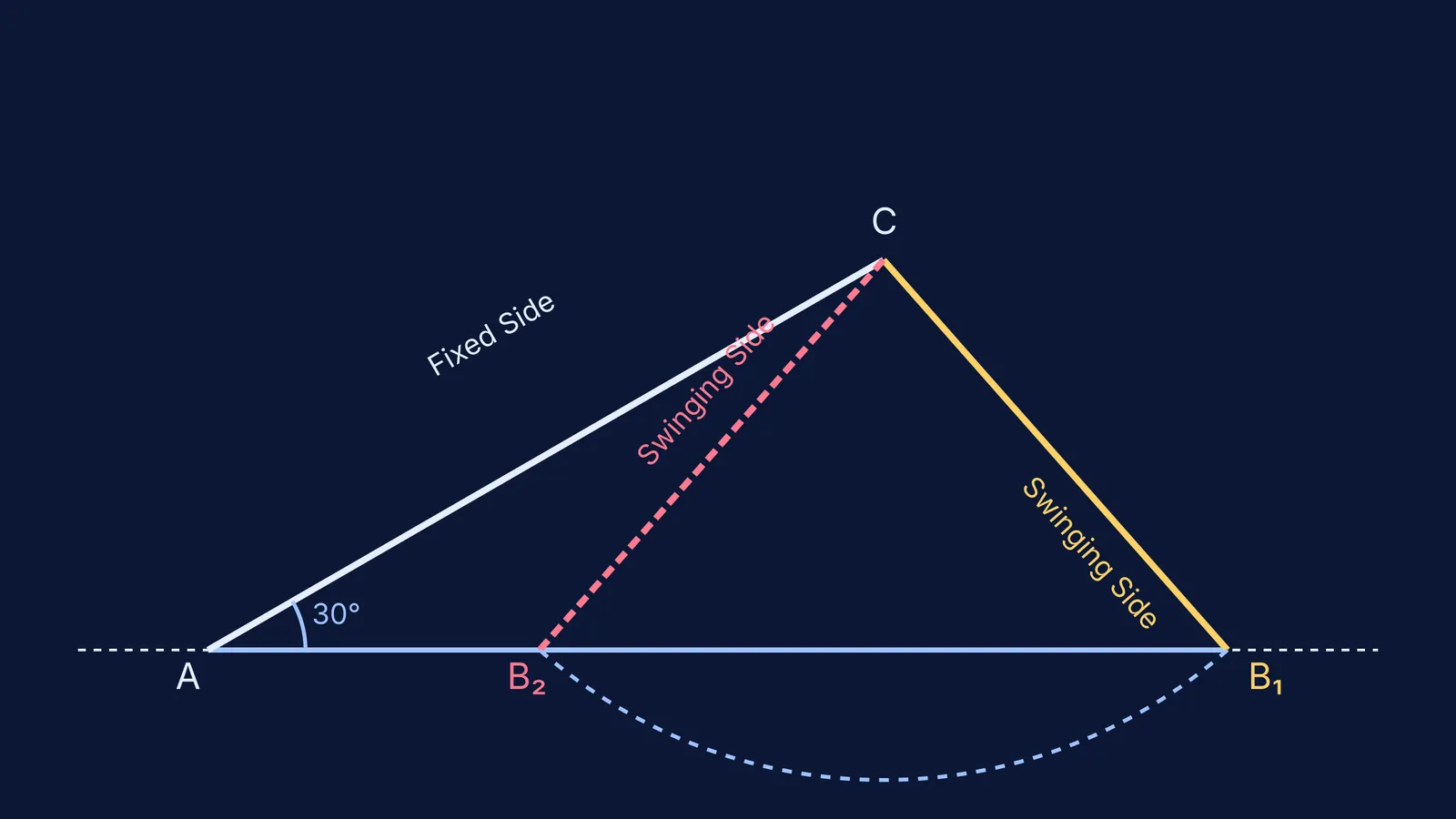
Imagine you are building a triangle from metal rods. You fix a base line and set a specific angle at one end. From that angle, you attach a rod of a known length (Side 1). At the end of Side 1, you attach a second rod (Side 2) with a hinge, allowing it to swing freely.
Because the angle between Side 1 and Side 2 is not fixed, Side 2 acts like a pendulum. A 2015 study in *Mathematics Teacher* notes that investigating this swinging side helps students see exactly why the rule fails: if Side 2 is shorter than Side 1, it can often hit the base line in two different places. This creates two completely different triangles (one acute and one obtuse) that share the exact same SSA measurements. Because it does not guarantee a single, unique shape, SSA is invalid for proofs.
There is exactly one exception where SSA works. If the given angle is a right angle and the swinging side (the hypotenuse) is longer than the fixed vertical leg, the pendulum can only hit the base line once. In school curriculums, this specific right-angled case is taught as its own distinct rule: RHS (Right angle-Hypotenuse-Side).
How do you test if an angle is included?
The most common reason students accidentally use SSA is because they confuse it with the valid SAS rule. To avoid this trap, you need to check if the angle is "included."
If the problem gives you side AB and side BC, the included angle must be ∠B. If the problem gives you side AB, side BC, and ∠A, the angle is not trapped between your known sides. You have SSA, and you cannot prove congruence.
How do you name corresponding parts correctly?
Once you have successfully used a valid rule to prove congruence, you can use the principle of CPCTC (Corresponding Parts of Congruent Triangles are Congruent) to find missing measurements. However, to do this accurately, the way you write the final congruence statement matters.
If you write ΔABC ≅ ΔPQR, the order of the letters tells you exactly which parts match. The first letter corresponds to the first letter, the second to the second, and the third to the third. This means vertex A matches P, B matches Q, and C matches R. It also means side AB is equal to side PQ.
Writing ΔABC ≅ ΔPRQ describes a completely different relationship. Always trace the perimeter of the triangles in the same direction to ensure your letters line up. If you are exploring other properties of triangles on a coordinate plane, checking the area of a triangle using determinants is another powerful tool.
If you find yourself stuck deciding whether a triangle proof needs SAS or if it has fallen into the SSA trap, the Fermi Problem Library has a step-by-step solver that explains the geometric reasoning rather than just printing an answer. It helps you trace exactly which sides and angles are included, ensuring you always build your proof on the correct foundation.


