On this page
Your textbook asks this question and then moves on. In the NCERT Class 11 Hydrocarbons chapter, straight after the Wurtz equations for ethane and n-butane, it asks: 'What will happen if two different alkyl halides are taken?' Here is the full answer, with reasoning you can write in an exam.
What is the Wurtz reaction?
The Wurtz reaction is the treatment of alkyl halides with sodium metal in dry ether to give a higher alkane, as described in the NCERT Hydrocarbons chapter. NCERT gives two examples:
2CH₃Br + 2Na → CH₃–CH₃ (ethane) + 2NaBr
2C₂H₅Br + 2Na → CH₃CH₂CH₂CH₃ (n-butane) + 2NaBr
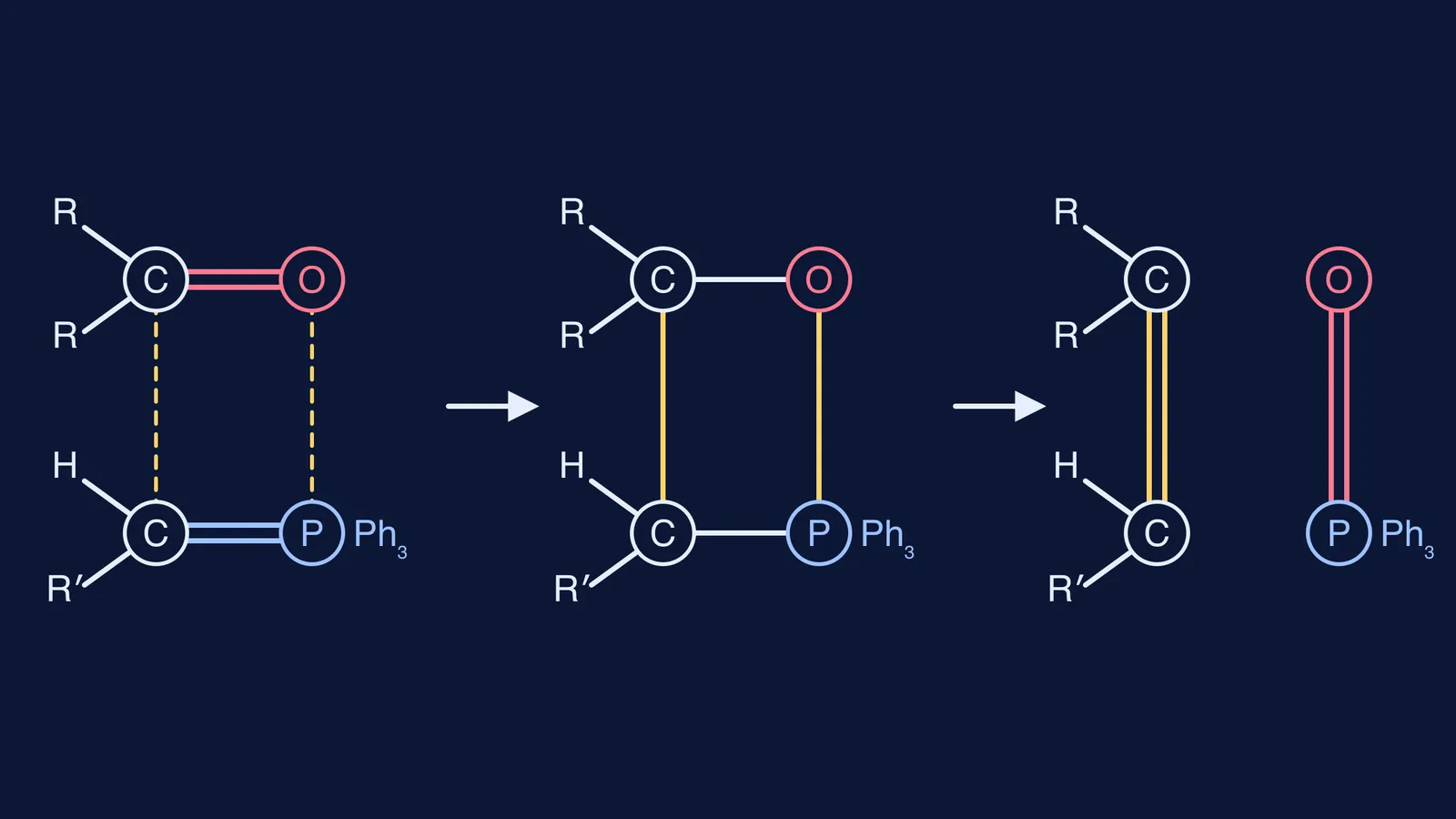
How does sodium do this? According to LibreTexts, sodium transfers one electron to the halogen, giving sodium halide and an alkyl radical; a second electron turns it into an alkyl anion, which then pushes the halide out of another alkyl halide molecule in an SN2 step. The point to hold on to: each new C–C bond joins two alkyl groups taken from whichever halide molecules meet in the flask. Sodium cannot choose.
What happens when you mix methyl bromide and ethyl bromide?
Put CH₃Br and C₂H₅Br in one flask with sodium and both form reactive alkyl species. Any of them can attack either halide, so three couplings are possible:
CH₃ + CH₃ → ethane, C₂H₆
CH₃ + C₂H₅ → propane, C₃H₈
C₂H₅ + C₂H₅ → butane, C₄H₁₀
You wanted propane. You get propane, ethane and butane together.
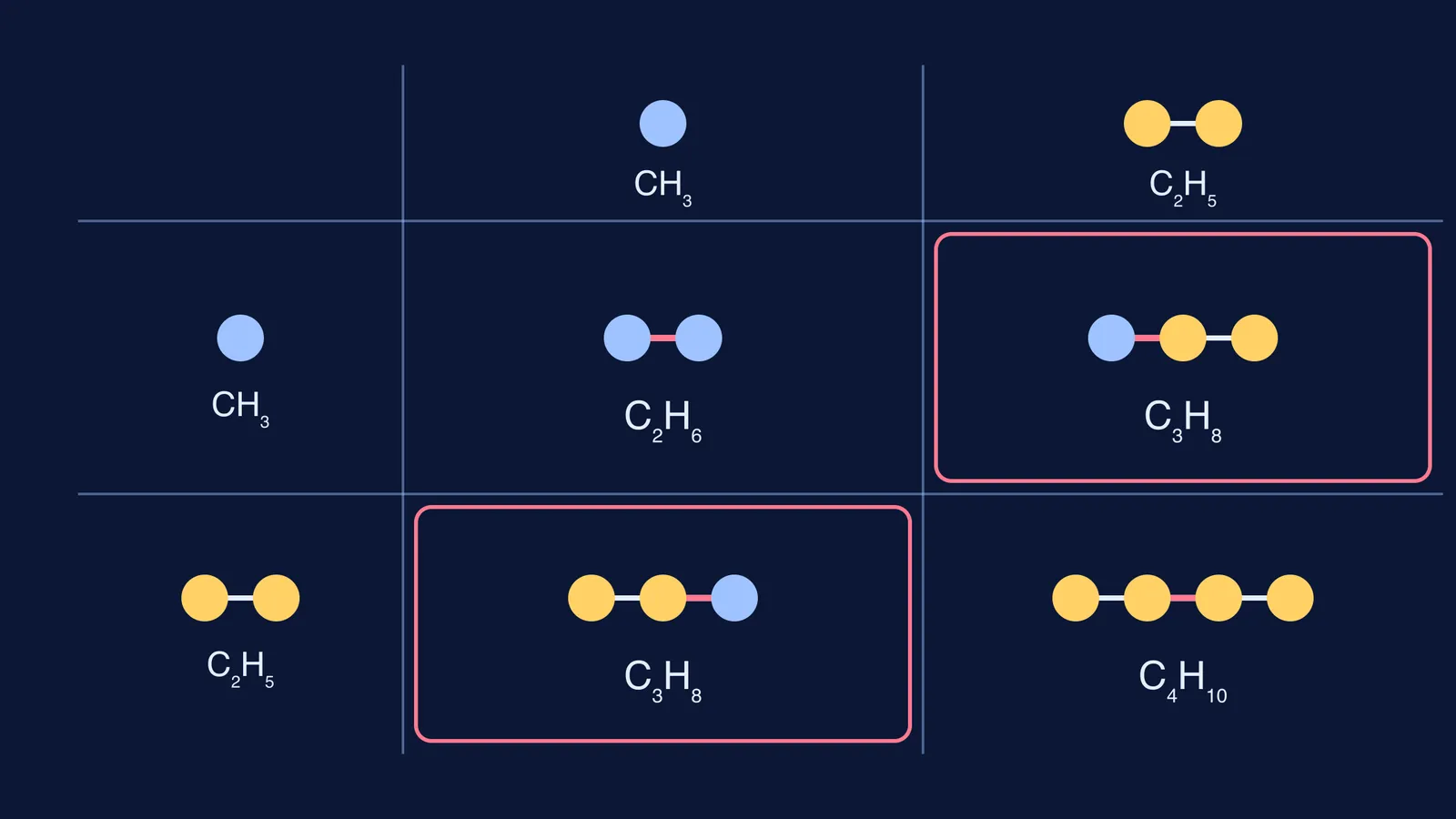
Now do a worked count. Picture a 2 × 2 grid, as in the diagram above: methyl or ethyl down the side, methyl or ethyl across the top. Two of the four boxes are propane, one is ethane and one is butane. If both halides reacted at exactly the same rate (real ones do not), that would be a 1 : 2 : 1 mix of ethane, propane and butane, and only half the couplings would make the product you wanted. Real ratios depend on how fast each halide reacts, but no ratio removes the unwanted pairings.
Can't you just separate the three alkanes?
You may read that the products are hard to separate because their boiling points are close. For this pair, check the numbers. Ethane boils at −88.6 °C (PubChem, ethane). Propane boils at −42.1 °C (PubChem, propane). Butane boils at −0.5 °C (PubChem, butane).
Neighbouring pairs are more than 40 degrees apart, so separating these three is possible in principle. The stronger objection is yield: much of your starting material becomes products you did not want, and you still need a separation step. The reaction is weak even with one halide; Wikipedia's Wurtz reaction article says it is of little value because yields are low. In an exam, give the mixture and the low yield first.
Why is Wurtz used only for symmetrical alkanes?
With a single halide, every pairing is the same: R + R → R–R. No mixture forms. The NCERT chapter says Wurtz is used to prepare higher alkanes containing an even number of carbon atoms, and the pairing rule explains why. Two consequences follow:
An alkane with an odd number of carbons, such as propane or pentane, cannot be split into two identical alkyl groups, so Wurtz would need two different halides and would give a mixture.
Methane cannot be made by Wurtz at all. The smallest possible product, from two methyl groups, is ethane.
For an unsymmetrical alkane, use a route that joins two different groups selectively: see how the Corey–House synthesis makes unsymmetrical alkanes. When one partner is an aryl halide, read about the Wurtz-Fittig and Fittig reactions, and compare the routes in preparing alkanes by Wurtz, Kolbe and decarboxylation.
A three-step check before you write Wurtz
Draw the target alkane and look for a C–C bond that cuts it into two identical alkyl groups.
If you find one, that group's halide plus sodium in dry ether is your Wurtz route.
If no such bond exists, Wurtz gives a mixture; choose another method.
Try it on four targets:
Hexane: cut the middle bond, CH₃CH₂CH₂–CH₂CH₂CH₃. Two propyl groups, so 1-bromopropane works.
2,3-Dimethylbutane: cut between the two CH groups, (CH₃)₂CH–CH(CH₃)₂. Two isopropyl groups, so 2-bromopropane works on paper.
Pentane: five carbons, no identical halves. Mixture.
2-Methylpropane (isobutane): four carbons, but every cut gives a methyl and an isopropyl group. Mixture.
The last one catches people: an even number of carbons is needed, but it is not enough. The molecule must also split into two identical halves.
For more practice choosing a route, the Fermi Problem Library has worked problems with a step-by-step solver that explains the reasoning rather than printing an answer.
Next time a question pairs two different halides with sodium, write all three products before you write anything else.