On this page
Say you need propane or 2-methylbutane, an alkane whose two halves are different. The Wurtz reaction cannot give you that cleanly. The Corey–House synthesis can, because it puts one half on copper and the other on a halide. Here is how it works and how to pick the pieces.
What is the Corey–House synthesis?
The Corey–House synthesis couples a lithium dialkylcuprate (R₂CuLi, a Gilman reagent) with an alkyl halide R′–X to form the alkane R–R′, as the Corey–House synthesis entry on Wikipedia summarises it. It runs in three steps:
Make an alkyllithium: R–X + 2 Li → R–Li + LiX
Make the Gilman reagent: 2 R–Li + CuI → R₂CuLi + LiI
Couple: R₂CuLi + R′–X → R–R′ + RCu + LiX
The LibreTexts chapter on organometallic coupling reactions/10%3A_Organohalides/10.08%3A_Organometallic_Coupling_Reactions) gives the example 2 CH₃Li + CuI → (CH₃)₂CuLi + LiI. Notice step 3: only one of the two R groups on copper ends up in your product. The other leaves as RCu.
Wikipedia notes that the reagent is named after Henry Gilman, who reported an early organocopper coupling in 1936. LibreTexts credits the coupling to E. J. Corey and Herbert House, working independently at Harvard and MIT in the late 1960s. Corey and Gary Posner's 1967 paper is titled "Selective formation of carbon-carbon bonds between unlike groups using organocopper reagents", and George Whitesides, House and co-workers followed in 1969 with "Reaction of lithium dialkyl- and diarylcuprates with organic halides". If the "-ate" in cuprate puzzles you, see our explainer on why anionic complexes end in -ate, as in ferrate and cuprate.
Why does the Wurtz reaction give a mixture?
The NCERT Class 11 chapter on hydrocarbons describes the Wurtz reaction as alkyl halides plus sodium in dry ether, "used for the preparation of higher alkanes containing even number of carbon atoms". It then asks what happens if two different alkyl halides are taken.
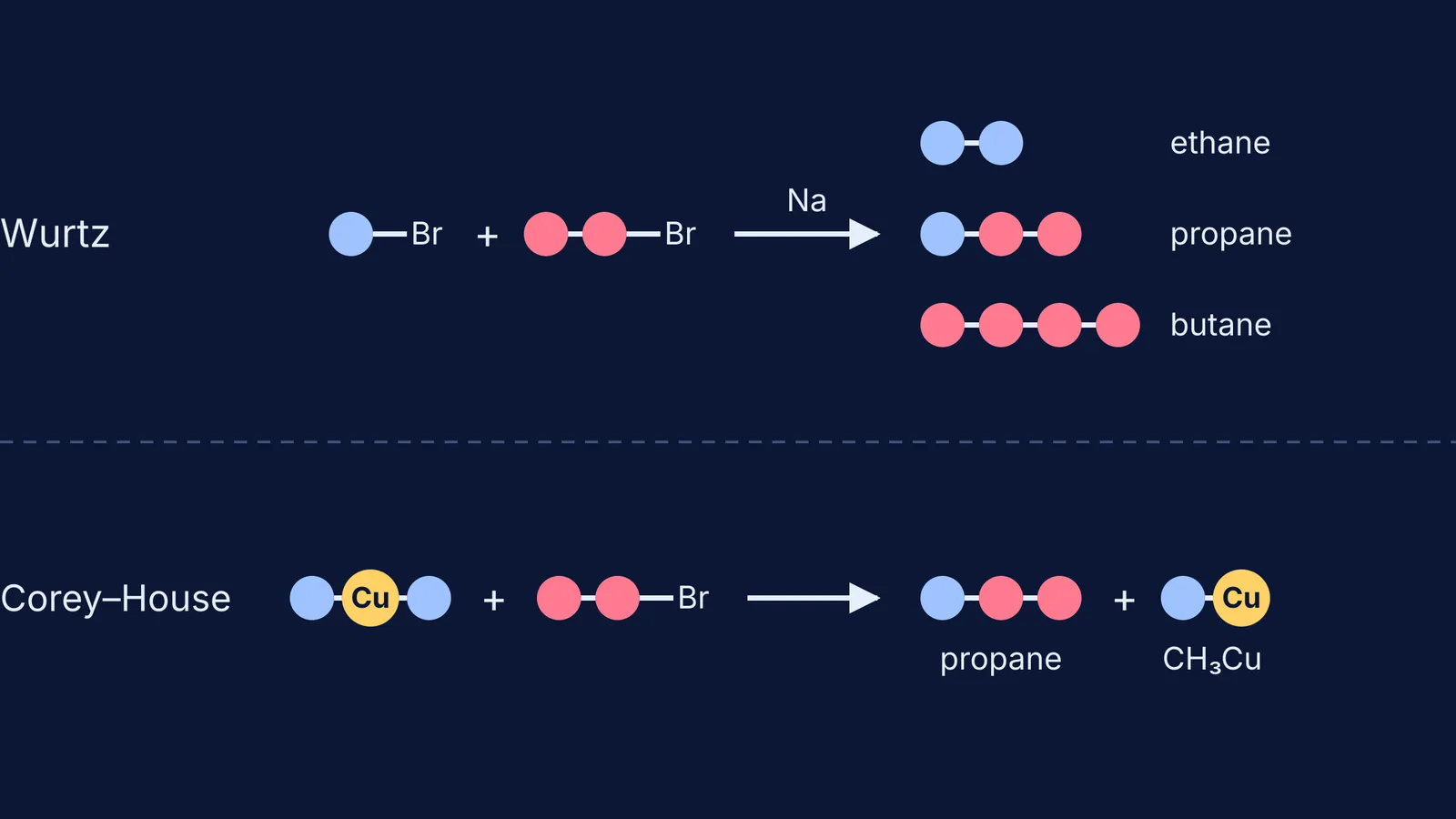
The answer: sodium joins any two alkyl groups it meets. Mix CH₃Br and C₂H₅Br with sodium and you get ethane, propane and butane. The same NCERT chapter lists their boiling points as 184.4 K, 230.9 K and 272.4 K, so all three are gases at room temperature: you have a mixture to separate, and only part of your starting material became propane.
In Corey–House the carbon on copper acts as the nucleophile, and the halide carbon is the electrophile with a leaving group. For alkyl bromides and tosylates, the Wikipedia entry describes an SN2-like attack with inversion at the halide carbon, followed by reductive elimination from copper. The new bond forms between an R from copper and the R′ from the halide, so you get one cross product instead of three.
How do you choose the cuprate and the alkyl halide?
On the halide side, the Corey–House entry lists methyl, benzylic, allylic, primary and secondary cycloalkyl halides as good partners; tertiary and open-chain secondary halides give unsatisfactory results. The cuprate side is more forgiving: the same entry says branched and even tertiary alkyl groups on copper are generally tolerated. LibreTexts gives a stricter textbook rule: for a good yield, both RX and R′X should be primary.
From the wider scope comes one rule: put the branch on copper, and keep the halide small and unbranched. If your textbook teaches the all-primary version, answer its way in the exam.
Worked example: make 2-methylbutane, (CH₃)₂CH–CH₂CH₃.
Choose a bond to cut. Cutting C2–C3 gives an isopropyl piece and an ethyl piece.
Option A: (C₂H₅)₂CuLi + 2-bromopropane. The halide is open-chain secondary, so reject it.
Option B: [(CH₃)₂CH]₂CuLi + bromoethane. The halide is primary, so choose this one.
Make the cuprate: 2-bromopropane + 2 Li gives isopropyllithium; two equivalents of it with CuI give lithium diisopropylcuprate.
Couple: [(CH₃)₂CH]₂CuLi + CH₃CH₂Br → (CH₃)₂CHCH₂CH₃ + (CH₃)₂CHCu + LiBr.
Check the carbons: 3 + 2 = 5, the carbon count of 2-methylbutane.
To practise more cuts like this, the Fermi Problem Library has worked problems with a step-by-step solver that explains the reasoning rather than printing an answer.
Where do students lose marks on Corey–House?
Check these before you write the final equation:
By-product: the copper keeps one of its own groups, so the by-product is RCu, not R′Cu.
Stoichiometry: two equivalents of R–Li per CuI make one R₂CuLi.
Halide choice: never put a tertiary or open-chain secondary carbon on the halide side.
Odd carbon counts: Corey–House makes odd-carbon alkanes such as propane cleanly. The even-carbon limitation belongs to Wurtz.
Look-alike reactions: NCERT's hydrocarbons chapter notes that Kolbe's electrolytic method also gives alkanes with an even number of carbon atoms, so do not offer it for propane either.
If terms like nucleophile, leaving group or inversion still feel shaky, the Fermi Concept Library gives every chemistry concept its own lesson and its place in the map, so you can fill the gap before returning to the reaction.
For more on this chapter, see why alkanes are called paraffins and alkenes olefins, and our guide to asking AI the 'why' behind named organic reactions.