

On this page
Alkanes are historically called *paraffins*, while alkenes are known as *olefins*. Although modern IUPAC nomenclature uses systematic names based on carbon chain length and saturation, these traditional terms remain common across textbooks, competitive exams, and industrial chemistry.
Both names record how early chemists tested these hydrocarbons in the laboratory. Understanding their origins provides an intuitive mental model for predicting how they react.
Why are alkanes called paraffins?
In 1830, German chemist Karl von Reichenbach isolated a translucent, wax-like solid from beechwood tar at his works in Blansko. The substance proved unreactive toward almost every known reagent, resisting concentrated nitric acid, boiling sulfuric acid, and strong alkalis.
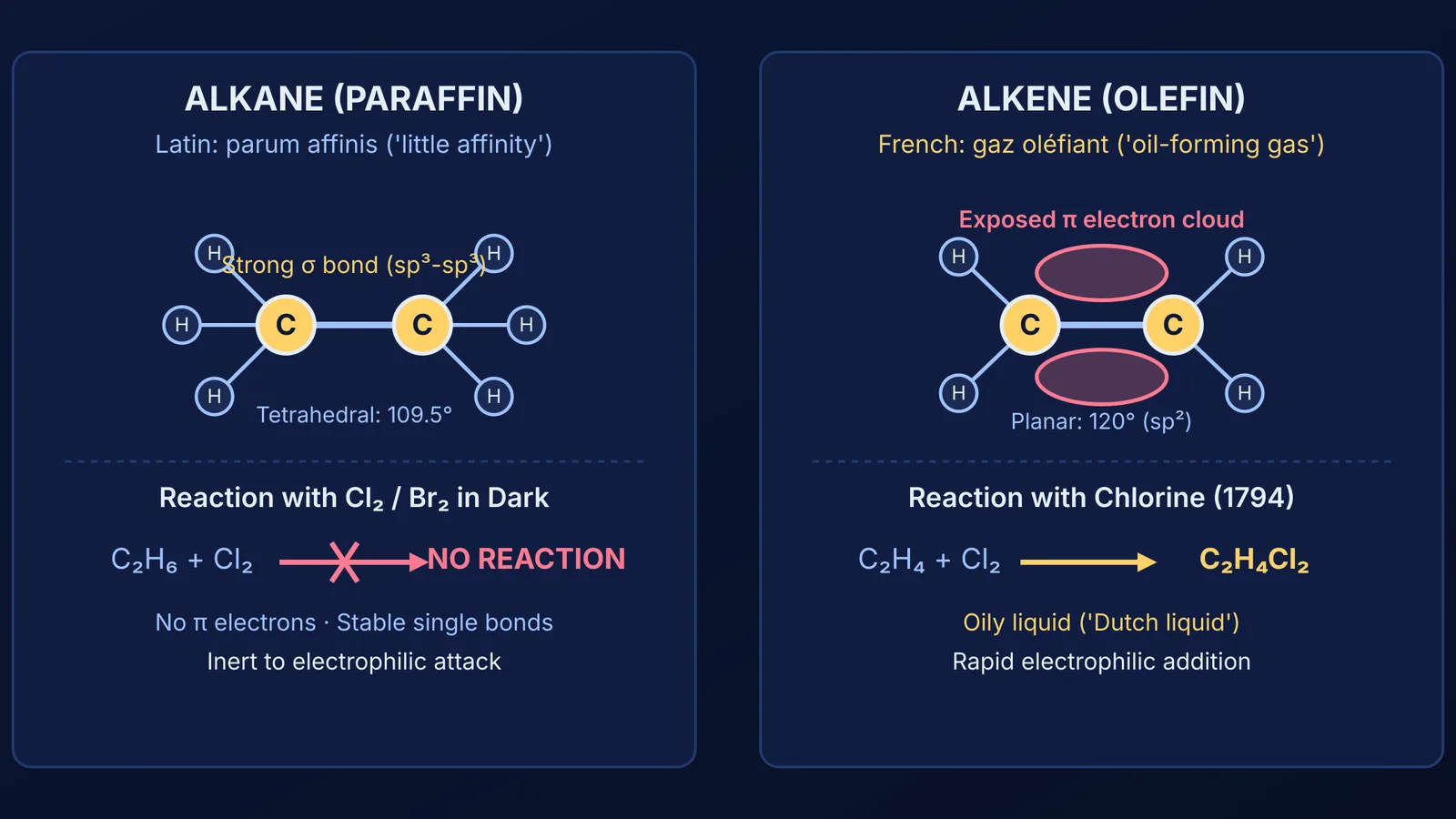
Reichenbach coined the term *paraffin* from the Latin *parum* ('little') and *affinis* ('affinity'), as documented in historical reviews of paraffin chemistry (Sanderson et al., 1988). Paraffin literally translates to 'having little affinity' for chemical reactions.
As explained in OpenStax Chemistry 2e, acyclic alkanes follow the general formula C_n H_{2n+2} with all carbon atoms sp³ hybridised in a tetrahedral geometry. Because all valence electrons are locked within strong, non-polar single sigma (σ) bonds, alkanes have no unshared electron pairs or low-energy empty orbitals. At room temperature, they display negligible affinity for electrophiles or nucleophiles, reacting only under vigorous conditions such as high heat or ultraviolet light. This inertness defines the boundary between addition and substitution reactions in carbon compounds.
Why are alkenes called olefins?
The name *olefin* originated thirty-six years earlier. In 1794, four Dutch researchers—Jan Rudolph Deiman, Adriaan Paets van Troostwijk, Anthoni Lauwerenburgh, and Nicolaas Bondt, known as the Society of Dutch Chemists—dehydrated ethanol with sulfuric acid to produce ethene gas.
When mixed with chlorine gas, the two gases combined into oily droplets of 1,2-dichloroethane, historically known as 'Dutch liquid' (PubChem CID 11).
Because ethene produced this characteristic oil upon chlorination, French chemists named it *gaz oléfiant*, meaning 'oil-forming gas' from the Latin *oleum* ('oil') and *facere* ('to make'). According to Encyclopaedia Britannica, this name was later shortened to *olefin* to describe all hydrocarbons containing carbon-carbon double bonds.
In IUPAC nomenclature, acyclic hydrocarbons with one double bond are called alkenes (general formula C_n H_{2n}), though petrochemical industries still use 'olefins' for feedstocks like ethylene and propylene.
How do bond structures explain this difference in reactivity?
The contrast between 'little affinity' and 'oil-forming' reactivity stems directly from orbital geometry and electron density.
In alkanes, every carbon-carbon linkage is a localized sigma bond formed by coaxial overlap of sp³ hybrid orbitals. These bonding electrons are held tightly between nuclei, leaving no accessible electron pairs to initiate reaction.
In alkenes, as detailed in OpenStax Chemistry 2e, the double-bonded carbons are sp² hybridised with trigonal planar geometry and bond angles near 120°. The carbon-carbon double bond contains one strong sigma bond and one weaker pi (π) bond formed by lateral overlap of unhybridised 2p orbitals.
Because this π electron cloud extends above and below the nuclear plane, its electrons are loosely held and sterically exposed. The alkene acts as a nucleophile. When an electrophile such as chlorine or bromine approaches, the double bond donates π electrons, breaking the weaker π bond to form two strong carbon-halogen σ bonds. This thermodynamic drive also explains data in heat of hydrogenation and alkene stability.
If you struggle to visualise how orbital geometry dictates chemical behaviour, the Fermi Concept Library covers every concept in physics, chemistry, biology, mathematics and computing, each with its own lesson and its place in the map.
How do you distinguish alkanes and alkenes in exam problems?
In school boards and entrance tests, questions often ask you to distinguish an unknown paraffin from an olefin. Use this four-step diagnostic framework:
Calculate unsaturation: Compute the double bond equivalent DBE = c + 1 - (h / 2) for C_c H_h. A DBE of 0 indicates an alkane (paraffin); a DBE of 1 indicates an alkene (olefin) or ring.
Test with bromine water: Shake the hydrocarbon with bromine in CCl₄ in the dark. An alkene immediately decolorises the reddish-brown solution by forming an oily vicinal dibromide. An alkane shows no colour change.
Test with Baeyer's reagent: Add cold, alkaline dilute KMnO₄. An alkene oxidises to a glycol, discharging the purple colour and depositing brown MnO₂. An alkane does not react.
Check substitution conditions: Halogenation of an alkane requires ultraviolet light or high heat and evolves hydrogen halide gas (HX).
Worked example: Hydrocarbon X (C₂H₆) and Hydrocarbon Y (C₂H₄) are treated with chlorine in the dark at room temperature. Cylinder Y forms oily droplets of C₂H₄Cl₂, while Cylinder X shows no change. Hydrocarbon X is ethane (a paraffin), whose stable σ bonds lack affinity for chlorine without light. Hydrocarbon Y is ethene (an olefin), whose exposed π cloud undergoes electrophilic addition to yield 1,2-dichloroethane—the original Dutch liquid.
When solving multi-step synthesis roadmaps, the Fermi Problem Library offers worked problems with a step-by-step solver that explains the reasoning rather than printing an answer. This reasoning-first approach makes it easier to tackle advanced transformations like alkane isomerisation and aromatisation.


