

On this page
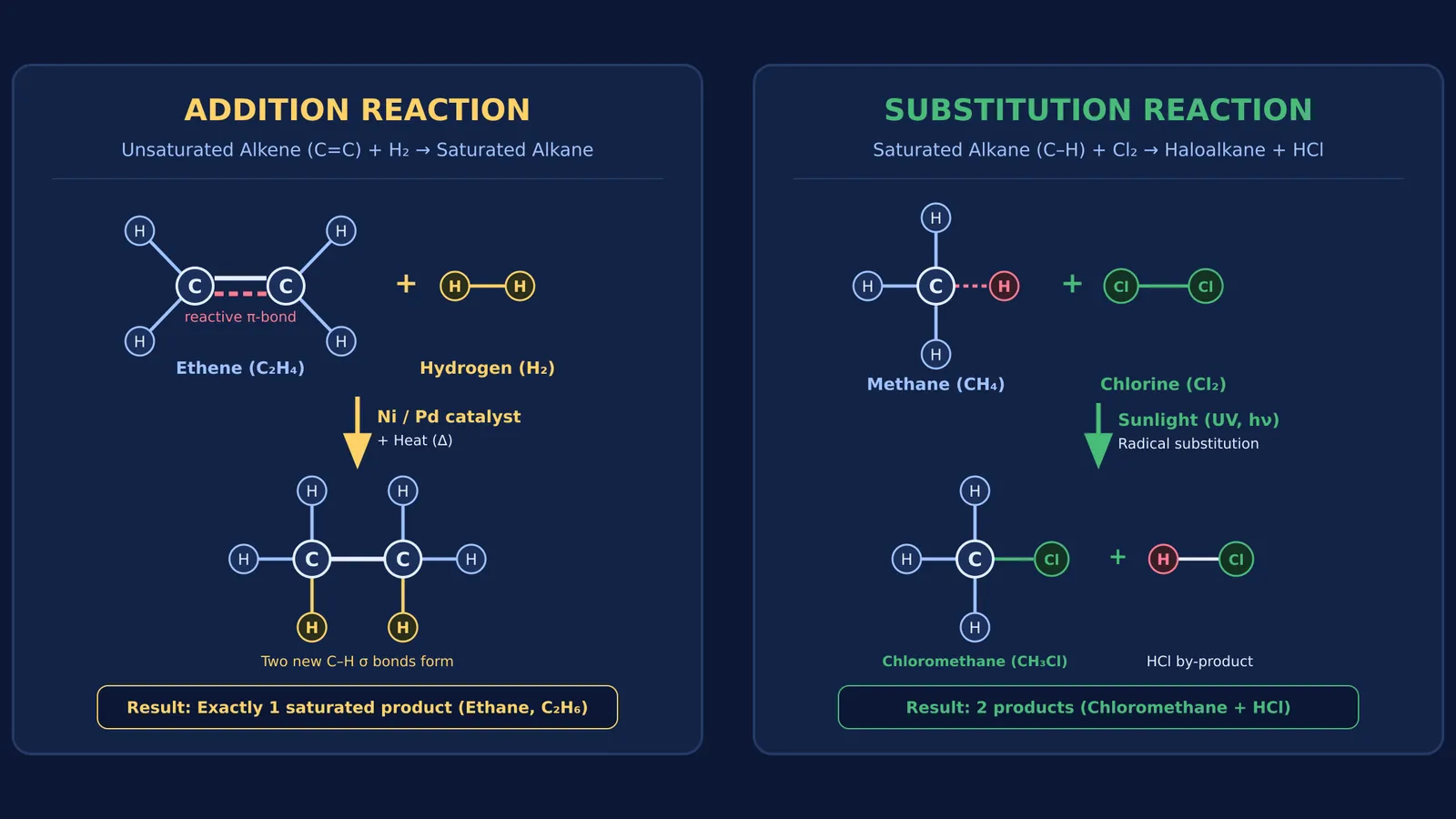
In carbon chemistry, an addition reaction occurs when an unsaturated hydrocarbon combines with another reagent to form a single saturated product. As outlined in the CBSE Secondary Science Curriculum, unsaturated hydrocarbons contain at least one double bond (alkenes) or triple bond (alkynes). According to the OpenStax Chemistry 2e textbook, a double bond consists of a strong sigma (σ) bond and a weaker pi (π) bond. During addition, the reactive π bond breaks without altering the carbon skeleton, forming two new single σ bonds.
The classic Class 10 example is catalytic hydrogenation. When ethene (PubChem CID 6325) reacts with hydrogen gas over a finely divided nickel (Ni) or palladium (Pd) catalyst with heat, the double bond opens to form ethane:
CH₂=CH₂ + H₂ → CH₃–CH₃ (Ni catalyst, heat)
Because all reactants merge into one compound, an addition reaction yields exactly one product:
R₂C=CR₂ + H₂ → R₂CH–CHR₂ (Ni catalyst)
When comparing how functional groups change across families, Carbon compounds in Class 10 details how homologous series determine reactivity. The Fermi Concept Library maps every concept in physics, chemistry, biology, mathematics and computing, helping students visualise how π-bond reactivity links to higher-level mechanisms.
How does hydrogenation turn vegetable oils into solid fats?
The major industrial application of addition reactions is the hydrogenation of vegetable oils. Cooking oils from groundnut, mustard, or sunflower seeds contain long carbon chains with multiple double bonds; they are liquid polyunsaturated fatty acids. In industrial food processing, passing hydrogen gas through heated vegetable oil over a nickel catalyst converts liquid oils into semi-solid saturated fats, commonly known as vanaspati ghee. French chemist Paul Sabatier received the 1912 Nobel Prize in Chemistry for developing this method of hydrogenating organic compounds with metal catalysts.
The Class 10 NCERT textbook notes that vegetable oils containing unsaturated carbon chains are recommended for everyday cooking, whereas animal fats contain saturated fatty acids that can be harmful to health when consumed regularly.
What is a substitution reaction in saturated hydrocarbons?
Unlike alkenes, saturated hydrocarbons (alkanes) contain only single carbon-carbon and carbon-hydrogen covalent bonds. In methane (PubChem CID 297), all four carbon valence electrons form stable single bonds with hydrogen. Because every valency is satisfied, alkanes cannot open bonds to add incoming atoms, remaining inert to acids, alkalis, and oxidising agents under ordinary conditions.
In the presence of sunlight (ultraviolet radiation), alkanes undergo a substitution reaction, where one atom replaces another. Sunlight breaks chlorine molecules into reactive chlorine atoms, which swap for hydrogen atoms one by one:
CH₄ + Cl₂ → CH₃Cl + HCl (in sunlight)
This reaction produces two products: chloromethane and hydrogen chloride gas. In excess chlorine, substitution proceeds in four successive steps:
CH₄ + Cl₂ → CH₃Cl + HCl (chloromethane)
CH₃Cl + Cl₂ → CH₂Cl₂ + HCl (dichloromethane)
CH₂Cl₂ + Cl₂ → CHCl₃ + HCl (trichloromethane or chloroform)
CHCl₃ + Cl₂ → CCl₄ + HCl (tetrachloromethane or carbon tetrachloride)
To examine the homolytic cleavage steps behind this reaction, the guide on free radical chlorination of methane tracks each propagation and termination intermediate.
How can you distinguish saturated and unsaturated compounds in exams?
Board exams and viva practicals often ask students to distinguish an alkane from an alkene experimentally. The standard method is the bromine water test:
Bromine water is a reddish-brown aqueous solution of elemental bromine (Br₂).
Adding bromine water to an unsaturated hydrocarbon (such as ethene or propene) triggers an immediate addition reaction. Bromine adds across the double bond to form colourless 1,2-dibromoethane (CH₂Br–CH₂Br), decolourising the reddish-brown liquid instantly.
Adding bromine water to a saturated hydrocarbon (such as ethane or methane) produces no addition in indoor light; the reddish-brown colour persists unchanged.
A second test is combustion: saturated hydrocarbons burn with a clean blue flame in good air, whereas unsaturated hydrocarbons burn with a luminous, sooty yellow flame due to unburnt carbon particles. Recognizing these structural distinctions is also essential when drawing structural isomers of butane and pentane.
How do you solve Class 10 reaction identification questions?
CBSE Class 10 exam questions regularly present molecular formulas and ask students to identify which compounds undergo addition or substitution. You can solve them using this three-step framework:
Check the general formula: Determine whether the hydrocarbon fits CnH2n+2 (alkane), CnH2n (alkene), or CnH2n-2 (alkyne).
Assign the reaction type: Unsaturated compounds (CnH2n and CnH2n-2) possess multiple bonds and undergo addition reactions. Saturated compounds (CnH2n+2) have only single bonds and undergo substitution reactions.
Specify the reaction condition: Hydrogen addition requires a nickel or palladium catalyst with heat; chlorine substitution requires sunlight (UV radiation).
Worked example: Given CH₄, C₂H₆, C₃H₆, and C₄H₈, determine which will decolourise bromine water through an addition reaction.
CH₄ and C₂H₆ match CnH2n+2, so they are saturated alkanes that undergo substitution in sunlight without decolourising bromine water.
C₃H₆ and C₄H₈ match CnH2n, so they are unsaturated alkenes (propene and butene) that undergo addition and decolourise bromine water.
The Fermi Problem Library provides worked problems with a step-by-step solver that explains the reasoning rather than printing an answer, helping students master multi-step hydrocarbon questions.


