

On this page
Alkanes are the most straightforward hydrocarbons. Because they contain only single carbon-carbon and carbon-hydrogen bonds, they are highly stable and largely unreactive at room temperature 1. But when exposed to high heat, pressure and the right catalysts, their carbon skeletons can rearrange, close into rings, or snap apart entirely.
For students preparing for the JEE and NEET, three high-temperature reactions of alkanes appear repeatedly: isomerisation, aromatisation and pyrolysis. These reactions are not just exam staples; they are the industrial backbone of modern petroleum refining, transforming raw crude oil into high-octane fuels and essential chemical feedstocks 2.
What is the isomerisation of alkanes?
Isomerisation is the process of converting a straight-chain alkane into a branched-chain isomer without adding or losing any atoms 1. Branched alkanes burn much more smoothly in engines, giving them a higher octane rating.
When a straight-chain alkane is heated in the presence of a platinum catalyst, it isomerises into branched chains. In this process, the alkane does not lose any carbons or hydrogens, keeping the same molecular weight 1.
For example, butane is the most common alkane that is put under the process of isomerisation, as it yields branched alkanes with high octane numbers. If you need a refresher on drawing these structures, reviewing the structural isomers of butane is a good starting point.
How does the aromatisation of hexane yield benzene?
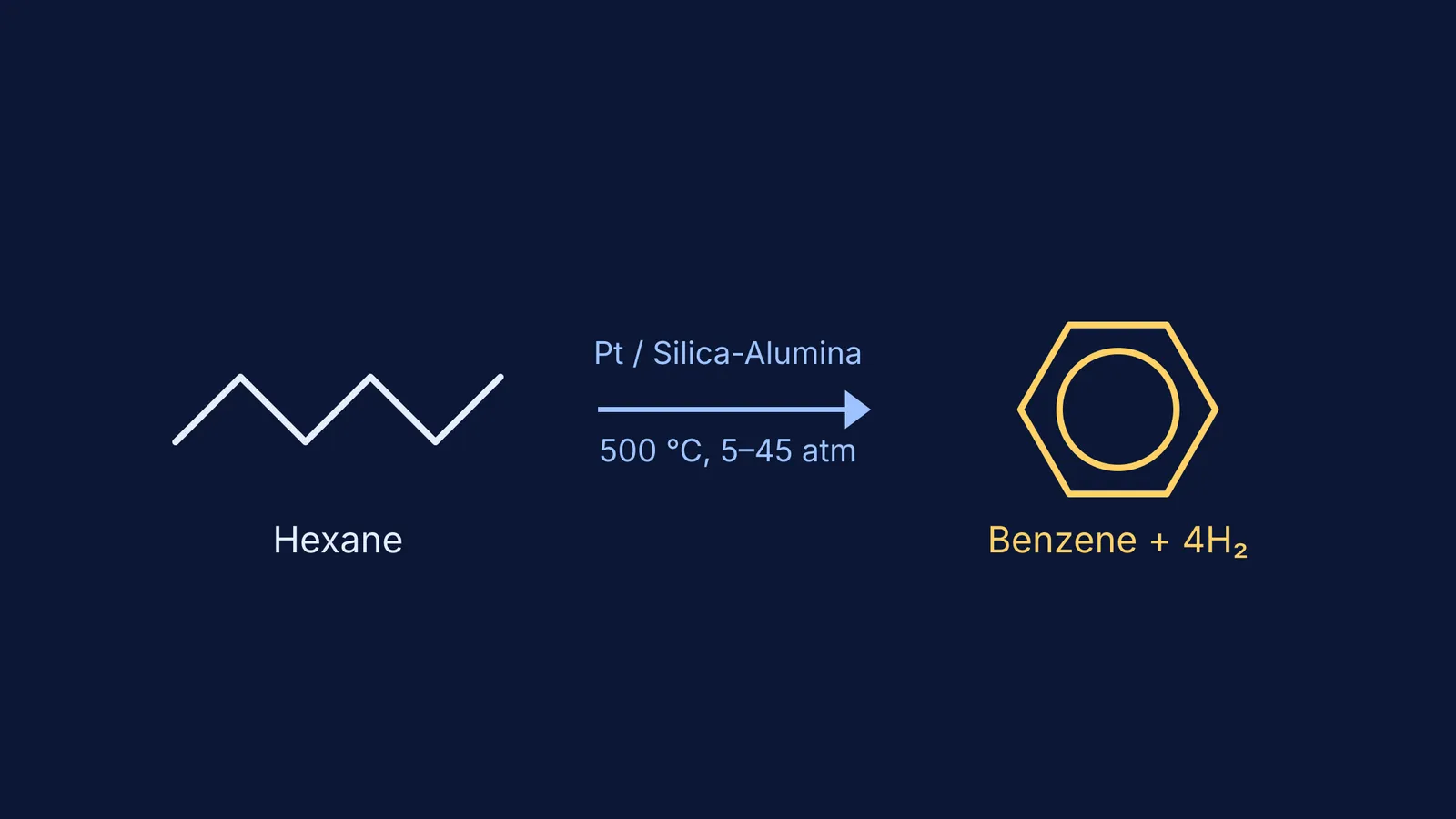
Alkanes can fold into themselves to form stable aromatic rings in a process known as aromatisation, or catalytic reforming. In this reaction, alkanes become cycloalkanes or aromatic hydrocarbons, giving off hydrogen as a by-product 1.
This reaction requires extreme conditions. Depending on the exact process, the temperature ranges from 495 to 525 °C and the pressure from 5 to 45 atm 2. It also relies on a catalyst, almost always platinum on a silica or silica-alumina support base.
Under these conditions, a molecule with six carbon atoms like hexane will dehydrogenate and aromatise into benzene. If you use a longer chain, the extra carbons become side chains on the benzene ring. For instance, aromatising normal heptane under the exact same conditions yields toluene 2.
What happens during the pyrolysis of alkanes?
Pyrolysis, often called cracking, is the thermal decomposition of large alkane molecules into smaller, more useful fragments 3). Unlike isomerisation and aromatisation, which rearrange the skeleton, pyrolysis breaks the carbon-carbon bonds completely.
When alkanes are heated, they split via a homolytic mechanism with the formation of free radicals 1. Steam cracking, a form of thermal cracking, operates at temperatures of 750 to 900 °C 3).
The products are a mixture of lower alkanes and alkenes. Industrial cracking relies heavily on specific temperatures, and sometimes acid catalysts like zeolites (in catalytic cracking), to steer the reaction towards desired products like ethene and propene, the building blocks for most plastics. You can see the origins of these simple fragments when naming carbon compounds in Class 10.
How can you master alkane reactions?
Organic chemistry relies on spotting patterns in reagents rather than memorising equations line by line. Here is a plan to lock these reactions in:
Focus on the catalyst: A platinum catalyst signals a rearrangement (isomerisation) or ring formation and hydrogen loss (aromatisation). High heat alone, or with zeolites, signals fragmentation (pyrolysis).
Track the carbons: In isomerisation and aromatisation, the number of carbon atoms in your reactant must exactly match the number in your product. In pyrolysis, the sum of the carbons in all the fragments must equal the starting alkane.
Map the concepts: If you forget why a straight chain prefers to become branched, or why benzene is so stable, trace the ideas back to their roots in the Fermi Concept Library.
If you find yourself staring at an unfamiliar reagent over an arrow, Fermi's AI tutor can help. A student can bring a scanned assignment, and the tutor will build a plan for the session, writing on a board, drawing the figure, and checking understanding as it goes.


