

On this page
Coordination compounds often feature a central metal ion surrounded by a cluster of ligands. When this entire structure carries a net negative charge, the rules of IUPAC nomenclature step in to flag that charge directly in the name.
What is an anionic complex?
A coordination complex is simply a central metal atom bonded to surrounding molecules or ions, known as ligands. If you add up the charges of the metal and all its ligands, you get the net charge of the complex.
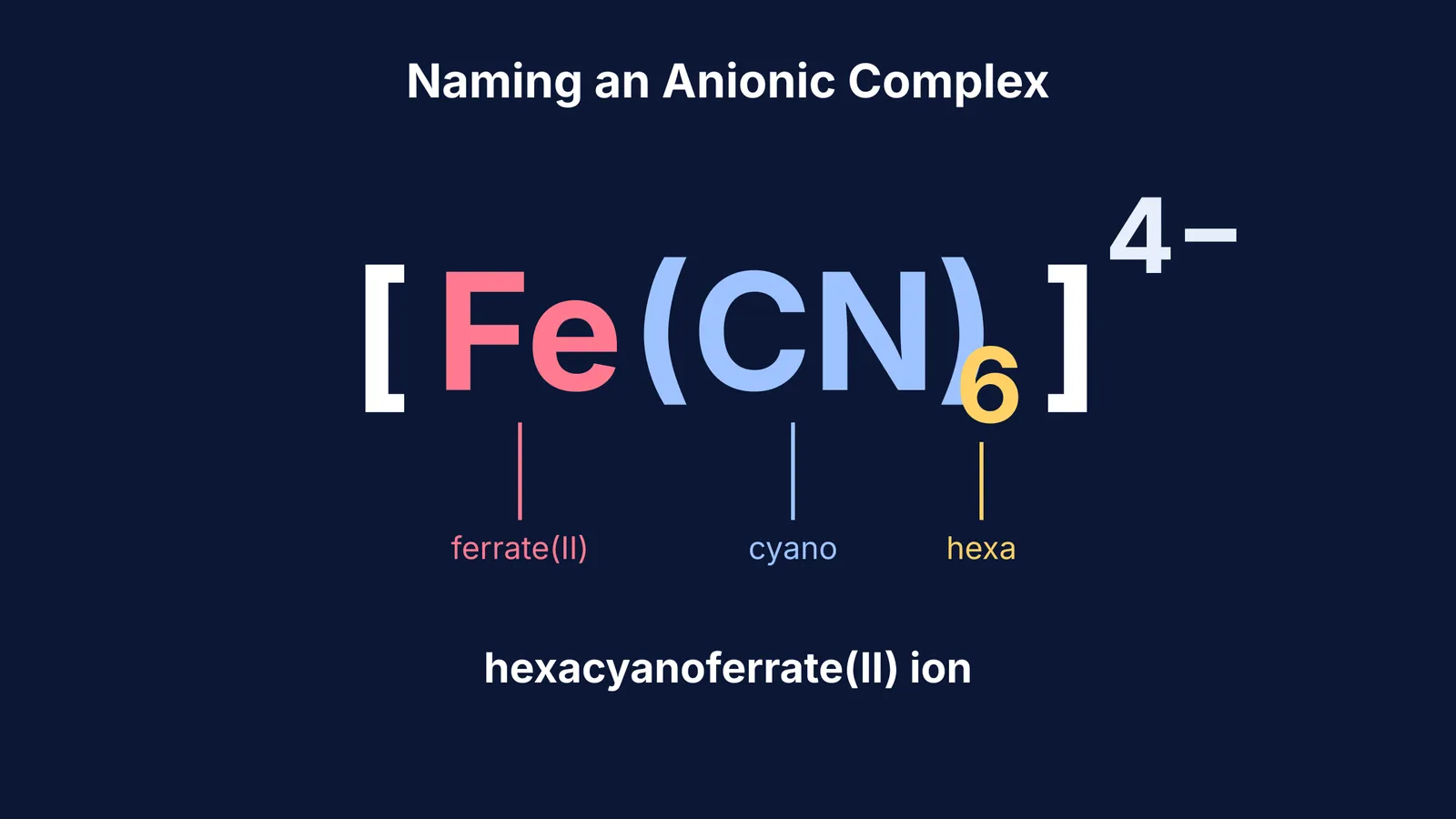
When that net charge is negative, the complex is called an anionic complex. For example, in the compound K₄[Fe(CN)₆], the potassium ions (K⁺) sit on the outside as counter-ions. The square brackets hold the complex itself: [Fe(CN)₆]⁴⁻. Because the complex ion has a negative charge, it is anionic.
To signal this negative charge to anyone reading the name, IUPAC rules require the central metal's name to end in the suffix -ate (LibreTexts/Coordination_Chemistry/Structure_and_Nomenclature_of_Coordination_Compounds/Nomenclature_of_Coordination_Complexes)). If the complex is neutral or positive (cationic), the metal keeps its ordinary English name.
Why do some metals use their Latin names?
Adding "-ate" to the end of some English metal names produces clumsy words. "Ironate" or "copperate" do not flow well.
To solve this, chemists revert to the metal's Latin root before adding the suffix. This usually happens for elements whose chemical symbols are already based on their Latin names. For instance, the symbol for iron is Fe, from the Latin *ferrum*. Drop the "-um", add "-ate", and you get ferrate.
This rule is strictly applied in coordination chemistry to ensure international consistency.
What are the most common Latin roots in coordination chemistry?
You will need to recognise these standard Latin conversions for the most common transition and post-transition metals. Here is the list you should commit to memory:
Iron (*Ferrum*): Ferrate
Copper (*Cuprum*): Cuprate
Silver (*Argentum*): Argentate
Gold (*Aurum*): Aurate
Lead (*Plumbum*): Plumbate
Tin (*Stannum*): Stannate
If you are exploring the oxidation states of transition metals, you will notice that other metals keep their English names. Zinc becomes zincate, cobalt becomes cobaltate, and nickel becomes nickelate.
How do you name an anionic complex step by step?
Let us apply the rules to name the complex ion [Fe(CN)₆]⁴⁻.
Name the ligands first: There are six cyanide (CN⁻) ligands. The prefix for six is "hexa", and the anionic ligand name for cyanide is "cyano". This gives us hexacyano.
Name the metal: Because the complex carries a 4− charge, it is anionic. The metal is iron, so we use the Latin root and add the suffix to get ferrate.
Calculate the oxidation state: The total charge of the complex is −4. Each cyanide ligand contributes −1. Let the oxidation state of iron be x. Since x + 6(−1) = −4, the oxidation state of iron (x) is +2.
If you find balancing these charges tricky, Fermi's AI tutor can work out what you already know and build a plan for the session, guiding you through the algebra of finding oxidation numbers from structure.
Assemble the name: Put the pieces together and add the oxidation state in Roman numerals in parentheses at the end.
The final name is hexacyanoferrate(II) ion. If it is part of the potassium salt K₄[Fe(CN)₆], you simply name the cation first: potassium hexacyanoferrate(II).
How does the cuprate naming work?
Let us look at another common example: the [CuCl₄]²⁻ ion.
Name the ligands: There are four chloride (Cl⁻) ligands. The prefix for four is "tetra", and the ligand name for chloride is "chloro" (or "chlorido" in more recent IUPAC updates). This gives tetrachloro.
Name the metal: The complex has a 2− charge, making it anionic. Copper (Cu) comes from the Latin *cuprum*, so the metal is named cuprate.
Calculate the oxidation state: The total charge is −2. Four chloride ligands contribute −4. Let the copper oxidation state be y.
y + 4(−1) = −2 y = +2
Assemble the name: The complete name is the tetrachlorocuprate(II) ion.
This pattern repeats across the periodic table, whether you are dealing with argentate complexes in silver electroplating or plumbate compounds in batteries.
Are there exceptions to the -ate rule?
The rule of adding -ate to anionic complexes is absolute, but you must be careful with neutral or cationic complexes. For example, [Cu(NH₃)₄]²⁺ is the tetraamminecopper(II) ion. Because its net charge is positive, the Latin root is ignored and the suffix is omitted.
Similarly, the number of ligands does not change the metal's name. Whether it is a dicyanoargentate(I) ion with two ligands or a hexachloroplumbate(IV) ion with six, the Latin root and the -ate ending remain strictly tied to the overall negative charge of the coordination sphere.
By mastering this handful of Latin roots, you will never be caught off guard when a cuprate or argentate complex appears on a chemistry paper. To practise these naming conventions across different functional groups and compounds, visit the Fermi Concept Library.


