

On this page
Almost every Class 9 congruence proof ends with the same two words: "by CPCT". Those words are where the proof pays off. They also cost students marks when they turn up in the wrong place.
What is CPCT in triangle congruence?
CPCT is short for "corresponding parts of congruent triangles". Two triangles are congruent when one fits exactly on top of the other, so their three sides and three angles match in pairs. CPCT says that once you have proved two triangles congruent, every matching pair of parts is equal.
The idea goes back to Euclid. His Book I, Proposition 4, which you know as SAS, ends by concluding that "the remaining angles equal the remaining angles respectively, namely those opposite the equal sides" (Euclid, Elements I.4, D. E. Joyce's edition). His side-side-side case (I.8) and his two-angles-and-a-side case (I.26) end in a similar way, by concluding that further matching parts are equal.
The pattern is always the same. You check three parts, and the other three parts follow.
Why can you use CPCT only after proving congruence?
CPCT is a consequence of congruence. It is not a test for it. A proof runs in one direction:
Find three equal parts that fit a rule (SAS, ASA, AAS, SSS or RHS).
Conclude that the triangles are congruent.
Use CPCT to get the other three equal parts.
If you write "AC = BD by CPCT" before step 2, you are assuming the very thing you were asked to prove. The proof has a gap, even if the answer is true.
The order of the letters matters too. Writing triangle AOC ≅ triangle BOD pairs A with B, O with O and C with D. So CPCT gives AC = BD and angle OAC = angle OBD. It does not give AC = OD. Read off the parts by position, not by how the figure looks.
How do you use CPCT in a proof?
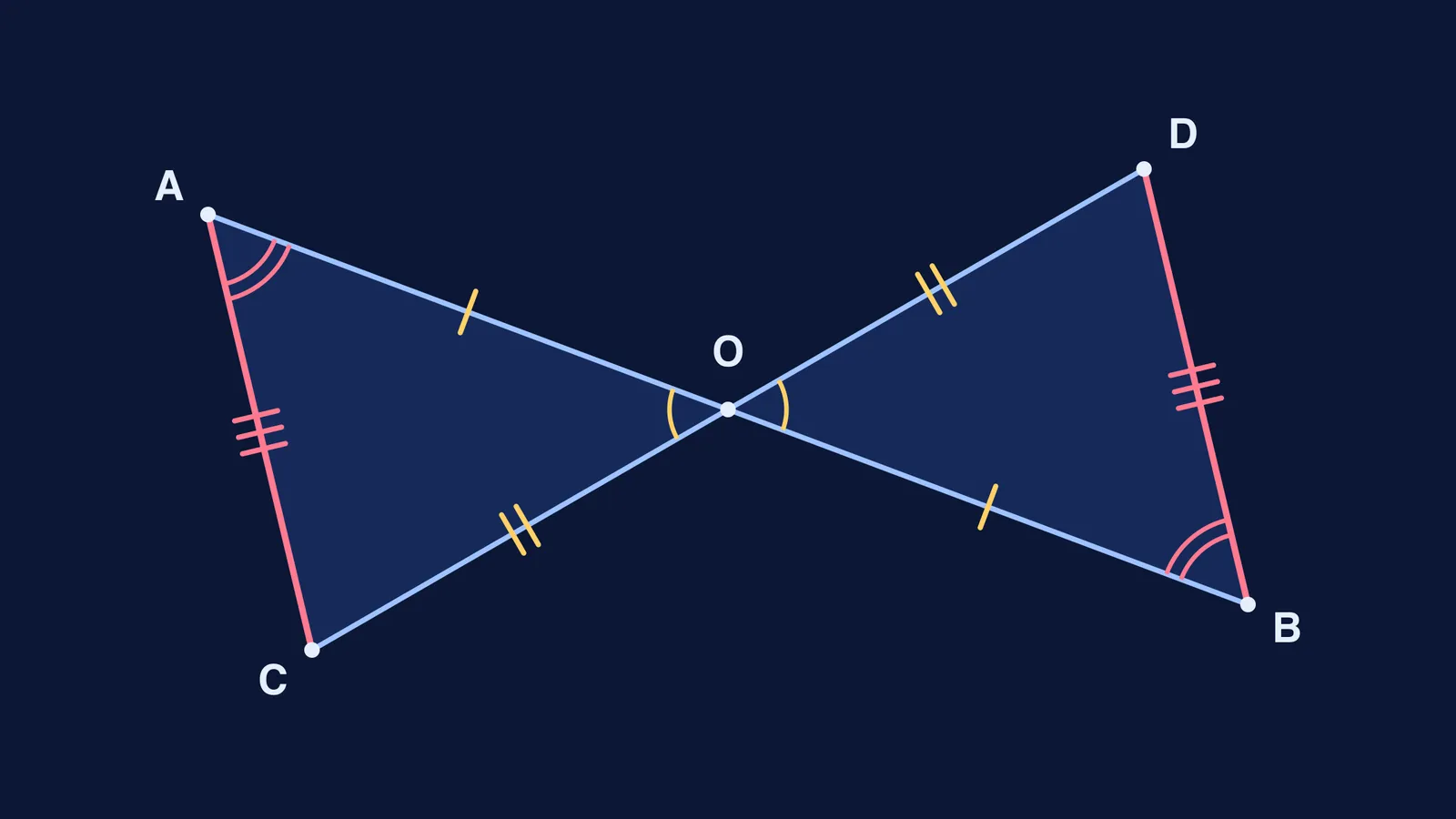
Here is a worked example. Problem: line segments AB and CD bisect each other at O. Prove that AC = BD and that AC is parallel to BD. The diagram at the top of this page shows this figure: the given parts are marked in yellow and the parts CPCT gives you are marked in pink.
In triangles AOC and BOD:
OA = OB (O is the midpoint of AB, given)
OC = OD (O is the midpoint of CD, given)
Angle AOC = angle BOD (vertically opposite angles)
So triangle AOC ≅ triangle BOD (SAS: the angle in step 3 lies between the sides in steps 1 and 2)
AC = BD (CPCT)
Angle OAC = angle OBD (CPCT)
Angles OAC and OBD are alternate angles made by the transversal AB with lines AC and BD, so AC is parallel to BD.
The proof uses three facts and one congruence, then uses CPCT to collect the parts you actually wanted. Step 7 shows a second pay-off: an angle you got from CPCT becomes the starting point for the next argument. Euclid works the same way in Proposition 5. He uses side-angle-side twice and reads off equal angles to show that the base angles of an isosceles triangle are equal (Elements I.5).
If you get stuck finding the equal angle in step 3, our guide to angle chasing in geometry gives you a fixed order to try.
Which CPCT mistakes cost marks?
Go through this checklist before you write "CPCT":
Is there a congruence line above it, and does it name the rule?
Does the rule really apply? Two sides and an angle that is not between them (SSA) do not fix a triangle. Take AB = 10 cm, BC = 6 cm and angle A = 30°. The cosine rule gives AC² − 17.32 AC + 64 = 0, so AC can be about 12.0 cm or about 5.3 cm. Those are two different triangles.
Equal angles alone (AAA) fix the shape but not the size. Equilateral triangles with sides of 3 cm and 5 cm have the same angles but are not congruent.
Are the vertices written in matching order, so that each pair you claim really corresponds?
Are you using CPCT to prove congruence? That runs the argument backwards.
How should you practise CPCT questions?
Work backwards from what you are asked to prove. Write down the target, such as AC = BD. Then ask which two triangles contain those parts. Look for three equal parts in that pair, name the rule, and only then write CPCT.
When a proof stalls because you picked the wrong triangles, the Fermi Problem Library has worked problems with a step-by-step solver that explains the reasoning rather than printing an answer. If the congruence rules themselves feel shaky, the Fermi Concept Library gives each mathematics concept its own lesson and shows where it sits in the map.
Once CPCT feels routine, try using it with coordinates. Our post on classifying a triangle as isosceles or right-angled shows you how to check equal sides with the distance formula.


