

On this page
Angle chasing means finding an unknown angle by moving one fact at a time from angles you know to angles you don't, with no protractor and no trigonometry. Often a student who gets stuck is not missing a theorem; they don't know which one to try next. A fixed order helps with that.
What is angle chasing in geometry?
It is one of the basic tools of olympiad geometry: Evan Chen's textbook Euclidean Geometry in Mathematical Olympiads (Mathematical Association of America, 2016) opens with a chapter titled Angle Chasing. The same skill runs through school geometry, from simple triangle problems to circle theorems.
You need very few facts, and all of them are in Euclid's Elements, free to read in an online edition hosted at Clark University.
Which angle facts do you need?
Five facts carry many problems. Euclid writes "two right angles" where we write 180°.
Triangle sum and exterior angle: the three angles of a triangle add up to 180°, and an exterior angle equals the sum of the two opposite interior angles (Book I, Proposition 32).
Parallel lines: a line crossing two parallel lines makes alternate angles equal, corresponding angles equal, and co-interior angles add up to 180° (Book I, Proposition 29).
Isosceles triangles: the base angles of an isosceles triangle are equal (Book I, Proposition 5).
Cyclic quadrilaterals: opposite angles of a quadrilateral drawn in a circle add up to 180° (Book III, Proposition 22).
Same segment: in a circle, angles standing on the same chord on the same side are equal (Book III, Proposition 21).
If the first two feel shaky, revise them with our posts on finding x in triangle angle sum problems and complementary and supplementary angle pairs.
How do you do angle chasing step by step?
Use the same five steps every time. Each new angle sends you back to step 2.
Mark the givens. Write every known angle on the figure in degrees. Put tick marks on equal sides and arrows on parallel lines. Name each angle with three letters; the middle letter is the vertex.
Parallel lines. Find every transversal crossing a pair of parallel lines and copy angles across it.
Isosceles triangles. Look for tick marks and for two radii of the same circle. Each pair gives you two equal base angles.
Cyclic quadrilaterals. If four points lie on a circle, use opposite angles adding to 180° and equal angles on the same chord.
Close the triangle. Use the angle sum to get the last angle, then check one angle a second way.
Why this order? Parallel and equal marks are already on the figure, so they are quickest to spot. A hidden circle takes more looking, and the triangle sum needs two angles already found.
Worked example: a cyclic quadrilateral with parallel sides
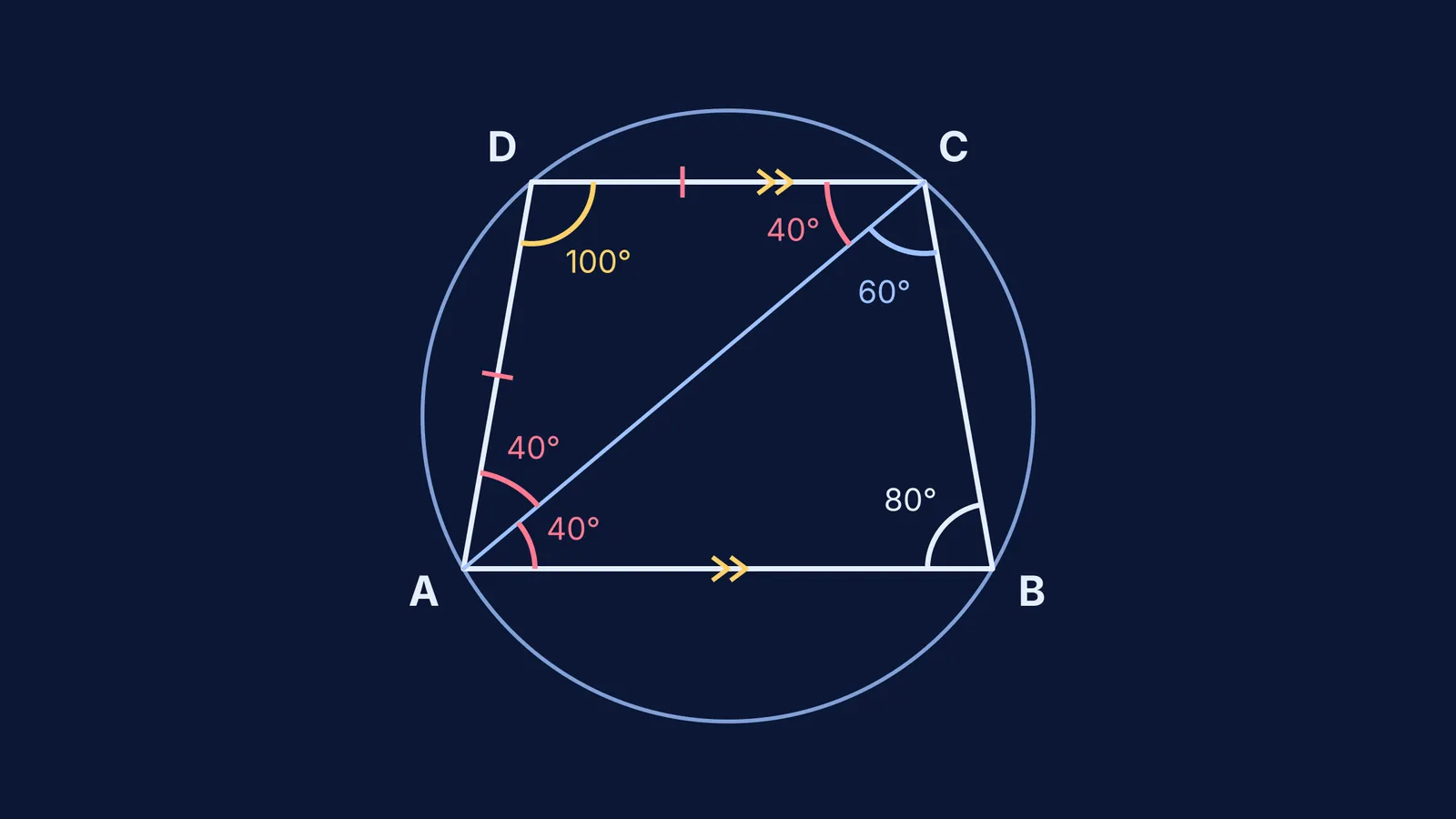
Problem. ABCD is a cyclic quadrilateral with AB parallel to DC and AD = DC. Angle ADC = 100°. Find angle ABC and angle ACB.
Mark the givens. Write 100° at D, tick AD and DC as equal, and put arrows on AB and DC. Draw the diagonal AC.
Parallel lines. AC crosses AB and DC, so angle BAC = angle ACD (alternate angles). We don't know either value yet, so move on.
Isosceles triangle. In triangle ADC, AD = DC, so angle DAC = angle DCA = (180° − 100°) ÷ 2 = 40°. Go back to step 2: angle BAC = angle ACD = 40°.
Cyclic quadrilateral. Angles ABC and ADC are opposite, so angle ABC = 180° − 100° = 80°.
Close the triangle. In triangle ABC, angle ACB = 180° − 40° − 80° = 60°.
Check a second way. AD crosses the parallel lines AB and DC, so angle DAB + angle ADC = 180°, giving angle DAB = 80°. From the chase, angle DAB = angle DAC + angle CAB = 40° + 40° = 80°. The two routes agree, so the answers stand: angle ABC = 80° and angle ACB = 60°.
What should you do when you get stuck?
Name one angle x. Express every other angle in terms of x, then look for two expressions for the same angle and set them equal.
Redraw the figure large and lopsided. A neat figure can make lines look parallel when nothing says so. Use only what is given or proved.
Look for hidden circles. Four points on a circle are easy to miss once the circle is not drawn in.
Read the middle letter. Angle ADC and angle DAC are different angles.
If the same kind of step keeps tripping you up, the Fermi Problem Library has worked problems with a step-by-step solver that explains the reasoning rather than printing an answer. If one fact itself feels unclear, the Fermi Concept Library gives each concept its own lesson.
Preparing for olympiads too? Our plan for preparing for olympiads alongside JEE shows where geometry practice fits in your week.


