

On this page
When you start geometry in Class 7, you learn that angles often come in pairs. The most common questions you will see in exams are complementary and supplementary angle problems, where you have to find an unknown angle from a word problem.
What are complementary and supplementary angles?
The rules for these angle pairs depend purely on their total:
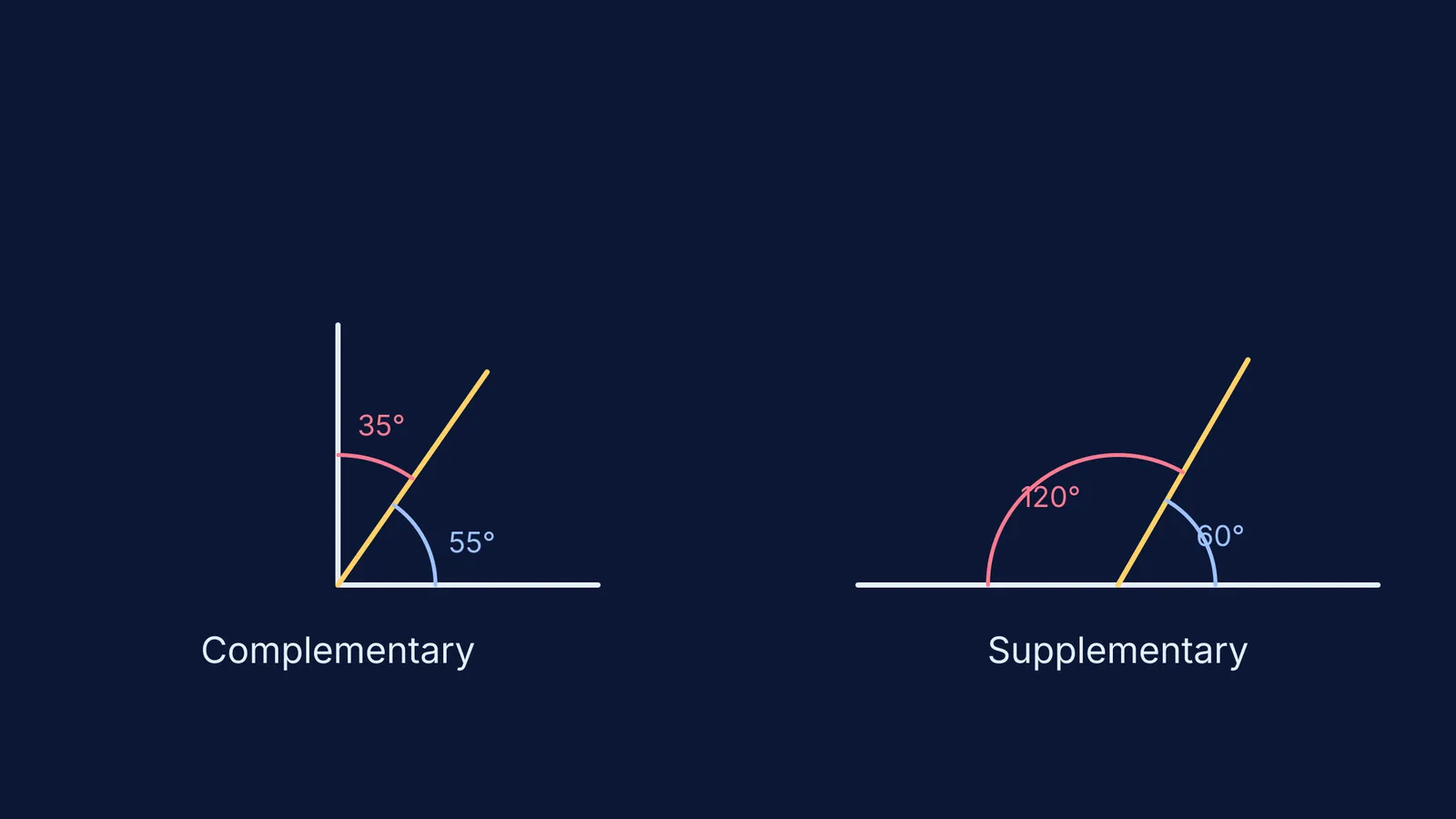
Complementary angles are two angles whose sum is exactly 90° (Maths is Fun). For example, 40° and 50° are complementary. To find the complement of an angle, you subtract it from 90°.
Supplementary angles are two angles whose sum is exactly 180° (Maths is Fun). For example, 120° and 60° are supplementary. To find the supplement of an angle, you subtract it from 180°.
A quick trick to remember which is which: C comes before S in the alphabet, and 90 comes before 180.
What is the difference between a linear pair and supplementary angles?
A linear pair consists of two adjacent angles (angles that share a common vertex and side) whose non-common sides form a straight line. Because a straight line measures exactly 180°, the angles in a linear pair always add up to 180°.
This leads to a common exam trap. All linear pairs are supplementary, but not all supplementary angles form a linear pair. Supplementary angles only need to add up to 180°—they can be completely separate from each other on the page, such as the opposite angles of a cyclic quadrilateral. A linear pair must be physically touching.
If you need a refresher on geometry definitions, the Fermi Concept Library covers every concept in mathematics.
A four-step plan for angle word problems
When you face complementary and supplementary angle problems, the hardest part is usually translating the English into algebra. You can use this reliable four-step framework for any exam question:
Identify the pair type: Read the question carefully to spot the keywords. If it says "complementary", write down "= 90°". If it says "supplementary" or "linear pair", write down "= 180°".
Assign your variables: Let the angle you need to find be x. Immediately write down the second angle as (90° − x) for complements, or (180° − x) for supplements.
Build the equation: Translate the remaining relationship (like "is 20° more than" or "is double") into an equals sign.
Solve and verify: Solve for x, then put your two angles back into the original sum to prove they reach 90° or 180°.
How do you find an angle that is 20° more than its complement?
This is one of the classic complementary supplementary angle problems in Class 7. Instead of giving you one angle, the question gives you a relationship between the two. We can apply our four-step plan.
First, the keyword is "complement", so our total is 90°. Second, let the unknown angle be x. The other angle must be 90° − x.
Third, the problem states that the angle x is 20° more than its complement. We can write this as an equation: x = (90° − x) + 20°
Fourth, solve for x: x = 110° − x 2x = 110° x = 55°
The angle is 55°. We can check our work: its complement is 90° − 55° = 35°. And 55° is indeed 20° more than 35°.
How do you solve supplementary angles in a ratio?
Another common word problem gives you the ratio of two supplementary angles. For example: "Two supplementary angles are in the ratio 2:3. Find the angles."
When you see a ratio, attach an x to each part. Let the angles be 2x and 3x. Because they are supplementary, their sum is 180°: 2x + 3x = 180° 5x = 180° x = 36°
Now, multiply x by the ratio numbers to find the actual angles: First angle = 2 × 36° = 72° Second angle = 3 × 36° = 108°
You can check your working: 72° + 108° = 180°.
If you get stuck setting up equations for word problems, the Fermi Problem Library is a step-by-step solver that explains the reasoning rather than just printing the final answer.
Whether you are working out why the angles of a triangle add to 180 degrees or calculating the angle between clock hands, mastering how to translate word problems into algebra will carry you through school geometry.


