

On this page
If you draw a triangle on a flat piece of paper and measure its three inside angles, they will always sum to exactly 180 degrees. This rule holds true whether the triangle is an equilateral shape with three identical 60-degree corners, or a long, thin scalene shape drawn across a blackboard.
But memorising the rule is different from seeing why it has to be true. When you physically manipulate a shape—either by folding paper or dragging points on a screen—the logic behind the formula clicks into place.
Why do the angles of a triangle add to 180 degrees?
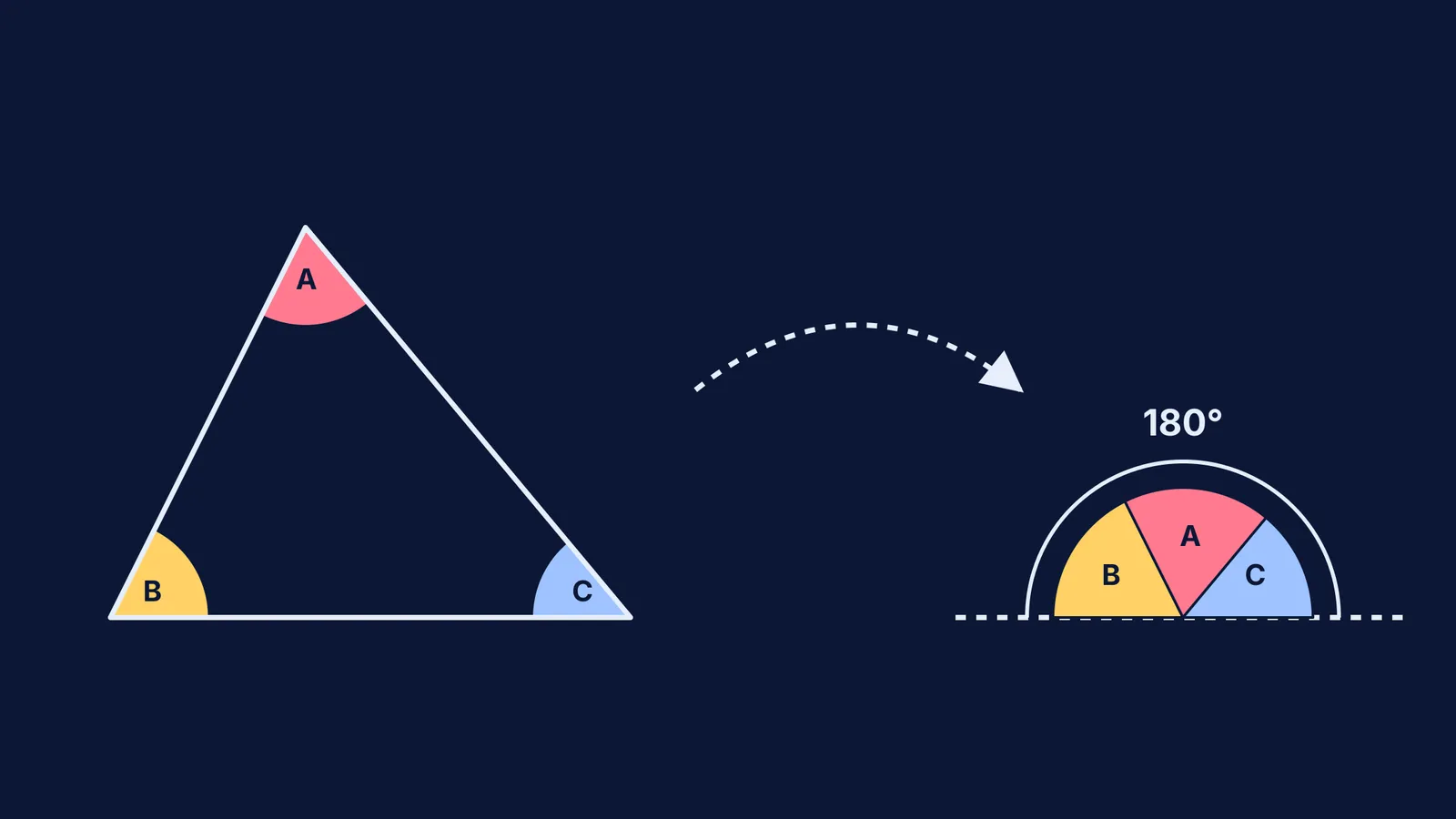
The easiest way to understand the 180-degree rule is to look at a straight line. A straight line represents an angle of 180 degrees, or exactly half of a full circle. If you take the three corners of any triangle and place them side by side so their points touch, their outer edges will perfectly align to form a straight line.
In formal mathematics, this is often proven using parallel lines. If you draw a line through the top point of a triangle that is perfectly parallel to its base, you create two "Z-angles" (alternate interior angles) on either side of the top point. Those alternate angles are equal to the two bottom angles of the triangle. Together, all three angles sit side by side on the straight, parallel line, proving their sum is exactly 180 degrees. This beautiful geometric proof demonstrates that the rule is not just a coincidence, but a fundamental property of flat space. It connects the concept of parallel lines directly to the structure of every triangle.
How can you test the 180-degree rule yourself?
You do not need to rely on a textbook to prove this concept. You can prove it with your own hands.
If you prefer a screen to paper, you can run the exact same experiment digitally using the Fermi Simulation Lab. You can construct a long, thin scalene triangle, predict its angle sum, and then drag the vertices around the screen to see the interior angles update in real time. No matter how extreme you make the shape, the total sum will stay locked at 180 degrees.
Does interactive geometry actually help you learn?
Reading a proof is passive, but active learning asks you to test the boundaries of a rule to see if it ever breaks. Students who learn mathematics using digital visualization tools improve their academic performance by an average of 39%, according to a 2025 meta-analysis of 88 empirical studies published in *Education Sciences*.
When you use interactive geometry, you build intuition. By pulling a shape apart and stretching its limits, you learn to "feel" the mathematical relationships rather than just blindly trusting an equation.
Next steps for your maths revision
The 180-degree rule is the first stepping stone to mastering flat-plane geometry. Once you trust how interior angles behave, you can move on to much harder problems.
If you are studying for your board exams or competitive tests, your next step might be tackling coordinate geometry, such as finding the area of a triangle using determinants, or finding the condition for three lines to be concurrent. The principles you build now by experimenting with shapes are exactly the same spatial principles mathematicians like Liu Hui used when approximating pi with polygons.


