

On this page
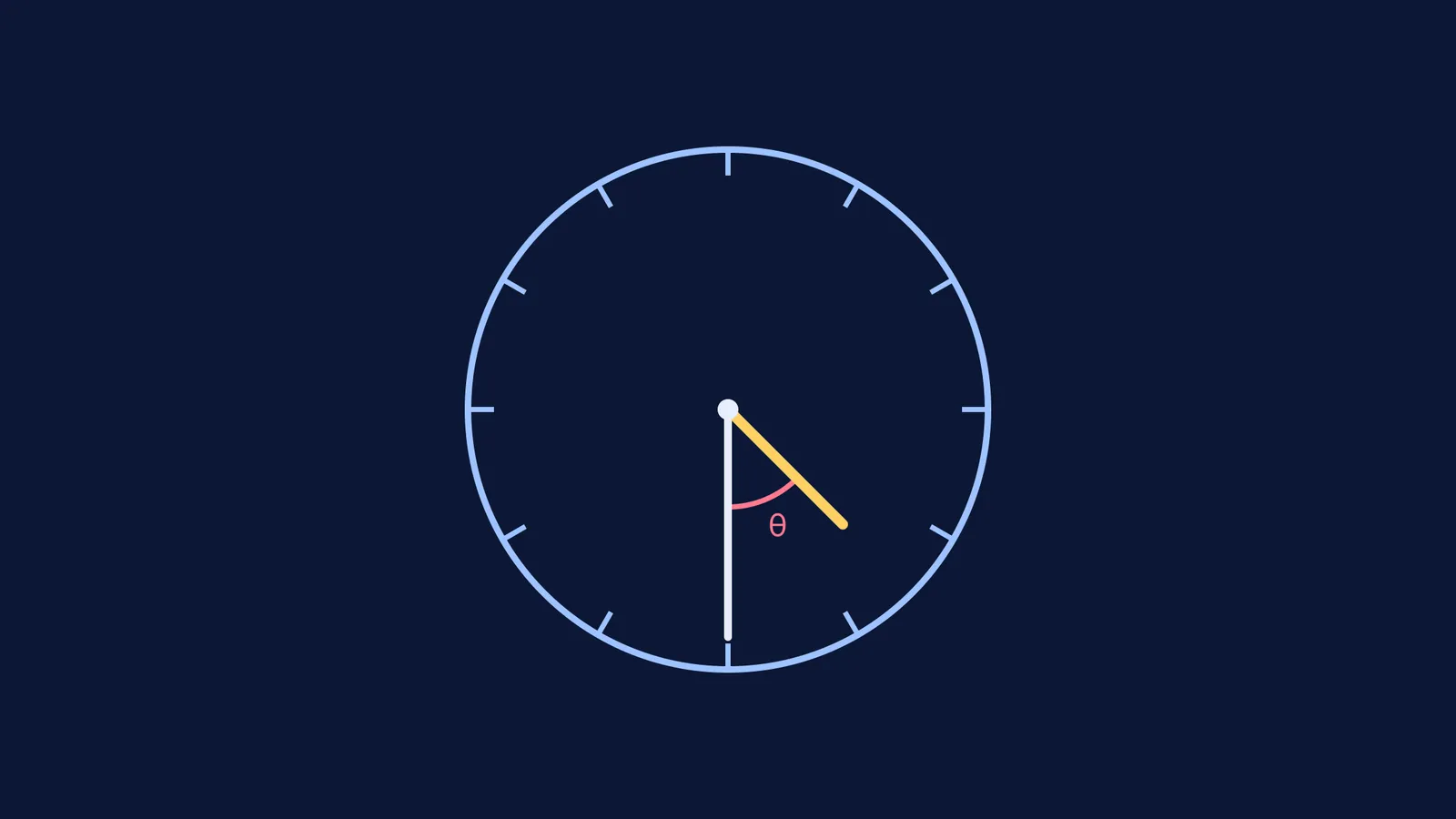
At first glance, finding the angle between the hands of an analogue clock seems like a simple matter of counting the numbers on the dial. However, because the hour hand drifts slowly between the numbers as the minutes tick by, calculating the exact angle requires factoring in the speeds of both hands.
Whether you are preparing for a competitive exam or brushing up on geometry, the mathematics of a clock face offers a classic lesson in relative motion.
What is the angle between the hands of a clock formula?
The standard formula to calculate the angle (θ) in degrees between the hour hand and the minute hand is:
θ = |30H − 5.5M|
Where:
H is the hour, from 1 to 12.
M is the minutes past the hour, from 0 to 59.
Because the angle must be a positive value, the vertical bars denote the absolute value. If the calculation yields a negative number, simply drop the minus sign. (For times starting at 12:00, you can use H = 0 to keep the arithmetic simple.)
For problems involving spinning objects and continuous change, see Rotational kinematics: equations for uniform angular acceleration.
Why do we use 5.5 in the clock angle formula?
To understand where the 30 and the 5.5 come from, we have to look at the angular speed of each hand as they travel around the 360° circle of the dial source.
The minute hand: It completes a full 360° turn in 60 minutes. Therefore, its speed is 360 / 60 = 6° per minute.
The hour hand: It completes a 360° turn in 12 hours (720 minutes). Its speed is 360 / 720 = 0.5° per minute.
The relative speed: Because both hands move in the same direction, the minute hand catches up to the hour hand at a relative speed of 6 − 0.5 = 5.5° per minute.
At exactly the top of the hour, the minute hand is at 0°, and the hour hand is exactly on its number. Since there are 12 numbers on the dial, the angle between each number is 360 / 12 = 30°. So, at H hours, the hour hand starts with a "head start" of 30H degrees. As the minutes tick by, the distance between the hands closes (or opens) at a rate of 5.5° for every minute M.
When you try to map this mentally, it can be tricky to picture the hour hand's slow drift. In cases like this, the Fermi Concept Library offers lessons that put the mathematics in its place on the map, helping you build an intuitive visual understanding before reaching for the formula.
A step-by-step example: 3:20
Let's apply the formula to a specific time: 3:20.
Note the values: H = 3, M = 20.
Plug them into the formula: θ = |30(3) − 5.5(20)|.
Multiply the terms: θ = |90 − 110|.
Subtract: θ = |−20|.
Take the absolute value: The angle is 20°.
How many times do clock hands overlap in a day?
It might seem intuitive that the hands should overlap once every hour, meaning 24 times a day. However, the hands overlap exactly 22 times in a 24-hour day source.
Because the minute hand has to travel more than 360° to catch up to the advancing hour hand, an overlap occurs roughly every 65 minutes and 27 seconds (specifically, 1 1/11 hours).
If you track them starting at 12:00 (when they overlap), the next overlap is near 1:05, then 2:10, and so on. Between 11:00 and 1:00, the only overlap occurs exactly at 12:00. As a result, there are only 11 overlaps in a 12-hour period.
This is a classic trap in reasoning. If you struggle with missing subtle physical constraints in physics problems, Fermi's AI tutor can work out what you already know and build a plan for the session, guiding you to discover these constraints yourself.
When are the hands of a clock opposite each other?
Just like the overlaps, the hands point in perfectly opposite directions (separated by 180°) 22 times in a 24-hour period source.
The first time they form a straight line is at 6:00. Just as with the overlaps, each subsequent time they are opposite takes slightly more than an hour—about 65.45 minutes. In the 12-hour window, the only time they are perfectly opposite between 5:00 and 7:00 is exactly at 6:00, which reduces the count to 11 times per half-day.
Both the overlap and opposite configurations depend on the steady, rigid motion of the gears. For a look at how physical properties can disrupt this timing, read Pendulum clock losing time in summer: thermal expansion of the rod.
These recurring patterns make clocks a reliable model for periodic motion. You can see similar mathematical cycles in SHM through a tunnel across the Earth: period and speed at centre, where a system oscillates over regular intervals.
How to mentally estimate the angle
If you need to quickly check your answer without doing complex arithmetic, you can use this mental framework:
Find the rough gap: Pretend the hour hand is exactly on its number. Count the hour markings between the two hands and multiply by 30°.
Calculate the drift: Note how many minutes past the hour it is. Halve this number to find how many degrees the hour hand has drifted.
Adjust the angle: If the hour hand's drift brings it closer to the minute hand, subtract the drift. If it moves away, add the drift.
For example, at 4:30:
The minute hand is on the 6 and the hour hand is near the 4. The gap is 2 hours, giving a baseline angle of 2 × 30 = 60°.
In 30 minutes, the hour hand drifts 30 × 0.5 = 15° towards the 5.
Because this drift moves the hour hand closer to the minute hand, subtract the 15° from the baseline. The final angle is 60 − 15 = 45°.
This method is highly effective for visual learners. To build confidence with similar edge cases, Fermi's AI tutor works through problems alongside the student, checking understanding as it goes.


