

On this page
Finding *x* in Class 7 triangle angle sum problems can be overwhelming for students, not because the arithmetic is hard, but because they do not know where to start. When faced with multiple intersecting lines and hidden angles, students who try to work backwards from the final answer often freeze. By teaching them to work forwards—chasing down every angle they can find on the diagram—you can reduce their cognitive load and build real problem-solving confidence.
What are the rules to find x in triangle problems?
Before solving for *x*, students need to know four geometric rules. A single diagram often requires two or three of these facts:
Triangle Angle Sum Property: The three interior angles of any triangle always add up to 180°. (You can see a visual proof of why the angles of a triangle add to 180 degrees).
Exterior Angle Theorem: When you extend one side of a triangle, the exterior angle formed equals the sum of the two opposite interior angles.
Linear Pair: Two adjacent angles on a straight line add up to 180°.
Isosceles Triangles: If a triangle has two equal sides, the angles opposite those sides are also equal.
Why do multi-step angle problems cause trouble?
When a Class 7 student is asked to "find *x*", the arithmetic is usually simple addition and subtraction. The difficulty lies in deciding which rule to use first.
Holding multiple theorems in working memory while searching for the final answer creates a bottleneck. A classic 1988 study by John Sweller published in *Cognitive Science* found that conventional problem-solving using means-ends analysis—working backwards from the unknown—requires a large amount of cognitive processing capacity, leaving little room for actual learning (source).
When students try to find *x* immediately, they often freeze. The trick is to teach them to ignore *x* temporarily and focus on what they *can* find.
How to solve find x in triangle angle sum problems?
The most reliable method for multi-step angle chasing is to work forwards. Here is a step-by-step framework you can use with your child:
Find any angle you can: Look at the diagram. Is there a straight line? Find its linear pair. Is there a triangle with two known angles? Find the third.
Write it on the diagram: Every time you calculate a new angle, write it directly on the figure. This offloads the number from working memory onto the paper.
Check for hidden clues: Look for tick marks that show equal sides (an isosceles triangle) or equal angles.
Repeat until you reach x: Once the surrounding angles are filled in, the path to *x* becomes obvious.
A worked example
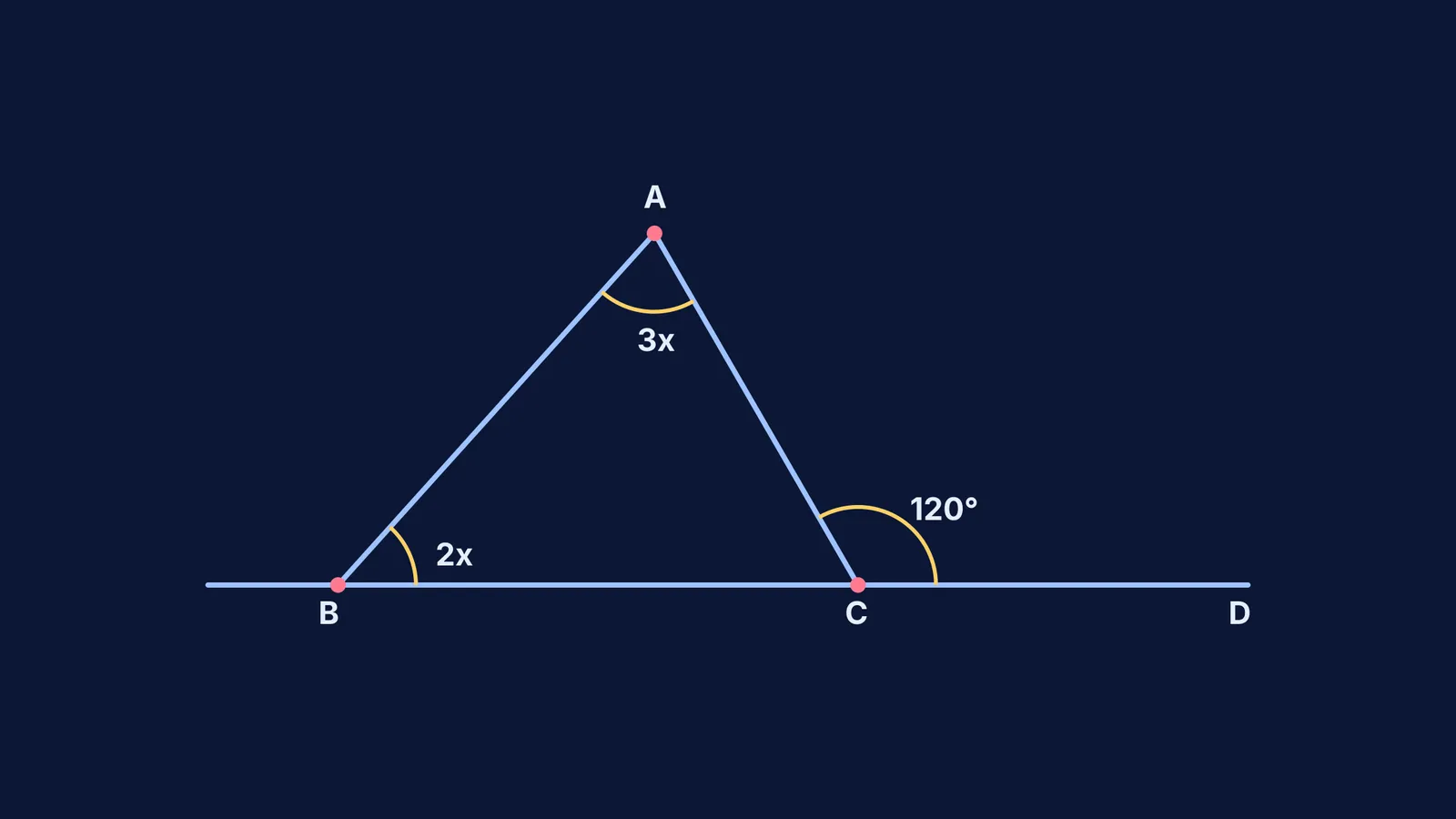
Imagine a triangle *ABC* where the side *BC* is extended to *D*. The interior angles are given as 2*x* and 3*x*, and the exterior angle at *C* is 120°.
Instead of freezing at the algebra, apply the exterior angle theorem directly: the exterior angle (120°) equals the sum of the two opposite interior angles (2*x* + 3*x*).
2*x* + 3*x* = 120°
5*x* = 120°
*x* = 24°
If the problem adds another triangle attached to side *AC*, they just take the newly found angles (48° and 72°) and keep walking across the diagram. Much like working through a Pythagoras theorem visual proof, rearranging the known pieces reveals the missing ones.
Using an AI tutor for angle chasing
Sometimes, a diagram has so many intersecting lines that neither you nor your child knows where to start.
This is where Fermi's AI tutor can help. Rather than just giving you the final value of *x*, the tutor holds a line of reasoning across a session and notices where a student is stuck. It will ask prompting questions—such as pointing out a hidden isosceles triangle or a linear pair—and build a plan for the session so your child learns the strategy, not just the answer.
If they just want to verify a specific textbook question, the Fermi Problem Library acts as a step-by-step solver that explains the reasoning rather than printing an answer.
By shifting the focus from "finding *x*" to "finding any angle", students turn a stressful algebra test into an active-learning puzzle.


