

On this page
Most of us learn a² + b² = c² as a formula to plug numbers into. A dissection proof shows you why it is true: you cut the shapes, slide them around, and watch the areas balance. Below is one proof to build, with a prediction before every check, then a test on triangles that are not right-angled.
What is the dissection proof of Pythagoras' theorem?
A dissection proof cuts shapes into pieces and rearranges them, so two areas are shown to be equal without any algebra beyond counting. The Cut the Knot collection lists 118 approaches to proving the theorem, and several of them are rearrangements like the one below.
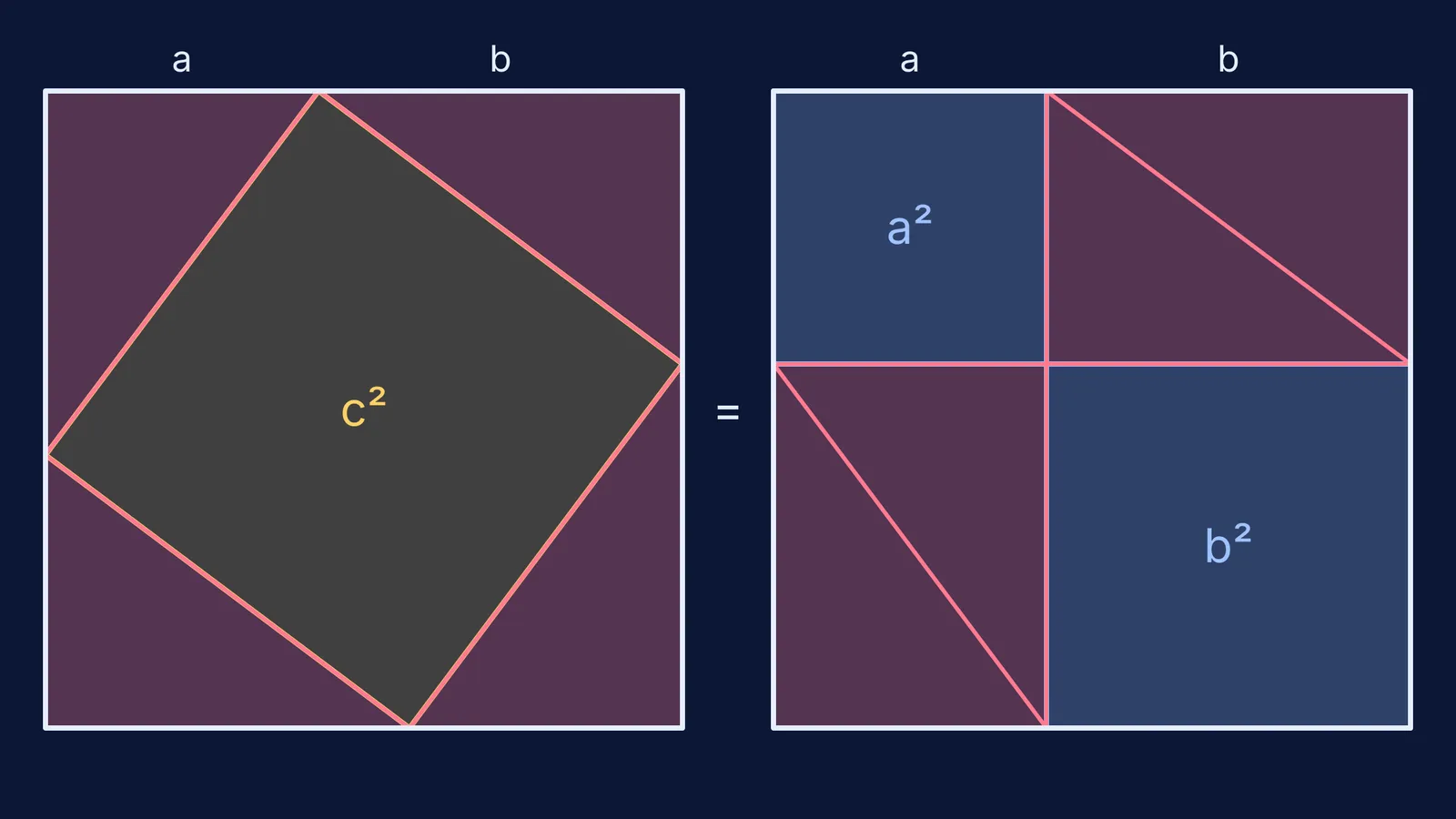
Take a right triangle with legs a and b and hypotenuse c. Make four identical copies. Now draw two large squares, each with side a + b.
Square 1: place the four triangles in the corners so their hypotenuses form a tilted square in the middle. The uncovered gap is a square of side c.
Square 2: pair the triangles into two rectangles, each a by b, and push them into opposite corners. The uncovered gaps are a square of side a and a square of side b.
Both big squares have the same area. Both contain the same four triangles. So whatever is left over must be equal too: c² = a² + b².
The proof Euclid gives in Elements Book I, Proposition 47 splits the square on the hypotenuse into two parallelograms, each equal to a square on a leg. The same page notes that the Old Babylonians used the relationship around 1900 to 1600 BCE, long before Pythagoras. For more on that history, read our piece on who found the Pythagorean theorem.
How do you work through it by predicting first?
Learning researcher Garvin Brod examined predicting as a learning strategy in Psychonomic Bulletin & Review (2021). He points to initial evidence that predicting boosts surprise at unexpected answers, which sharpens attention to the correct answer and strengthens memory of it. So predict before each move.
Before rearranging: with a = 3 and b = 4, how much of each big square do the four triangles cover? (Each triangle is 6, so 24 out of 49.)
Before looking at Square 1: what area is left over? (49 minus 24 is 25, a 5 by 5 square.)
Before looking at Square 2: will the two leftover squares add up to the same 25? (9 plus 16 is 25.)
Change the triangle: make a = 1 and b = 6. Does the argument still work? (Yes: it never used the lengths, only the right angles.)
Explain the key step aloud: why must the middle shape in Square 1 be a square, not just a rhombus? (At each point on the edge, the triangle's two acute angles add up to 90°, so the angle left over is 90° too.)
Does a² + b² = c² work for triangles that are not right-angled?
No, and the way it fails tells you about the angle. Euclid stated the converse in Elements Book I, Proposition 48: if the square on one side equals the sum of the squares on the other two sides, the angle between those two sides is right.
When the angle is wider than 90°, the square on the opposite side is larger than the sum, as Euclid shows in Book II, Proposition 12. When the angle is smaller than 90°, that square is smaller than the sum, as in Book II, Proposition 13. These are geometric versions of what we now call the cosine rule.
Test it yourself. For each triangle, compare the square of the longest side with the sum of the squares of the other two:
3, 4, 5: 25 against 9 + 16 = 25. Equal, so right-angled.
4, 5, 6: 36 against 16 + 25 = 41. Smaller, so the largest angle is acute.
4, 5, 7: 49 against 16 + 25 = 41. Larger, so the largest angle is obtuse.
Try the dissection with a triangle whose corner is not 90°: it no longer fits the corners of the big square, so the four triangles cannot close up around a square gap. The proof breaks exactly where the right angle was used.
Why move the pieces instead of just reading the proof?
A static diagram shows the result. Moving the pieces shows the argument: what stays fixed (the triangles, the big square) and what changes (the gaps). Our post on simulations versus static diagrams looks at when each helps, and Euclid's Elements and how proof-based geometry began is a good next read.
The Fermi Simulation Lab has interactive simulations for ideas that are easier to see than to read, so you can test predictions instead of taking them on trust. If the cosine rule still feels shaky, the Fermi Concept Library gives each mathematics concept its own lesson.
Pick up four triangles, make one prediction, and see whether the areas agree.


