

On this page
In coordinate geometry, the simplest way to find the shape of a triangle is to measure its sides. By computing the three side lengths and comparing them, you can classify the triangle without drawing it.
How do you prove a triangle is isosceles using coordinates?
To prove that a triangle is isosceles, you must show that at least two of its sides have equal length.
First, use the distance formula to calculate the length of all three sides. The Euclidean distance d between any two points (x₁, y₁) and (x₂, y₂) is given by d = √((x₂ − x₁)² + (y₂ − y₁)²).
Calculate the distances AB, BC and AC. If exactly two distances are the same, the triangle is an isosceles triangle. If all three are the same, it is equilateral (which is a special case of isosceles). If all three are different, the triangle is scalene.
How do you prove a triangle is right-angled using coordinates?
To prove that a triangle contains a 90-degree angle, you apply the converse of the Pythagorean theorem.
Find the lengths of the three sides using the distance formula.
Square each of the three lengths.
Identify the largest square.
Check if the sum of the two smaller squares equals the largest square.
If a² + b² = c², where c is the longest side, then the triangle is a right-angled triangle, and the right angle is opposite side c.
What happens if the points do not form a triangle?
Before classifying a triangle, you must be sure the three points actually form one. If three points lie on the same straight line, they are collinear, and they cannot form a triangle.
You can check for collinearity using the distance formula. For three points A, B and C, if the sum of the lengths of the two shorter segments equals the length of the longest segment (for example, AB + BC = AC), then the points are collinear. If you are already checking lengths, it takes only a moment to verify that the longest side is strictly less than the sum of the other two sides. This is known as the triangle inequality.
Common mistakes when using the distance formula
It is easy to make simple arithmetic errors that lead to the wrong classification:
Sign errors with negative coordinates: When one of the coordinates is negative, subtracting it in the formula means subtracting a negative number, which becomes an addition. For example, if x₂ is 4 and x₁ is −2, the term (x₂ − x₁)² becomes (4 − (−2))² = (4 + 2)² = 36.
Forgetting to square the differences: A common mistake is adding the differences before squaring them. Always evaluate the brackets first, square each result, and then add the squares.
Worked example: Isosceles right-angled triangle
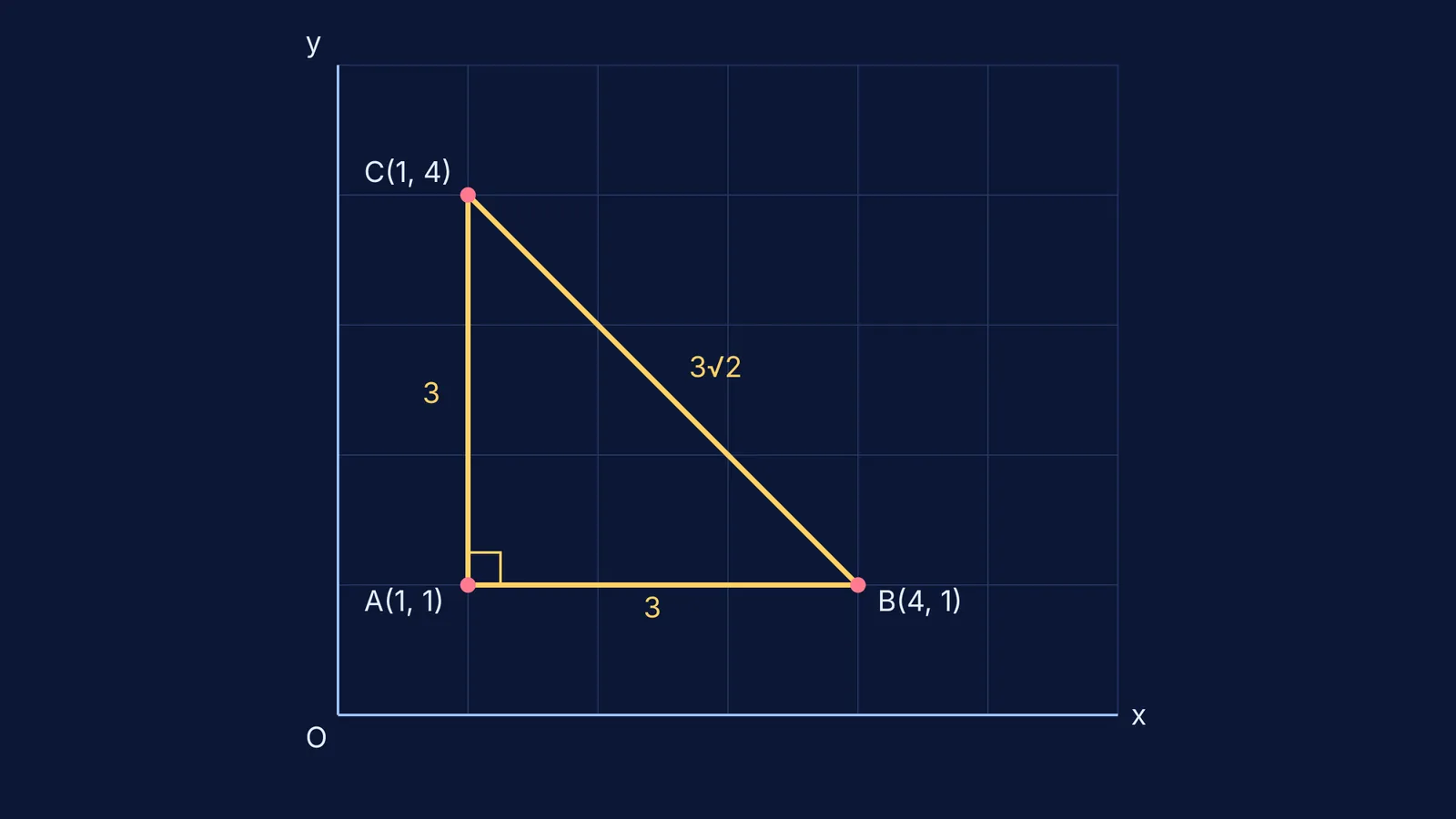
Consider a triangle with vertices at A(1, 1), B(4, 1) and C(1, 4). Let us classify it.
First, find the squared lengths of the three sides:
AB² = (4 − 1)² + (1 − 1)² = 3² + 0 = 9
AC² = (1 − 1)² + (4 − 1)² = 0 + 3² = 9
BC² = (1 − 4)² + (4 − 1)² = (−3)² + 3² = 9 + 9 = 18
Now, look at the lengths:
AB = 3
AC = 3
BC = √18 = 3√2
Since AB and AC are equal (both are 3), the triangle is isosceles.
Next, test for a right angle using the squares:
The two smaller squares are AB² = 9 and AC² = 9.
Their sum is 9 + 9 = 18.
The largest square is BC² = 18.
Since AB² + AC² = BC², the triangle satisfies the Pythagorean theorem. Therefore, it is an isosceles right-angled triangle.
How Fermi's AI tutor helps with coordinate geometry
Coordinate geometry combines algebra with shapes, which can make it hard to spot where a calculation went wrong. If you are practising tests like finding the area of a triangle using determinants or the section formula in 3D, a dropped negative sign can derail the whole proof.
When you have concept gaps in coordinate geometry, the Fermi Concept Library breaks down the proofs and formulas step by step. If you get stuck on a specific problem, Fermi's AI tutor works out what you already know and builds a plan for the session, guiding you through the distance formula and the Pythagorean test without just printing the final answer.


