On this page
The paper lands on your desk and you are already thinking about question 1. Stop for thirty seconds. A wrong subject, a missing page or a code that does not match your answer sheet can happen, and the first minutes decide whether it is fixed quietly or turns into a problem you have to argue about for weeks. The rule: check before you write, and if something is wrong, tell the invigilator at once.
What should you check the moment the question paper reaches you?
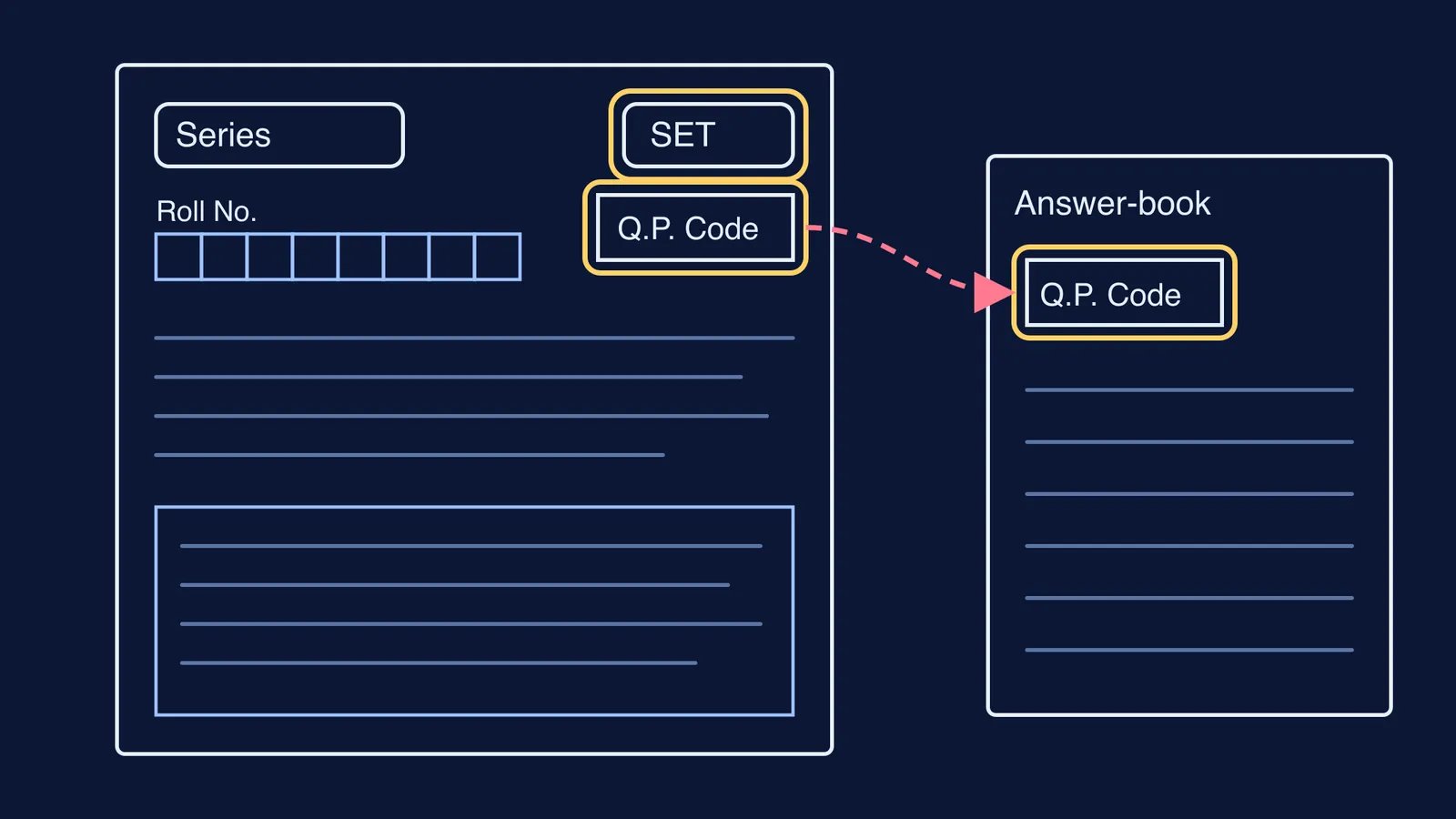
The cover of a real CBSE board paper tells you what to check. On a 2025 CBSE Class 12 question paper, the top of the cover shows the Series, the SET number and the Q.P. Code, with a box that says candidates must write the Q.P. Code on the title page of the answer-book. The NOTE below it asks you to check that the paper contains the stated number of printed pages and the stated number of questions. On that paper, 15 minutes are set aside to read the question paper, and no answers may be written during that time.
That reading time is your checking time. Use the first minute of it for this list:
Subject name on the cover matches today's exam on your admit card.
Q.P. Code and SET are printed clearly; write the Q.P. Code on your answer-book's title page.
Count the pages against the number printed in the NOTE.
Check the last question number against the question count in the NOTE.
Flip through for blank, smudged, repeated or out-of-order pages.
For OMR exams such as NEET-UG, check that the code on the test booklet is the same as the code on the answer sheet.
If you want the full habit for the rest of the cover, our post on reading the instructions on a question paper in 60 seconds walks through it.
Got the wrong question paper in the exam hall: what do you do?
Do not start writing, and do not try to fix it yourself by swapping with a neighbour or writing a corrected code. Raise your hand, keep the paper face up on your desk, and wait for the invigilator to come to you.
Change the middle sentence to fit what you found: "page 9 is missing", "pages 5 to 8 are printed twice", or "the booklet code and the answer sheet code are different". Be specific, show the page or the code, and stay polite. A clear sentence gets a faster fix than a worried one.
While you wait, note the time on the wall clock. If the replacement takes several minutes, ask calmly whether the delay can be noted. Then put it behind you and start from the first question you are sure of.
What if the invigilator does not fix it?
The 2021 NEET-UG test booklet was clear on this point. As quoted in a court report on a 2021 NEET-UG case, it said that if the code on the answer sheet differs from the booklet, the candidate should immediately report it to the invigilator for replacement of both the test booklet and the answer sheet.
The same report describes two candidates who were given mismatched booklet and answer-sheet codes, reported it to the invigilator, and were not given replacements. The Bombay High Court ordered a fresh exam for them; on 28 October 2021 the Supreme Court stayed that order so results could be declared, and said the two students' grievance would be taken up when the court reopened.
So if your problem is not resolved in the room:
Ask politely to speak to the centre superintendent.
After the exam, write down the room number, the time, the codes on your paper and answer sheet, and what you were told.
The same day, a parent or guardian should write to the board or the NTA through the contact details on its official website, attaching those notes and a copy of the admit card.
Is getting a different set from your friend a wrong paper?
No. Boards print several sets of the same paper on purpose, so the person next to you may have a different set with the same subject code. That is normal; our explainer on why board exams have multiple sets covers why. A wrong paper is a different subject or Q.P. code, missing or repeated pages, or a booklet and answer sheet that do not match.
Also keep the rest of your desk clean of anything that could raise questions while you wait; see what is allowed in the exam hall.
How do you practise this before the real exam?
Make the cover check part of every mock paper. Before you start the timer, spend one minute on the six checks above, then write the code on your answer sheet. By exam day it will feel as automatic as writing your roll number.
When you review a mock afterwards, the Fermi Problem Library has worked problems with a step-by-step solver that explains the reasoning, which helps you see whether a lost mark came from the method or from rushing.