

On this page
Every spring outside secondary school exam halls across India, the scene follows a predictable script. Within minutes of the final bell, students gather at the gates, swapping question papers. Inevitably, someone glances at a classmate's paper and gasps: Set 3 looked effortless, while Set 1 felt impossibly tough.
That panic feels real, but it misinterprets how standardized exams work. When you receive a specific question paper code, you are not taking an unfair test. You are working through a calibrated permutation designed to safeguard exam security while holding academic standards constant.
Why are there different sets in board exam papers?
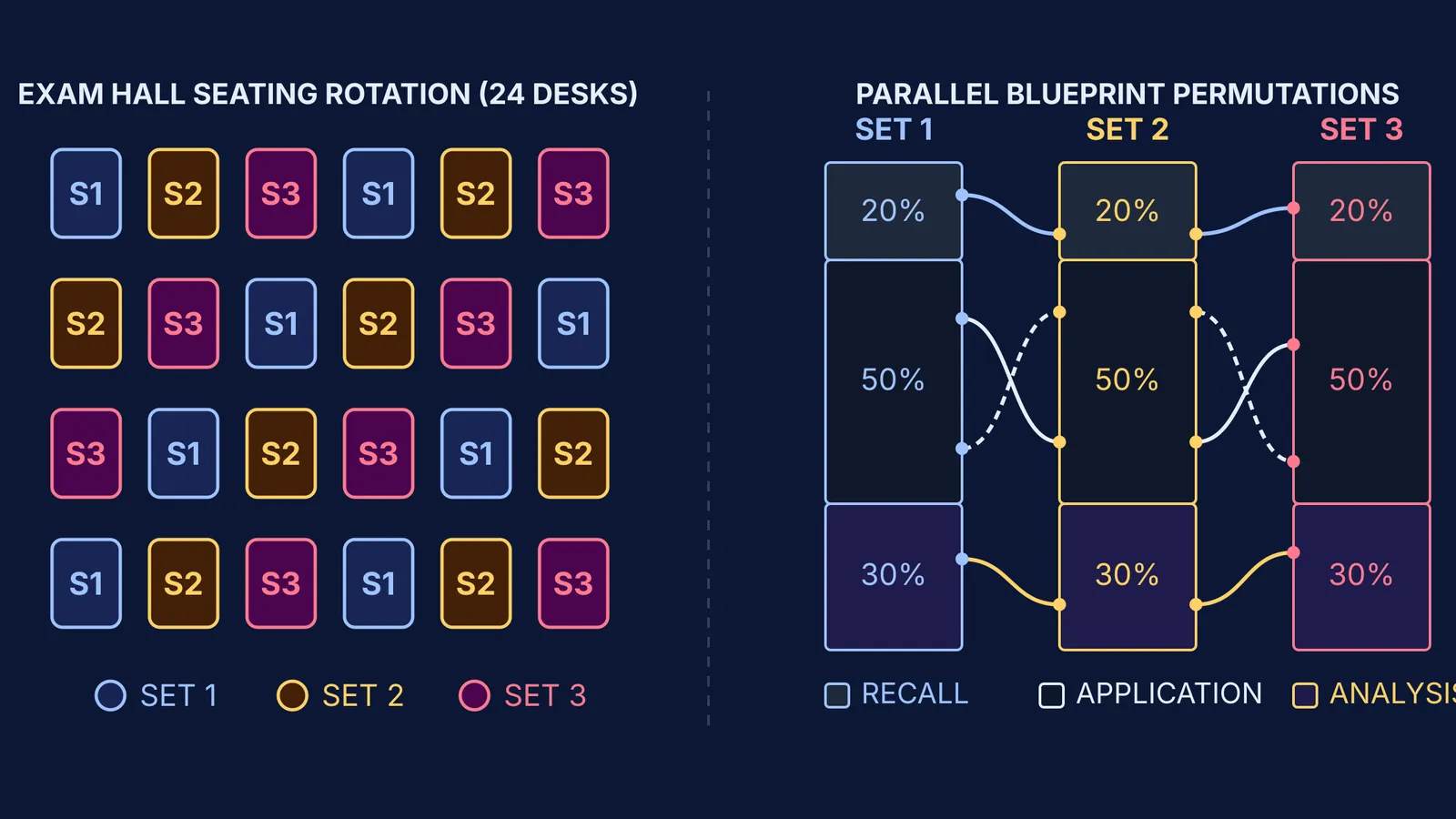
The primary reason examination boards like CBSE issue three or four question paper sets is exam security. Under standard administration protocols outlined in CBSE examination guidelines, examination rooms accommodate 24 candidates seated in close rows. If every student received an identical question paper, maintaining academic integrity would require intrusive policing.
To eliminate line-of-sight copying, invigilators distribute question papers in strict rotation—Set 1, Set 2, Set 3, Set 1—across rows and aisles. This guarantees that no student shares a code with an immediate neighbour. A student cannot glance across to copy Question 5, because Question 5 on their desk corresponds to a different problem or section on their neighbour's sheet. Multiple sets eliminate casual copying without altering the curriculum content tested.
How are different question paper sets constructed?
A common worry among students and parents is that one set is secretly harder than another. However, official examination bye-laws require paper setters to build every set from an identical blueprint.
Under CBSE question paper blueprints, all sets must follow the identical assessment structure and cognitive balance: roughly 20% recall and objective questions, 50% application and competency-based questions, and 30% analytical short or long constructed responses. To maintain parity, boards use three mechanisms:
Order shuffling: Between 70% and 90% of questions are identical across sets in a region, but their numerical sequence is scrambled.
Parameter variation: In mathematics and physics, parallel questions test the same formula using different numerical values.
Option permutation: Multiple-choice items keep identical questions while rearranging answer choices (A, B, C, D).
If unintended discrepancies in difficulty or question errors occur, post-exam moderation policies adjust mean scores across sets. Furthermore, studying official CBSE marking schemes shows that marks are awarded for underlying steps and value points rather than question positions.
Why does your friend's set always look easier?
If paper sets share matched difficulty, why do students convince themselves that friends had an easier time? The answer lies in cognitive psychology.
First, question order distorts perceived difficulty. In *Memory & Cognition*, Yana Weinstein and Henry L. Roediger III (2012) showed that item sequence strongly biases students' subjective evaluations of their performance without changing their actual test scores. Encountering tough problems early anchors students into believing the entire paper was unusually harsh. A classmate meeting those same questions near the end perceives the paper as manageable. Adopting a structured exam hall time management strategy prevents early bottlenecks from setting a pessimistic anchor.
Second, memory relies on the availability heuristic documented by Amos Tversky and Daniel Kahneman (1973)90033-9). For your own paper, every minute of friction and hesitation remains vivid. When scanning a friend's paper outside the hall without time pressure, you notice only the questions you know how to solve, creating the illusion of an easier test.
Finally, post-exam discussions drive upward social comparison, a concept from Leon Festinger's (1954) social comparison theory. Comparing unverified answers with peers amplifies vocal, confident classmates and fuels unproductive rumination. Learning principles for navigating comparison without losing motivation protects focus during exam season.
For students wanting to build problem-solving confidence across varied question formats, the Fermi Problem Library provides worked problems with a step-by-step solver that explains the reasoning rather than printing an answer. Reviewing core ideas in the Fermi Concept Library gives you a clear lesson for every concept in mathematics and science, helping ensure numerical variations never rattle your preparation.
What should students and parents do after the exam?
Conducting an exam post-mortem at the gate changes no marks while sapping energy for the next paper. Use this practical post-exam routine instead:
Enforce a strict gate boundary:
Pack your question paper into your bag immediately after leaving the hall.
Avoid congregating at school gates or messaging groups to cross-check unofficial answer keys.
Use a supportive debrief script:
Parents should replace *"Was your set hard?"* with *"The paper is finished. How is your energy, and what would you like to eat?"*
Focus on effort and closure rather than speculative cut-offs.
Take a calm reset:
Rest, eat, or exercise before opening books for the next subject.
If academic stress feels overwhelming, the national Tele MANAS service (toll-free helpline 14416) offers free, confidential psychological support.
Board exam sets exist to protect fairness. Once you hand in your sheet, your attention belongs on the next paper.


