

On this page
Many lost marks have nothing to do with hard questions. They go on time spent on both parts of an internal choice, or on guessing at a question you thought carried no penalty. The general instructions at the top of a paper are the rules for how it is scored, and they take about a minute to read.
Why should you read the instructions on the question paper?
Because the rules change, and the paper in front of you is the only version that counts that day.
The CBSE Class 10 Science sample paper for 2025-26 has 39 questions in 3 sections, and the sections follow subjects: Section A is Biology, Section B is Chemistry and Section C is Physics. The 2024-25 Science sample paper was split differently, into Sections A to E by question type.
Entrance exams change too. The JEE (Main) 2027 Information Bulletin from NTA says Paper 1 will have negative marking for wrong answers in both Section A (multiple choice) and Section B (numerical value). Under that bulletin, a wrong numerical answer costs 1 mark, the same as a wrong MCQ. If an older guide says otherwise, trust the current bulletin.
What do question paper instructions tell you?
Almost every set of general instructions covers four things:
Sections: how the paper is split and which question numbers belong to each part.
Choices: whether all questions are compulsory, and where you get an internal choice (answer one of two, not both).
Marks: what each question type is worth, and whether a wrong answer costs marks.
Rules: what you may use and how to write it, such as a value for pi, figures to draw or rounding.
The CBSE Class 10 Mathematics Standard sample paper shows all four on one page: 38 compulsory questions in Sections A to E, internal choices in 2 questions each of Sections B, C and D and in the 2-mark parts of Section E, pi taken as 22/7 unless a question says otherwise, and calculators not allowed.
What does a 60-second instruction scan look like?
Before you write anything, run six checks, about 10 seconds each:
Count. Total questions, marks and time. Check your paper really has that many questions.
Map. Which question numbers belong to which section, and what type each section is.
Choices. Circle every OR now, so you answer only one part later.
Marks. What each section is worth, and which question types carry negative marking.
Rules. Constants, units, rounding, figures, calculators, and which language version counts.
Plan. Pick your section order and write a finishing time for each section in the margin.
If your board gives reading time, this scan fits easily inside it. Our guide to using the 15 minutes of reading time in board exams covers the rest.
Worked example: what the Maths sample paper instructions add up to
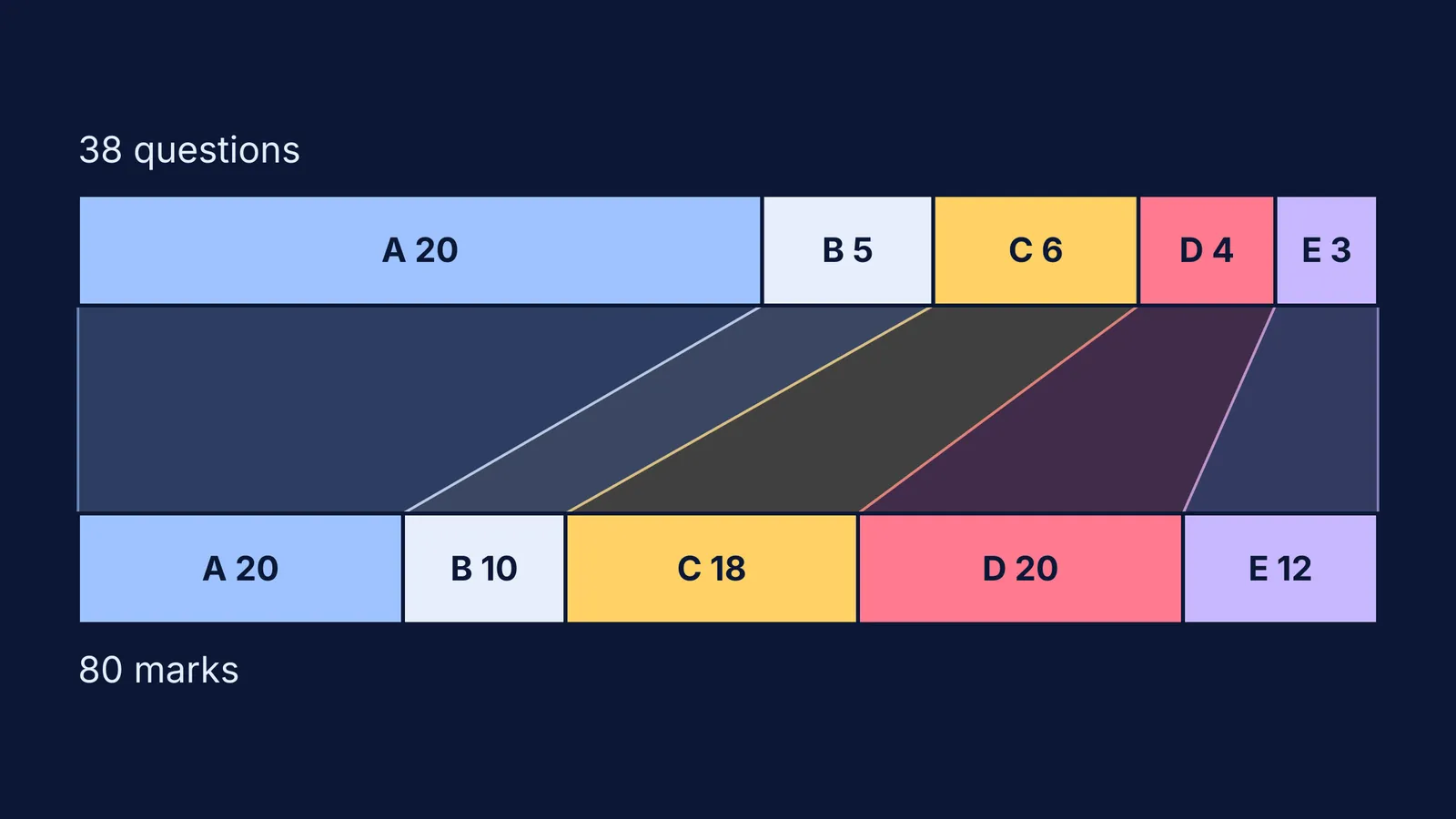
Here is what the Maths Standard sample paper's instructions tell you:
Section A: questions 1 to 20, 1 mark each, so 20 marks.
Section B: questions 21 to 25, 2 marks each, so 10 marks.
Section C: questions 26 to 31, 3 marks each, so 18 marks.
Section D: questions 32 to 35, 5 marks each, so 20 marks.
Section E: questions 36 to 38, case studies of 4 marks each, so 12 marks.
That is 80 marks in 3 hours. Section A has more than half the questions (20 of 38) but a quarter of the marks, while Section D's 4 questions are worth just as much. At 180 minutes for 80 marks, a fair budget is a little over 2 minutes per mark: about 11 minutes for each 5-mark long answer, with a few minutes left to check.
For the choices you circled, see how to choose between internal choice questions in 30 seconds.
What changes in a computer-based test like JEE Main?
On screen, the instructions also tell you how answers are saved. NTA's computer-based test guidelines, in Appendix III of the JEE (Main) 2027 bulletin, make three points worth practising:
Clicking a question number in the palette does not save your answer to the current question. You have to click Save & Next.
A question marked for review without an answer gets no mark. One that is answered and marked for review will be evaluated.
The timer runs on the server, and the exam ends by itself when it reaches zero.
JEE Advanced has its own rules for multiple-correct questions, explained in how partial marking works in JEE Advanced.
How do you make the scan a habit?
Run the six checks on every mock, not just on exam day. Afterwards, sort lost marks into slips (you knew it but missed something) and gaps (you did not know how). If the same slip keeps returning in physics or maths, the Fermi Problem Library has worked problems with a step-by-step solver that explains the reasoning rather than printing an answer, so you can see where your method went off.
Start with this week's mock: give the instructions their full 60 seconds before you look at question 1.


