

On this page
The multiple correct questions in JEE Advanced are notorious for destroying otherwise strong scores. Because the marking scheme heavily punishes incorrect guesses, these questions demand a completely different approach from the standard single-choice format.
Understanding exactly how the partial marking system evaluates your choices is the first step to turning these questions from a risk into a reliable source of points.
How does the JEE Advanced partial marking scheme work?
While the exact marking scheme can change slightly from year to year, the standard structure outlined on the official JEE Advanced website is designed to reward precision and punish guessing. For a question with four options where one or more may be correct, the scoring usually breaks down like this:
Full Marks (+4): Awarded only if you select all the correct options and no incorrect options.
Partial Marks (+3): Awarded if all four options are correct, but you choose only three of them.
Partial Marks (+2): Awarded if three or more options are correct, but you choose only two of them.
Partial Marks (+1): Awarded if two or more options are correct, but you choose only one of them.
Zero Marks (0): Awarded if you leave the question completely blank.
Negative Marks (-2): Awarded if you select any incorrect option, regardless of how many correct options you also picked.
The critical takeaway is the severe penalty. In a standard single-correct question, a wrong guess costs you -1 mark. In the multiple-correct section, a single wrong guess instantly drags your score down by -2 marks.
What is the best multiple correct strategy?
The most effective approach is to prioritise accuracy over completeness. You do not need to mark every correct option to benefit from the question; you simply need to avoid marking any incorrect ones.
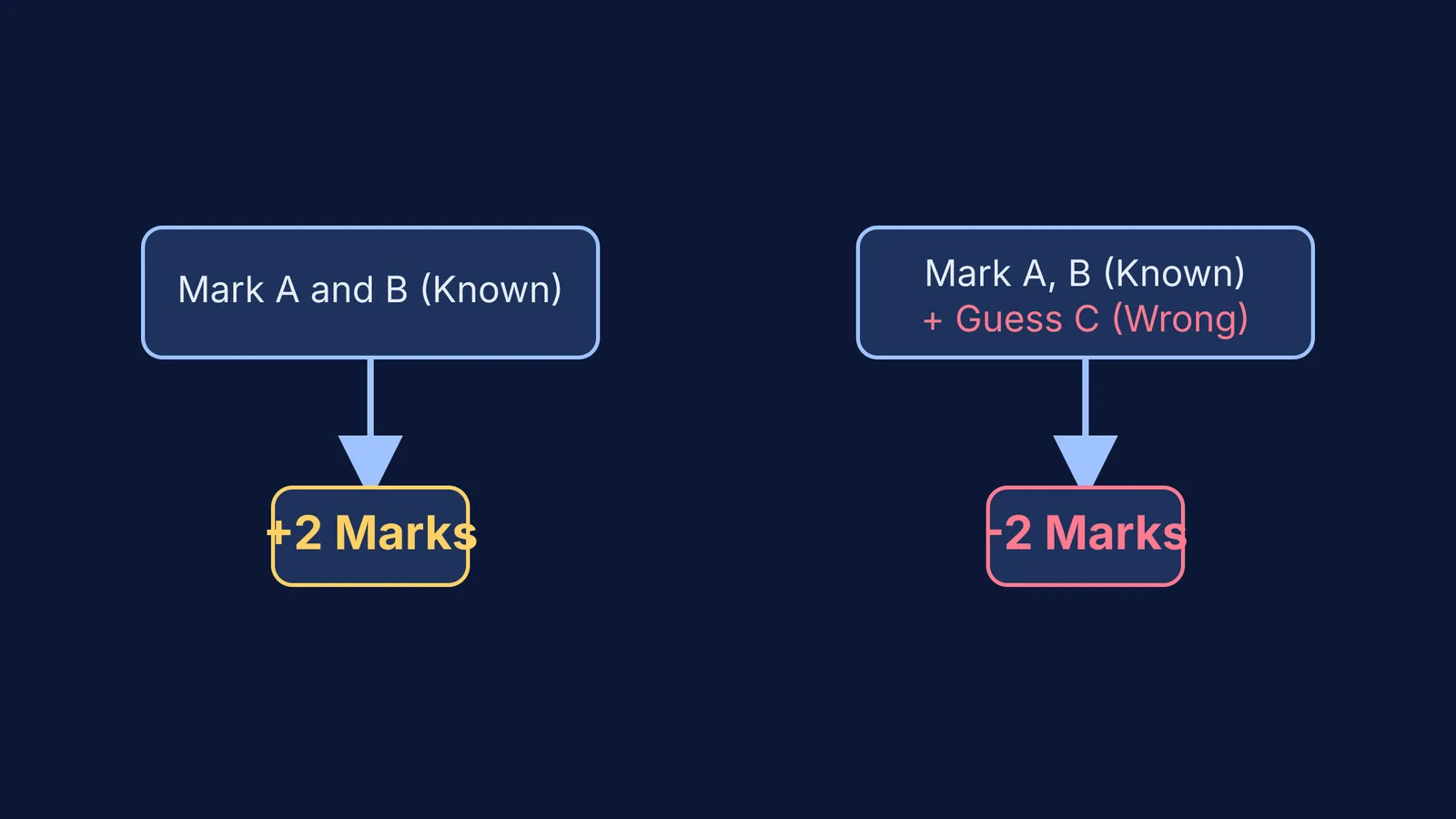
Consider a scenario where options A, B, and C are correct. You have worked through the physics and are entirely certain that A and B are right. However, you are unsure about option C.
If you mark only A and B, you receive a safe +2 marks, according to the official JEE Advanced marking rules. If you decide to guess C and it turns out to be wrong, you trigger the negative marking condition and receive -2 marks instead. That four-mark swing is enough to shift your rank by thousands of places.
If you are struggling to build confidence in your core concepts before the exam, Fermi's AI tutor can work out what you already know and build a plan for the session. But in the exam hall, the golden rule remains: never guess the final option.
Why does dimensional analysis help with multiple correct questions?
Many JEE Advanced multiple correct questions test several concepts at once. Before doing heavy calculations, you can check if any options can be eliminated using units and dimensions, or by testing extreme limiting cases (such as setting time to zero or distance to infinity).
This tactic is extremely effective because the options are often independent. If an option provides an algebraic expression for velocity, you can verify its dimensions first. If the dimensions do not match, you immediately know the statement is false and can safely avoid marking it. By eliminating the wrong answers early, you protect yourself from the harsh negative marking system.
How do mutually exclusive options work?
Sometimes, the examiners provide options that directly contradict each other. For example, option A might claim that a particle's final velocity is greater than 5 m/s, while option B claims it is less than 2 m/s.
If you can mathematically prove that one of these statements is true, you automatically know the other is false. Recognising mutually exclusive pairs reduces the number of options you need to solve from scratch. This saves you valuable exam time and minimises the risk of making an error that could trigger a penalty.
When should you leave an option blank?
Leaving an option blank is a strategic choice, not a failure. You should only attempt to mark all the options if you have derived the final expression yourself and it matches the choices perfectly, or if the options are mathematically dependent on one another.
To help you decide during a test, use this decision framework based on the JEE Advanced marking rules:
100% sure of one option: Mark it and take the +1 mark.
100% sure of two options: Mark both and take the +2 marks.
100% sure of two, but unsure of the third: Mark only the two you know.
Guessing completely: Leave the question blank for 0 marks.
Applying this discipline during your preparation is vital. For extra practice in tackling complex, multi-step scenarios without relying on guesses, you can try the Fermi Problem Library, which provides worked problems with a step-by-step solver that explains the reasoning rather than printing an answer.
For more advice on evaluating your performance, read our guide on How to analyse a mock test: a 60-minute review routine, or explore ways to improve by Using your mock test data: accuracy, time and what to fix next.


