

On this page
You reach a 5-mark question and see two options with OR between them. Spend three minutes deciding and you lose time; pick on mood and you can get stuck halfway. Here is a 30-second routine you can use in any subject.
What is an internal choice in a CBSE paper?
An internal choice is a question printed with two alternatives, where you answer only one. The CBSE Class 12 Mathematics sample question paper for 2026-27 says there is no overall choice, but "an internal choice has been provided in 2 questions in Section B, 3 questions in Section C, 2 questions in Section D and one sub-part each in 2 questions of Section E". The Class 10 Science sample paper for the same year says a student "is expected to attempt only one of the alternatives in these questions".
Both papers note that the question paper design is unchanged for 2026-27. Check the sample paper for your own subject on the CBSE Academic sample paper page, because the number of choices differs by subject.
How do you choose between two OR questions quickly?
Both options carry equal marks, so ask which one you can finish, or get furthest in. Run three checks, about ten seconds each.
Parts. Count what each option asks you to produce: a figure, a proof, a value, an "also find". Every extra deliverable is one more place to stall.
Marks per step. The CBSE marking scheme gives marks for steps, so ask which steps you can definitely earn even if the final answer slips. A figure, a formula or a correct set-up often carries a mark of its own.
Confidence, tested. Write the first line of each option in your head, then name the method for the hardest step. If you can do both for one option, take it.
Then commit. Write the question number and the letter clearly, for example Q34 (B), and do not switch unless you are truly blocked.
Worked example: Q34 from the 2026-27 maths sample paper
Q34 in the 2026-27 Class 12 maths sample paper is a 5-mark area question with two options.
(A) Using integration, find the area of the region where 0 ≤ y ≤ √(4 − x²) and x ≥ 2 − y.
(B) Using integration, find the area bounded by y² = 2x and the line x − 2y = 0.
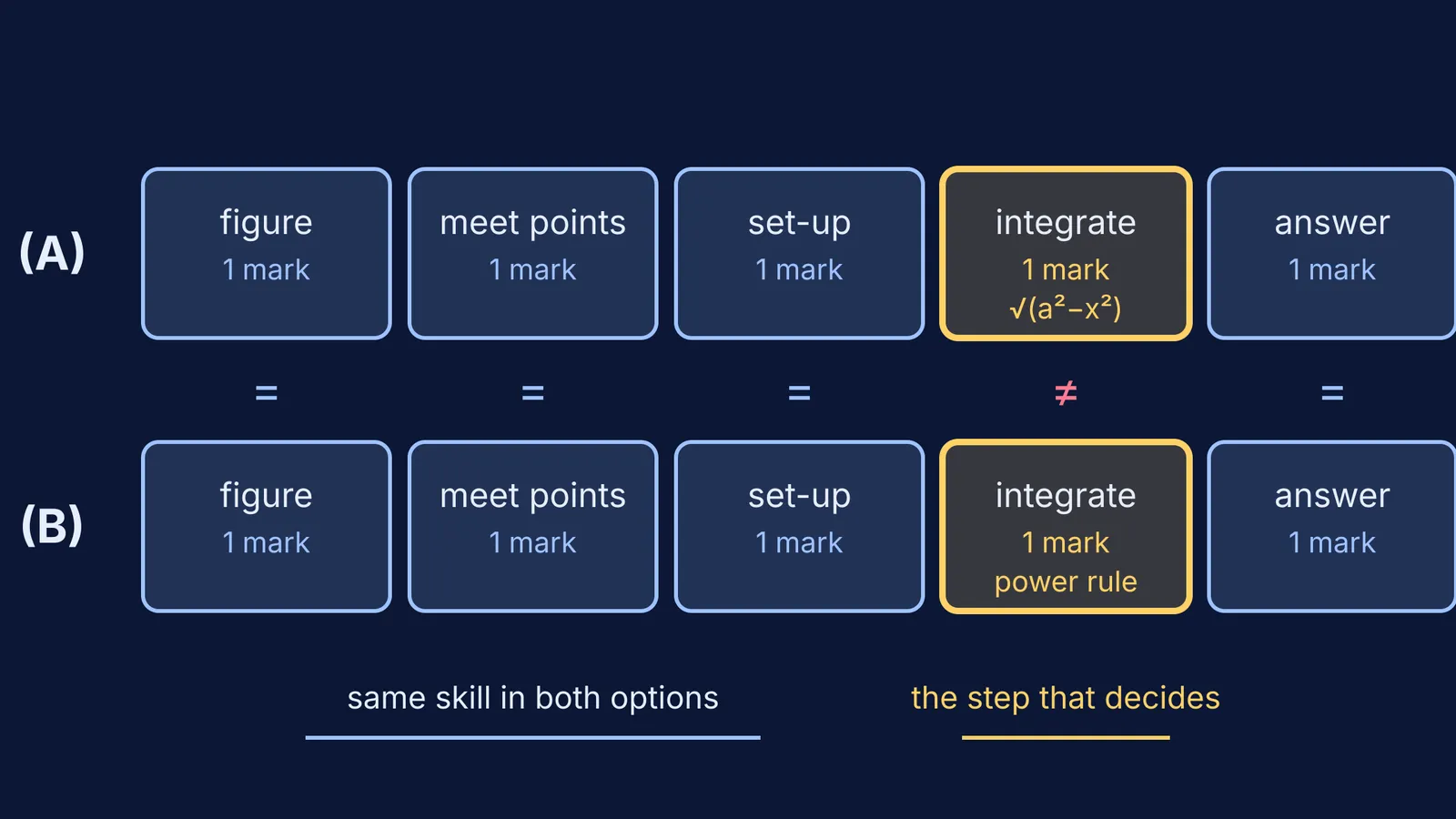
Parts: both need a figure, the points where the curves meet, an integral and a final value. A tie.
Marks per step: the official marking scheme gives 1 mark for the correct figure in each option, and splits the rest into 1-mark steps for the intersection points, the integral set-up, the integration and the answer. In (A) the curves meet at (0, 2) and (2, 0); in (B) at (0, 0) and (8, 4). Only one step really differs: (A) needs the standard result for the integral of √(a² − x²) and ends at π − 2, while (B) needs only the power rule and ends at 16/3.
Confidence: if you know the √(a² − x²) formula cold, either option works. If you hesitate over it, take (B), because its hardest step is a simple power integral and the first three steps carry the same marks either way.
Why shouldn't you trust your gut about which option is easier?
A question that looks familiar is not always one you can finish. A 2023 study in the Journal of Intelligence by Karaca and colleagues notes that students often overpredict their exam results. In two studies of grade predictions before four in-class exams, low-performing students' miscalibration and confidence stayed stable from exam to exam. Grade predictions are not question choices, but feeling sure is not evidence. That is why the third check asks you to write a first line rather than rely on a feeling. See why students misjudge their own learning.
How do you practise choosing before the board exam?
In each sample paper, solve both options of every OR question at home, with a timer, and note which option you would have picked.
Compare your working with the marking scheme to see where the step marks sit. Our guide to using CBSE marking schemes to write answers that earn the marks walks through this.
Keep a short list of your shaky formulas. If an option leans on one, that is your signal to take the other.
Leave a few minutes at the end to check your answers in the last 10 minutes.
When you get stuck on one option during practice, the Fermi Problem Library has worked problems with a step-by-step solver that explains the reasoning rather than printing an answer, so you can see which step you were missing. If the trouble is a concept rather than a step, such as why that integral formula holds, the Fermi Concept Library covers every concept in physics, chemistry, biology, mathematics and computing, each with its own lesson.
Next time you see OR, give it 30 seconds: parts, steps, first line. Then start writing.


