On this page
Add any positive number to its reciprocal and you never get less than 2. Try it: 4 + 1/4 = 4.25, 0.5 + 2 = 2.5, 1 + 1 = 2. This small fact turns up in JEE inequality questions, in trigonometry (tan θ + cot θ) and in minimum-value problems, so it is worth knowing two clean proofs and the one place students slip.
How do you prove x + 1/x ≥ 2 using AM-GM?
The AM-GM inequality says that for non-negative numbers a and b, (a + b)/2 ≥ √(ab), with equality exactly when a = b (Wikipedia: Inequality of arithmetic and geometric means).
Take x > 0 and put a = x, b = 1/x. Both are positive, so:
(x + 1/x)/2 ≥ √(x · 1/x)
The product x · 1/x is 1, so the right side is √1 = 1.
Multiply by 2: x + 1/x ≥ 2.
Equality needs a = b, that is x = 1/x, so x² = 1. Since x is positive, x = 1. The trick works because the product of the two terms is a constant; that is the thing to look for whenever you reach for AM-GM. For more practice, see our guide to using AM-GM in JEE problems.
How do you prove it with (√x − 1/√x)² ≥ 0?
This proof needs nothing but the fact that a real number squared is never negative. The same idea proves the two-number AM-GM inequality itself: expanding (x − y)² ≥ 0 gives (x + y)² ≥ 4xy (Wikipedia).
For x > 0, √x is a real number, so:
(√x − 1/√x)² ≥ 0
Expand: x − 2 · √x · (1/√x) + 1/x ≥ 0
The middle term is 2, so x − 2 + 1/x ≥ 0
Rearrange: x + 1/x ≥ 2.
The square is zero only when √x = 1/√x, which again gives x = 1. A third route: start from (x − 1)² ≥ 0, so x² + 1 ≥ 2x, then divide by x. That last step is only safe because x is positive; dividing by a negative number flips the sign, as our post on when an inequality sign flips explains.
What happens when x is negative?
Both proofs above needed x > 0: AM-GM needs non-negative numbers, and √x is not real for negative x. So the statement "x + 1/x ≥ 2 for all x" is false. Check x = −2: you get −2 − 0.5 = −2.5.
The fix takes one line. If x < 0, write x = −t with t > 0. Then x + 1/x = −(t + 1/t), and since t + 1/t ≥ 2, we get x + 1/x ≤ −2, with equality at x = −1.
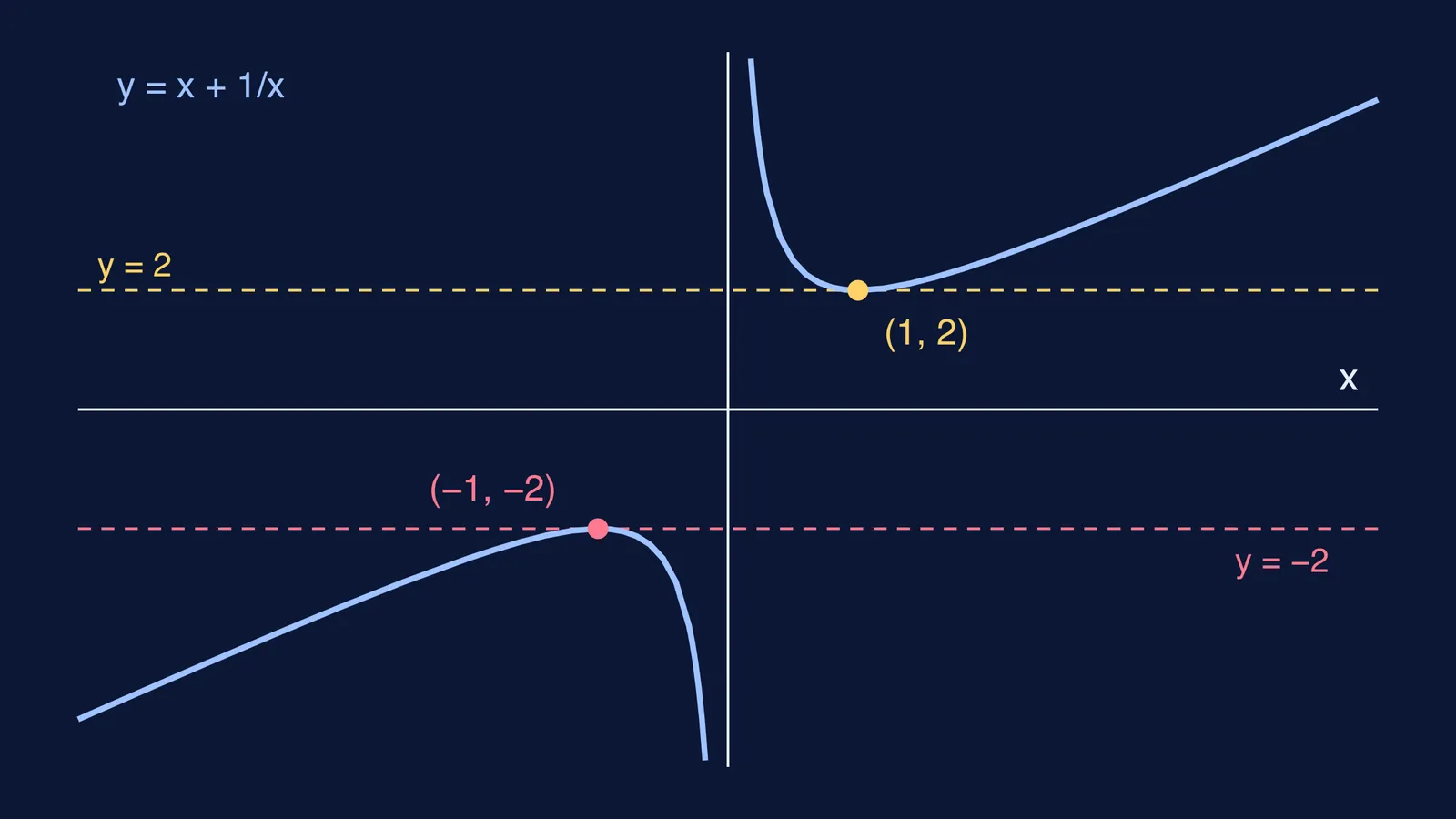
Put the two cases together and x + 1/x can take any value of 2 or more, or −2 or less, but never anything strictly between −2 and 2. The graph at the top of this post shows this: the right branch sits on or above the line y = 2 and touches it at (1, 2); the left branch sits on or below y = −2 and touches it at (−1, −2).
A three-question check before you use AM-GM
A common way to lose marks on these questions is to apply the result where it does not hold. Before writing "≥ 2", ask:
Are both terms positive? If x can be negative, split into cases as above.
Is the product of the terms a constant? For x + 1/x it is 1. For 4x + 9/x it is 36.
Can equality actually happen in the allowed range? If not, the bound is true but it is not the minimum.
Here is the check at work on three questions.
Minimum of 4x + 9/x for x > 0. Both positive, product 36, so 4x + 9/x ≥ 2√36 = 12. Equality when 4x = 9/x, so x = 3/2. Check: 6 + 6 = 12. Minimum is 12.
tan θ + cot θ for 0 < θ < 90°. Both positive and tan θ · cot θ = 1, so the sum is at least 2, reached at θ = 45°.
Minimum of x + 1/x for x ≥ 3. Question 3 fails: x = 1 is not allowed, so 2 is not reached. On this range the function is increasing (the graph rises to the right of x = 1), so the minimum is at x = 3: 3 + 1/3 = 10/3.
If you want more questions like these, the Fermi Problem Library has a step-by-step solver that explains the reasoning, so you can see where each condition gets checked rather than just the final number. For the wider picture, try this visual proof of the AM-GM inequality, then come back and prove 4x + 9/x ≥ 12 without looking.