

On this page
You have probably proved that (a + b)/2 ≥ √ab with algebra. The picture version is shorter, and it shows what the algebra hides: how far apart the two means are, and why they meet only when the numbers are equal.
What does the AM-GM inequality say?
For two positive numbers a and b, the arithmetic mean (a + b)/2 is always at least the geometric mean √ab, and the two are equal if and only if a = b (AM–GM inequality, Wikipedia).
How does a semicircle prove AM ≥ GM?
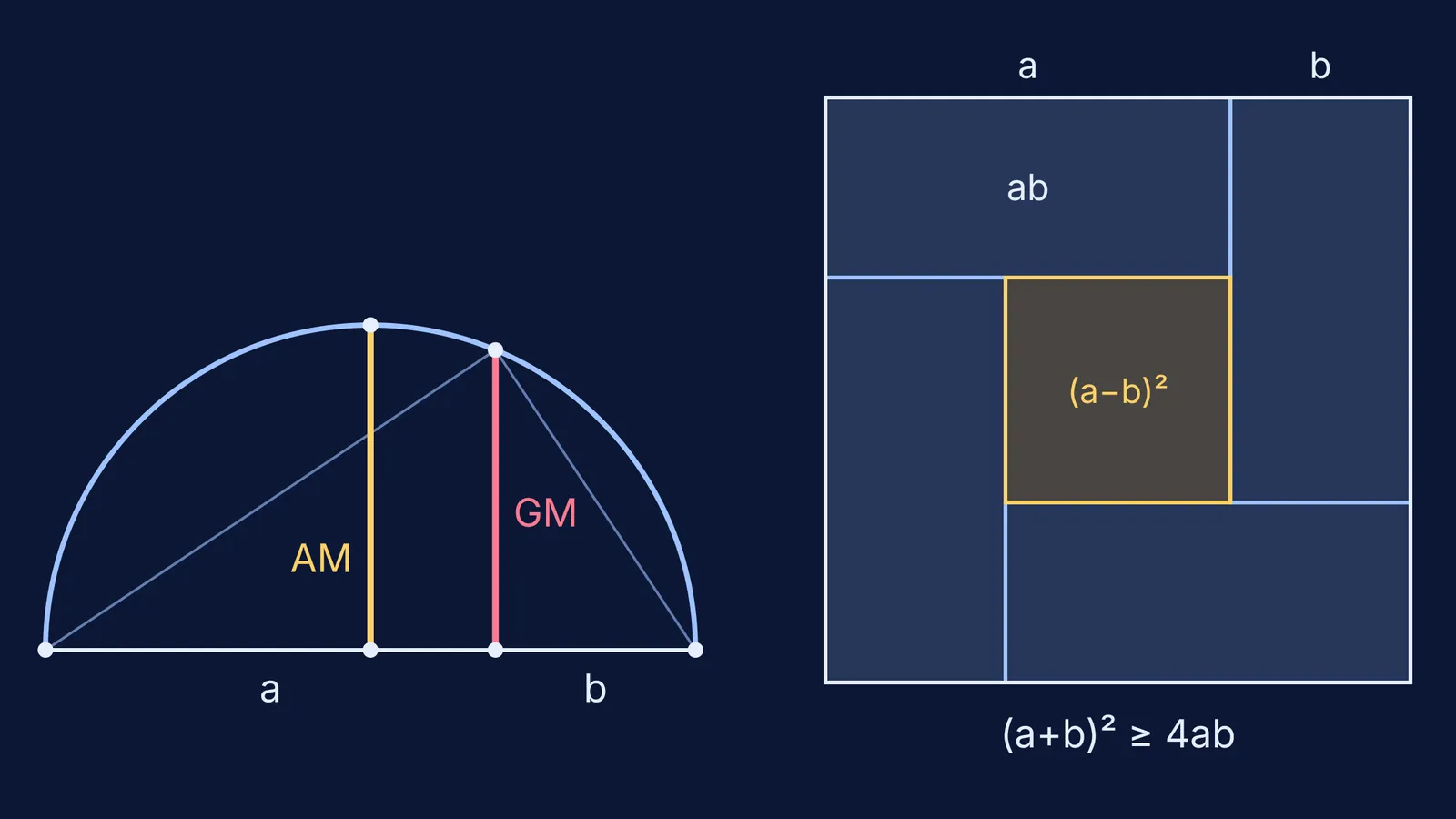
Draw a segment of length a, and right after it a segment of length b, so the whole diameter is a + b. Draw a semicircle on it. At the point where a meets b, draw a perpendicular up to the curve.
Two lengths now stand side by side:
The radius is half the diameter, so it equals (a + b)/2, the arithmetic mean.
The perpendicular equals √ab, the geometric mean. In a right triangle, the altitude to the hypotenuse is √(pq), where p and q are the two pieces it cuts the hypotenuse into (geometric mean theorem). The triangle here is right-angled because any angle in a semicircle is 90°.
Euclid gave this construction in Elements Book VI, Proposition 13, "to find a mean proportional to two given straight lines" (Euclid's Elements VI.13, D. E. Joyce's edition).
Now the proof is one glance: no perpendicular from the diameter to the curve can be taller than the radius at the centre. So GM ≤ AM. The perpendicular reaches the full radius only when it stands at the centre, which means a = b.
How do four rectangles inside a square show the same thing?
Make four copies of an a × b rectangle and arrange them in a pinwheel inside a square of side a + b, one in each corner. They leave a square hole in the middle with side a − b (taking a > b).
Now count areas:
The big square has area (a + b)².
The four rectangles have area 4ab.
The hole has area (a − b)², which can never be negative.
So (a + b)² = 4ab + (a − b)² ≥ 4ab. Take square roots and divide by 2 to get (a + b)/2 ≥ √ab, the same step the AM–GM article takes after its visual proof that (x + y)² ≥ 4xy. The hole shrinks to nothing exactly when a = b: the equality case again.
When are the arithmetic and geometric means equal?
Before you calculate, picture where the join sits on the diameter, predict whether the means will be close, then check.
a = 9, b = 4: the join is near the centre, so expect close values. AM = 6.5, GM = 6.
a = 16, b = 1: the join is near the edge, so the perpendicular is short. AM = 8.5, GM = 4.
a = 5, b = 5: the join is the centre. AM = GM = 5.
a = 100, b = 0.01: AM is just over 50, but GM is 1. When one number is tiny, the GM collapses.
The rule: the means are equal only when the numbers are, and drift apart as the numbers do. For ideas easier to see than to read, try the interactive simulations in the Fermi Simulation Lab.
How do you use AM-GM to find a maximum area?
Read the inequality the other way round: if a + b is fixed, ab can never exceed ((a + b)/2)², and the largest product comes when a = b.
Worked example 1. You have 40 m of fencing for a rectangular garden. With sides x and y, 2x + 2y = 40, so x + y = 20. Then xy ≤ (20/2)² = 100. The maximum area is 100 m², from a 10 m × 10 m square.
Worked example 2. Now one side lies along a wall, so you fence only three sides: x + 2y = 40, with x along the wall. Apply AM-GM to the two parts that add to a constant, x and 2y: (x + 2y)/2 ≥ √(2xy), so 20 ≥ √(2xy). That gives 2xy ≤ 400, so xy ≤ 200. Equality needs x = 2y, so y = 10 m, x = 20 m, and the maximum area is 200 m². It is not a square, because the terms you made equal were x and 2y.
Before you use AM-GM for a maximum, check three things:
Every term is positive.
The terms add to a constant (rewrite them until they do).
The equality case can actually happen within the problem's limits.
If the third check fails, the bound is true but never reached, and you need another method. For exam-style setups, read the AM-GM inequality in JEE maths; for the sequences side, see inserting arithmetic and geometric means between two numbers.
If a maximum problem will not come out, the Fermi Problem Library has worked problems with a step-by-step solver that explains the reasoning rather than printing an answer.


