

On this page
One wrongly flipped sign can turn a correct method into a wrong answer. Every flip rule in school algebra comes from one idea, so you can stop memorising separate cases.
When does the inequality sign flip?
The sign flips when you apply a decreasing operation to both sides, one where bigger inputs give smaller outputs. As the summary of inequality properties on Wikipedia) puts it, applying a monotonically increasing function to both sides keeps an inequality true, as long as both sides are in the function's domain. Applying a monotonically decreasing function reverses it.
Adding or subtracting the same number never flips anything. These four moves can:
Multiply or divide by a negative number: always flips.
Take reciprocals: flips when both sides have the same sign.
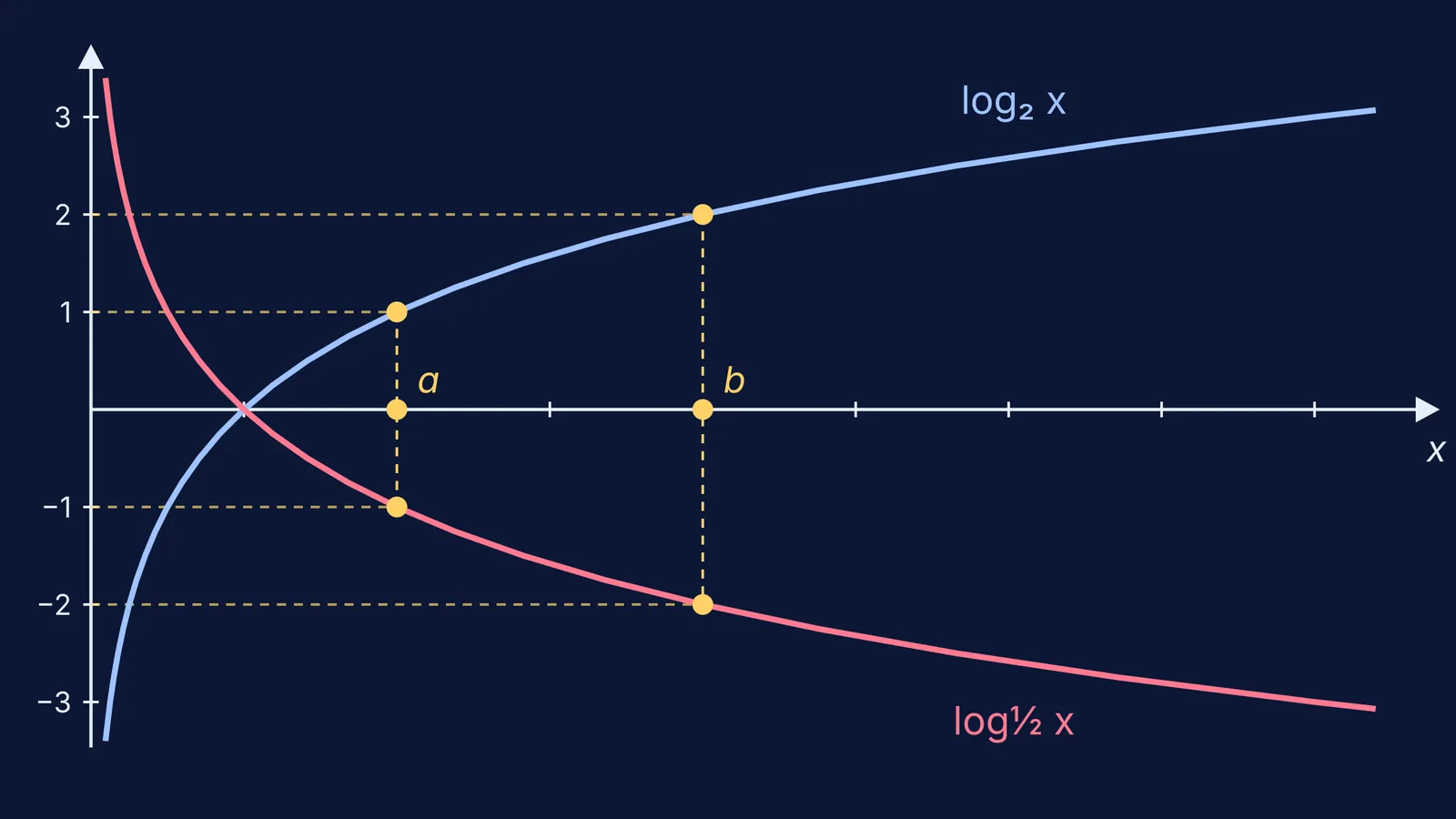
Take a log with base between 0 and 1: flips; both sides must be positive.
Square both sides: safe only when both sides are non-negative.
Why does multiplying by a negative number flip the sign?
OpenStax College Algebra states the multiplication property: if a < b and c > 0, then ac < bc, but if a < b and c < 0, then ac > bc. On a number line, multiplying by −1 reflects every point across zero. 2 is left of 5, but −2 is right of −5, so the order reverses.
The same OpenStax section solves −2x − 1 ≥ 5. Adding 1 gives −2x ≥ 6, and multiplying both sides by −1/2 reverses the sign, giving x ≤ −3.
The real trap is dividing by something whose sign you don't know, such as x or (x − 3). A letter with a minus sign in front can still be positive, as our post on why −x is not always negative explains. If you don't know the sign, split into cases or move everything to one side.
Do reciprocals flip an inequality?
For two numbers that are both positive or both negative, the Wikipedia summary) gives the rule: if a ≤ b, then 1/a ≥ 1/b. So 2 < 4 becomes 1/2 > 1/4, and −4 < −2 becomes −1/4 > −1/2.
When the signs differ, the order stays the same: −2 < 3 becomes −1/2 < 1/3, because a negative number's reciprocal is still negative. 1/x is decreasing on each side of zero but jumps at zero, so check signs before you flip.
When does taking a log flip the inequality?
The graph of y = log_b(x) is increasing if b > 1 and decreasing if 0 < b < 1, and its domain is (0, ∞), according to Lumen Learning's lesson on graphing logarithms, adapted from OpenStax Precalculus.
Worked example: solve log base 1/2 of x > 3.
The base is 1/2, which is below 1, so removing the log flips the sign: x < (1/2)³ = 1/8.
Logs need positive inputs, so add x > 0.
The answer is 0 < x < 1/8. Check: log base 1/2 of 1/16 is 4, and 4 > 3.
Students often forget step 2. Our post on why the logarithm of a negative number is undefined explains where that domain condition comes from.
Is it safe to square both sides of an inequality?
Only when both sides are non-negative. The same Wikipedia summary) states that if 0 ≤ a ≤ b, then aⁿ ≤ bⁿ for any n > 0.
When both sides are negative, squaring flips the sign: −5 < −2, but 25 > 4. When the signs differ, there is no rule. −3 < 2 gives 9 > 4, while −1 < 2 gives 1 < 4. That is why x < 3 does not mean x² < 9 (try x = −5).
A worked example: solve 1/x < 2
The tempting move is to multiply both sides by x to get 1 < 2x, so x > 1/2. That drops every negative answer: x = −1 gives −1 < 2, which is true.
Case method: if x > 0, multiplying by x keeps the sign, so x > 1/2. If x < 0, multiplying by x flips it: 1 > 2x, so x < 1/2, which together with x < 0 gives x < 0.
Sign-chart method: write 1/x − 2 < 0 as (1 − 2x)/x < 0. The critical points are 0 and 1/2. Testing each interval gives x < 0 or x > 1/2, the same answer. Our guide to counting integer solutions of a quadratic inequality uses the same interval testing.
Before you touch both sides, ask:
Is this operation increasing or decreasing here?
Do I know the sign of what I multiply or divide by? If not, split into cases.
Are both sides inside the domain (positive, for logs)?
Before squaring, are both sides non-negative?
If you want to find where a sign went wrong in a problem, the Fermi Problem Library has worked problems with a step-by-step solver that explains the reasoning rather than printing an answer. For monotonic functions and logarithms, the Fermi Concept Library has a lesson for each concept in mathematics.
Next time your answer and the key disagree, run the checklist before you redo the whole problem.


