On this page
Some half-cells have nothing solid to connect a wire to. In the Fe³⁺/Fe²⁺ couple both species are dissolved ions, and in the H⁺/H₂ couple one is a gas. Something has to hand electrons to them without changing the chemistry. That is platinum's job.
What does an inert electrode actually do?
The OpenStax chemistry text says inert electrodes "do not participate in the oxidation-reduction reaction and are present so that current can flow through the cell" (OpenStax Chemistry, Galvanic Cells, on LibreTexts/17:_Electrochemistry/17.02:_Galvanic_Cells)). The same section notes that the electrode is often platinum, gold or graphite, "all of which are inert to many chemical reactions".
An Fe³⁺ ion arrives at the platinum surface, picks up an electron and leaves as Fe²⁺, or the reverse. The platinum passes electrons to and from the outer circuit, and its own atoms stay put.
In cell notation, platinum sits at the outer edge, with a comma between ions in the same solution:
Pt(s) | Fe³⁺(aq), Fe²⁺(aq) for the iron redox couple (LibreTexts, Galvanic cells and electrodes/16:_Electrochemistry/16.02:_Galvanic_cells_and_Electrodes))
Pt(s) | Fe²⁺(aq), Fe³⁺(aq) || MnO₄⁻(aq), H⁺(aq), Mn²⁺(aq) | Pt(s) for a full cell where neither side has a solid metal, so both sides need platinum (OpenStax/17:_Electrochemistry/17.02:_Galvanic_Cells))
If the three kinds of half-cell still blur together, our guide to metal, gas and redox electrodes sorts them out.
Why platinum and not iron or copper wire?
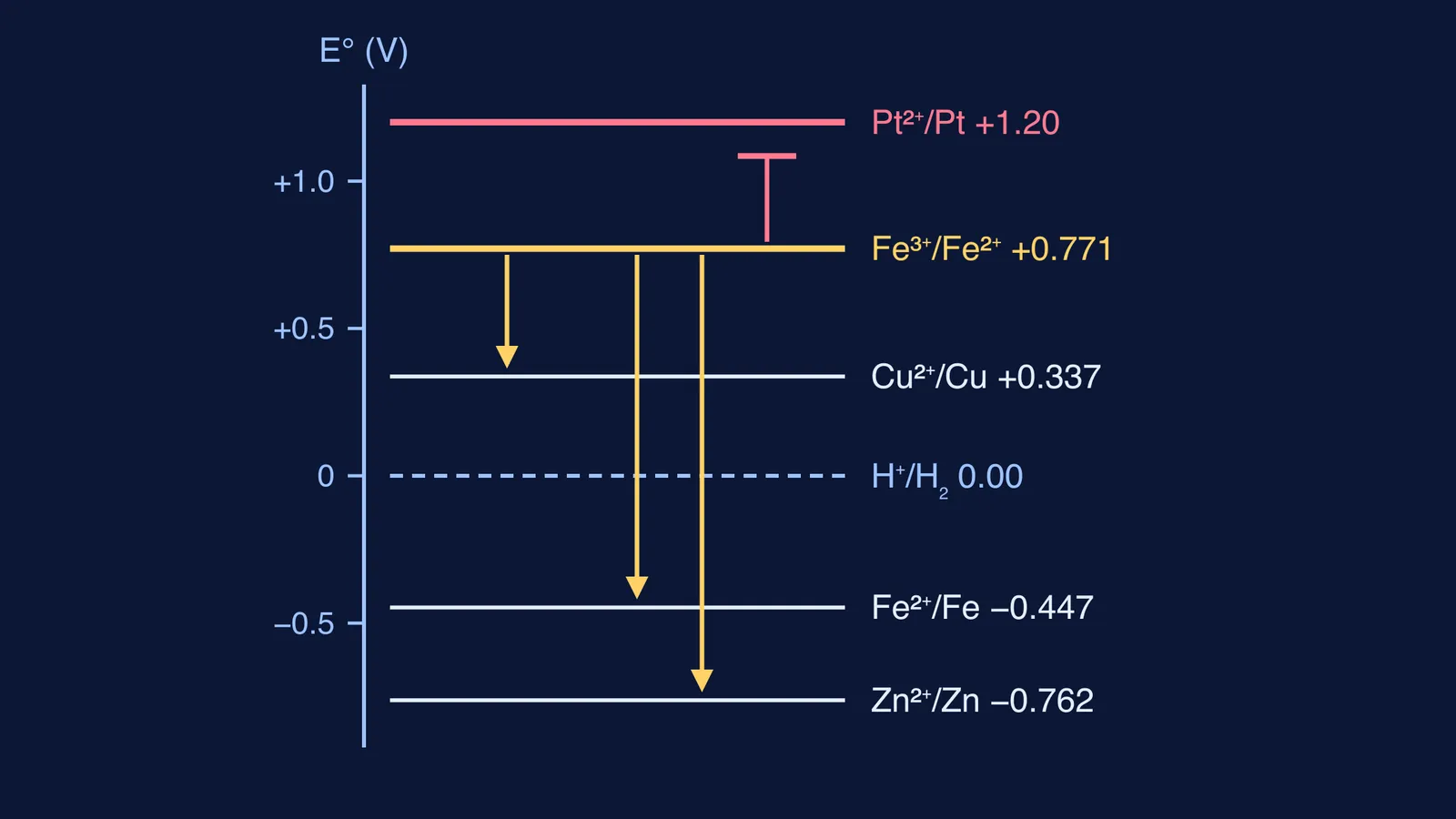
You can answer this with the table of standard reduction potentials (OpenStax Chemistry 2e, Appendix L). Ask: would Fe³⁺ oxidise this wire? Fe³⁺ + e⁻ → Fe²⁺ has E° = +0.771 V. Under standard conditions, Fe³⁺ can oxidise a metal whose own couple sits lower than that, and cannot oxidise one that sits higher.
Iron wire: E°(Fe²⁺/Fe) = −0.447 V. For Fe + 2Fe³⁺ → 3Fe²⁺, E°cell = 0.771 − (−0.447) = +1.218 V. Positive, so the wire dissolves and adds Fe²⁺ to the very solution you are studying.
Copper wire: E°(Cu²⁺/Cu) = +0.337 V. E°cell = 0.771 − 0.337 = +0.434 V. Still positive, so copper dissolves too.
Platinum wire: E°(Pt²⁺/Pt) = +1.20 V. E°cell = 0.771 − 1.20 = −0.429 V. Negative, so the reaction does not go and platinum stays a pure conductor.
Gold, at +1.498 V for Au³⁺/Au in the same table, passes the test too; OpenStax names platinum and gold as good inert electrodes because both are chemically unreactive. Our post on why gold and platinum do not corrode uses the same potentials.
Why is platinised platinum used in the hydrogen electrode?
For the H⁺/H₂ couple, not reacting is not enough. Hydrogen has to adsorb on the surface and exchange electrons quickly. The reasons given for platinum in the standard hydrogen electrode are that it does not corrode, it catalyses proton reduction, and it has a high exchange current density for that reaction (Wikipedia, Standard hydrogen electrode). Covering the platinum with fine platinum powder, called platinum black, increases the active surface area, which improves the reaction rate and the maximum possible current.
The standard electrode uses hydrogen gas at 1 bar bubbled over platinised platinum in acid with H⁺ at unit activity, roughly 1 M, and its potential is defined as zero (LibreTexts, Standard hydrogen electrode/Electrochemistry/Electrodes/Standard_Hydrogen_Electrode)). The exam point: platinum is chemically inert, not idle. For the full set-up, read how the standard hydrogen electrode works.
Does the platinum change the cell voltage?
Try this worked example: Zn | Zn²⁺ || Fe³⁺, Fe²⁺ | Pt. From the OpenStax table, E°(Zn²⁺/Zn) = −0.7618 V and E°(Fe³⁺/Fe²⁺) = +0.771 V.
Cathode (reduction, on the platinum surface): Fe³⁺ + e⁻ → Fe²⁺.
Anode (oxidation): Zn → Zn²⁺ + 2e⁻.
Overall: Zn + 2Fe³⁺ → Zn²⁺ + 2Fe²⁺.
E°cell = E°cathode − E°anode = 0.771 − (−0.7618) = 1.5328 V, or about 1.53 V.
Platinum's own value, +1.20 V, appears nowhere in that sum. That is what "inert" means in a calculation: the electrode material drops out. A common slip is to plug in Pt²⁺/Pt anyway. That is a method error, and working a few similar cells step by step in the Fermi Problem Library shows where each potential in the sum comes from.
When should you use the metal itself instead?
Inert to many reactions does not mean inert to every reaction. A quick checklist:
Couple contains a solid metal (Zn²⁺/Zn, Cu²⁺/Cu): the metal is the electrode.
Both species are ions (Fe³⁺/Fe²⁺): use an inert conductor such as platinum.
One species is a gas (H⁺/H₂, Cl₂/Cl⁻, O₂): the reaction runs on an inert conductor such as platinum (LibreTexts/16:_Electrochemistry/16.02:_Galvanic_cells_and_Electrodes)).
Unsure whether a wire would be attacked: compare its E° with the oxidising couple's.
If electrode potentials and cell notation still feel patchy, the Fermi Concept Library gives each chemistry concept its own lesson and its place in the map, so you can fill the gap before your next numerical.