

On this page
A half-cell is the fundamental building block of an electrochemical circuit, containing a conductive electrode and an electrolyte where either oxidation or reduction happens [[1]](https://chem.libretexts.org/Bookshelves/Analytical_Chemistry/Supplemental_Modules_(Analytical_Chemistry)/Electrochemistry/Basics_of_Electrochemistry/Electrochemical_Cells). When you join two of them with a salt bridge and a wire, electrons flow.
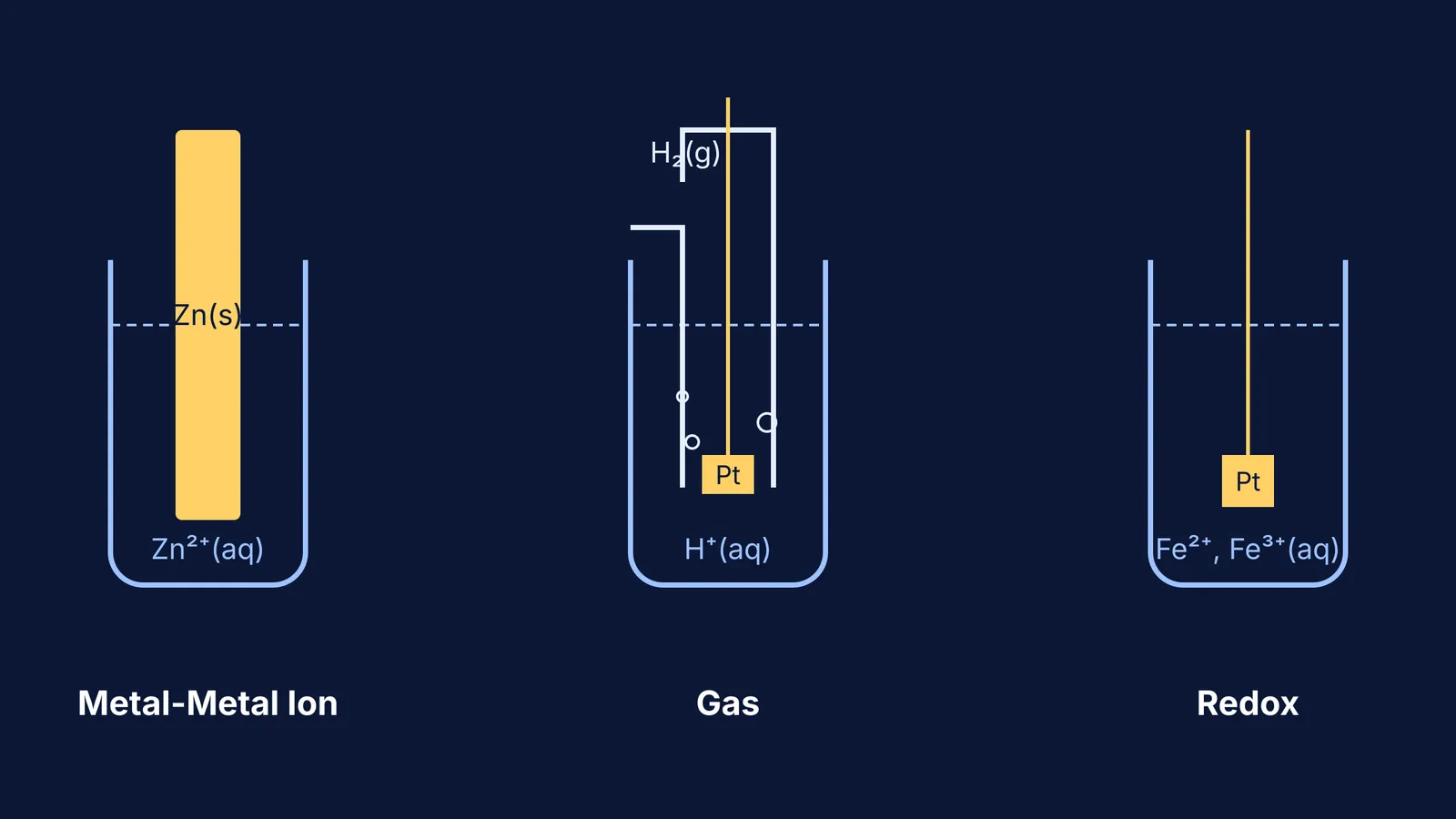
Every battery, sensor and electroplating bath relies on these half-cells. While they all do the same basic job—moving electrons in or out of a solution—they are built differently depending on what is reacting. The three main types are metal-metal ion electrodes, gas electrodes, and redox electrodes.
How do oxidation and reduction split?
Before diving into the types, it helps to see how a half-cell works. A full redox reaction requires both an oxidation (giving up electrons) and a reduction (gaining electrons). By physically separating these two halves, an electrochemical cell forces the electrons to travel through an external wire to get from one side to the other.
Each side is a half-cell. If a half-cell is acting as the anode, oxidation happens there, and electrons are pushed into the wire. If it is acting as the cathode, reduction happens, and electrons are pulled from the wire to react with the chemicals in the solution.
What is a metal-metal ion half-cell?
This is the simplest and most common type of half-cell. It consists of a solid piece of active metal dipped into a solution of its own ions [[1]](https://chem.libretexts.org/Bookshelves/Analytical_Chemistry/Supplemental_Modules_(Analytical_Chemistry)/Electrochemistry/Basics_of_Electrochemistry/Electrochemical_Cells).
A classic example is a zinc rod placed in a zinc sulphate (Zn²⁺) solution. The metal plays two roles at once: it is the reactant that gets oxidised or reduced, and it is the solid conductor that carries the electrons away to the circuit.
When it acts as an anode, the solid zinc atoms give up electrons and dissolve into the solution as aqueous ions. When it acts as a cathode, ions from the solution grab electrons and plate out as solid metal onto the rod. If you are learning to write electrochemistry cell notation and Nernst equations, you will write this simply as Zn(s) | Zn²⁺(aq).
How does a gas electrode work?
Gases like hydrogen or chlorine cannot conduct electricity, and you cannot make a solid wire out of them. A gas electrode gets around this by using an inert metal—usually platinum—to provide a surface for the reaction [[2]](https://chem.libretexts.org/Bookshelves/Analytical_Chemistry/Supplemental_Modules_(Analytical_Chemistry)/Electrochemistry/Basics_of_Electrochemistry/Standard_Hydrogen_Electrode).
The Standard Hydrogen Electrode (SHE) is the benchmark against which all other E° values of 3d metals are measured. In this half-cell, hydrogen gas (H₂) is bubbled over a piece of platinum foil submerged in an acidic solution of H⁺ ions. The platinum does not react or dissolve; it just provides a solid surface for the hydrogen gas and the ions to meet and exchange electrons.
How is a redox electrode different?
In a redox electrode (sometimes called an ion-ion electrode), the element changing its oxidation state stays in the solution the entire time [[2]](https://chem.libretexts.org/Bookshelves/Analytical_Chemistry/Supplemental_Modules_(Analytical_Chemistry)/Electrochemistry/Basics_of_Electrochemistry/Standard_Hydrogen_Electrode). No solid metal is formed, consumed or deposited.
Like the gas electrode, it uses an inert platinum conductor. However, instead of bubbling a gas, the platinum is simply dipped into a solution containing two different oxidation states of the same element, such as Fe²⁺ and Fe³⁺. The platinum acts as a sink or source of electrons, allowing the ions to oxidise or reduce each other right at its surface. This principle is key to understanding how more complex batteries and fuel cells operate over many cycles.
If you are struggling to spot the difference between these types of cells, you might have concept gaps around oxidation states or electron transfer. The Fermi Concept Library holds every concept in chemistry, each with its own lesson and its place in the map, so you can clear up those gaps.
How to identify half-cells?
When you are looking at a cell diagram or a homework problem, you can identify the type of half-cell by looking at the states of matter involved:
Is the solid electrode reacting? If the metal itself is dissolving or getting thicker (like Cu in Cu²⁺), it is a metal-metal ion electrode.
Is a gas bubbling in? If you see a gas like H₂ or Cl₂ entering the solution alongside an inert electrode like Pt, it is a gas electrode.
Are both forms in solution? If the reaction is between two aqueous ions (like Sn²⁺ and Sn⁴⁺) and the solid electrode is inert, it is a redox electrode.


