On this page
Most students can name the dry cell and the lead storage battery. Fewer can write the electrode reactions, say which electrode is the anode while charging, or work out how much electrical work a fuel cell can deliver. This post covers the cells your syllabus names, two worked calculations, the mistakes that cost marks, and a short practice routine.
Which cells does the syllabus expect you to know?
The NTA Syllabus for JEE (Main) 2026 ends its electrochemistry unit with "dry cell and lead accumulator, fuel cells", and the NEET (UG) 2026 syllabus uses the same words. The JEE (Advanced) 2026 information brochure lists "Batteries: Primary and Secondary, fuel cells; Corrosion." The reactions themselves are in Unit 2 of the NCERT Class 12 Chemistry Part I textbook. Check the syllabus for your own exam year, because NTA publishes a new one each cycle.
NCERT sorts batteries into primary (the reaction runs once) and secondary (current pushed through in reverse recharges it).
What happens inside a dry cell and a mercury cell?
The dry cell (Leclanché cell) has a zinc container as the anode and a graphite rod surrounded by manganese dioxide and carbon as the cathode. It is not actually dry: the space between them holds a moist paste of ammonium chloride and zinc chloride. NCERT gives the approximate reactions:
Anode: Zn → Zn²⁺ + 2e⁻
Cathode: MnO₂ + NH₄⁺ + e⁻ → MnO(OH) + NH₃
Manganese goes from +4 to +3, and the cell gives nearly 1.5 V.
The mercury cell uses a zinc–mercury amalgam anode and an HgO and carbon paste cathode in KOH and ZnO. Its overall reaction is Zn(Hg) + HgO → ZnO + Hg(l), and its potential stays at about 1.35 V for its whole life. NCERT's reason is a favourite one-mark question: the overall reaction involves no ion in solution whose concentration changes. With the Nernst equation from our post on cell EMF and the Nernst equation, you can see why: with only solids and a liquid in the overall reaction, Q stays at 1 and E stays at E°.
How does the lead accumulator recharge?
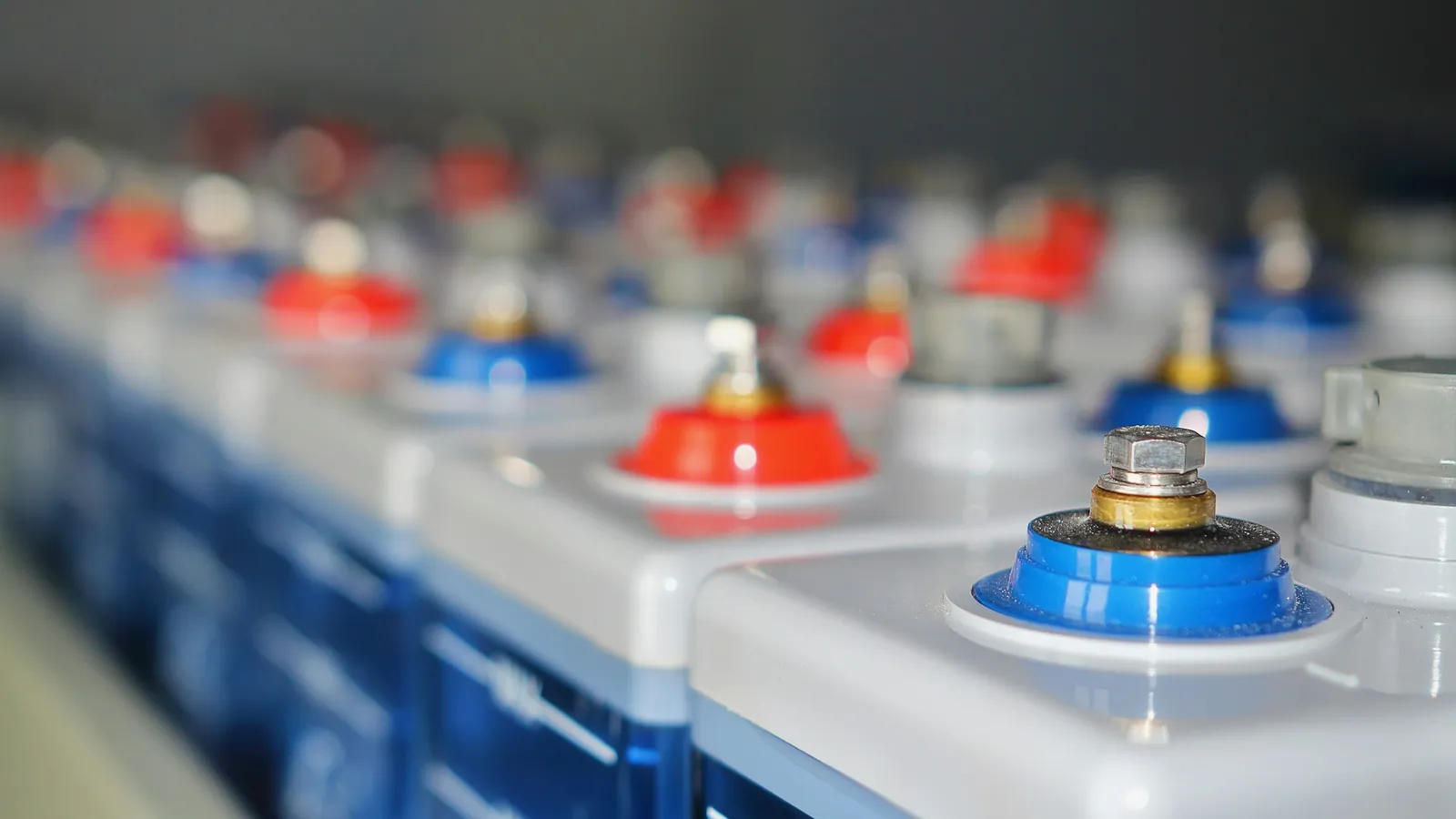
The lead storage battery in cars and inverters has a lead anode, a grid packed with PbO₂ as the cathode, and a 38% solution of sulphuric acid. On discharge:
Anode: Pb + SO₄²⁻ → PbSO₄ + 2e⁻
Cathode: PbO₂ + SO₄²⁻ + 4H⁺ + 2e⁻ → PbSO₄ + 2H₂O
Overall: Pb + PbO₂ + 2H₂SO₄ → 2PbSO₄ + 2H₂O
Read the overall equation before memorising anything else. Sulphuric acid is used up and water is made, so the acid gets weaker as the battery runs down. On charging, the reaction reverses and PbSO₄ turns back into Pb and PbO₂.
Why is a fuel cell more efficient than a power plant?
A fuel cell is a galvanic cell whose reactants are fed in continuously. In NCERT's hydrogen–oxygen cell, the gases bubble through porous carbon electrodes into concentrated NaOH, and the overall reaction is 2H₂ + O₂ → 2H₂O. NCERT notes that this cell powered the Apollo space programme and that fuel cells run at about 70% efficiency, against about 40% for thermal plants.
Worked example 1. How much of the energy of burning hydrogen can a fuel cell turn into electrical work at most?
Per mole of H₂, two electrons are transferred (H₂ → 2H⁺ + 2e⁻), so n = 2. E°cell = 1.23 V.
ΔG° = −nFE° = −2 × 96,485 × 1.23 = −237,400 J, about −237 kJ per mole of H₂.
The enthalpy change is the enthalpy of formation of liquid water, −285.83 kJ/mol, from the NIST Chemistry WebBook.
Maximum fraction = 237 / 285.8 = 0.83, or about 83%.
Real cells lose some of this, which is why NCERT quotes about 70%.
Why did lithium win for phones and cars?
Lithium-ion cells are not in the NCERT chapter. The 2019 Nobel Prize in Chemistry went to John Goodenough, Stanley Whittingham and Akira Yoshino for the lithium-ion battery. The Nobel summary says Goodenough showed in 1980 that a cobalt oxide cathode holding lithium ions could give as much as four volts, and Yoshino built the first commercially viable cell in 1985 with a carbon anode. The cells reached the market in 1991.
Worked example 2. Why is lithium attractive as an anode? Compare the charge one gram can supply.
Zinc: 1 g is 1/65.38 mol, and each atom gives 2 electrons. Charge = (2 × 96,485) / 65.38 = 2,950 C, about 820 mAh.
Lithium: 1 g is 1/6.94 mol, and each atom gives 1 electron. Charge = 96,485 / 6.94 = 13,900 C, about 3,860 mAh.
Lithium is light and, as NCERT's electrochemical series shows, it has the lowest standard electrode potential, so it gives a high voltage as well.
What mistakes do students make with cells?
In Sanger and Greenbowe's 1997 study, common misconceptions included the idea that electrons flow through the salt bridge and electrolyte, and that the + and − signs on electrodes are net charges. Most of the students who held these ideas could still calculate cell potentials correctly.
Watch for these in your own answers:
Electrons in the electrolyte. Electrons move through the external wire. Ions carry charge inside the cell.
Fixed anode labels. The anode is wherever oxidation happens. When you charge a lead accumulator, the lead plate is where PbSO₄ is reduced, so it becomes the cathode.
Wrong n. Count electrons from balanced half-reactions, never from coefficients alone.
If the movement of electrons and ions is the part you cannot picture, the Fermi Simulation Lab has interactive simulations for ideas that are easier to see than to read.
A practice routine for this topic
From memory, write anode, cathode and overall reactions for all four cells. Check against NCERT and redo any you missed two days later.
For each cell, write one line on why its voltage changes or stays steady.
Do three ΔG = −nFE calculations, writing n from half-reactions each time.
Draw the lead accumulator during charging and during discharge, labelling the anode, cathode and direction of electron flow in each.
Next, see how the same electrode potentials explain rusting in our post on corrosion as electrochemistry.