

On this page
Every E° value in your textbook table is measured against one electrode, the standard hydrogen electrode (SHE). The numbers below come from the NCERT Class 12 Chemistry chapter on electrochemistry.
What is the standard hydrogen electrode made of?
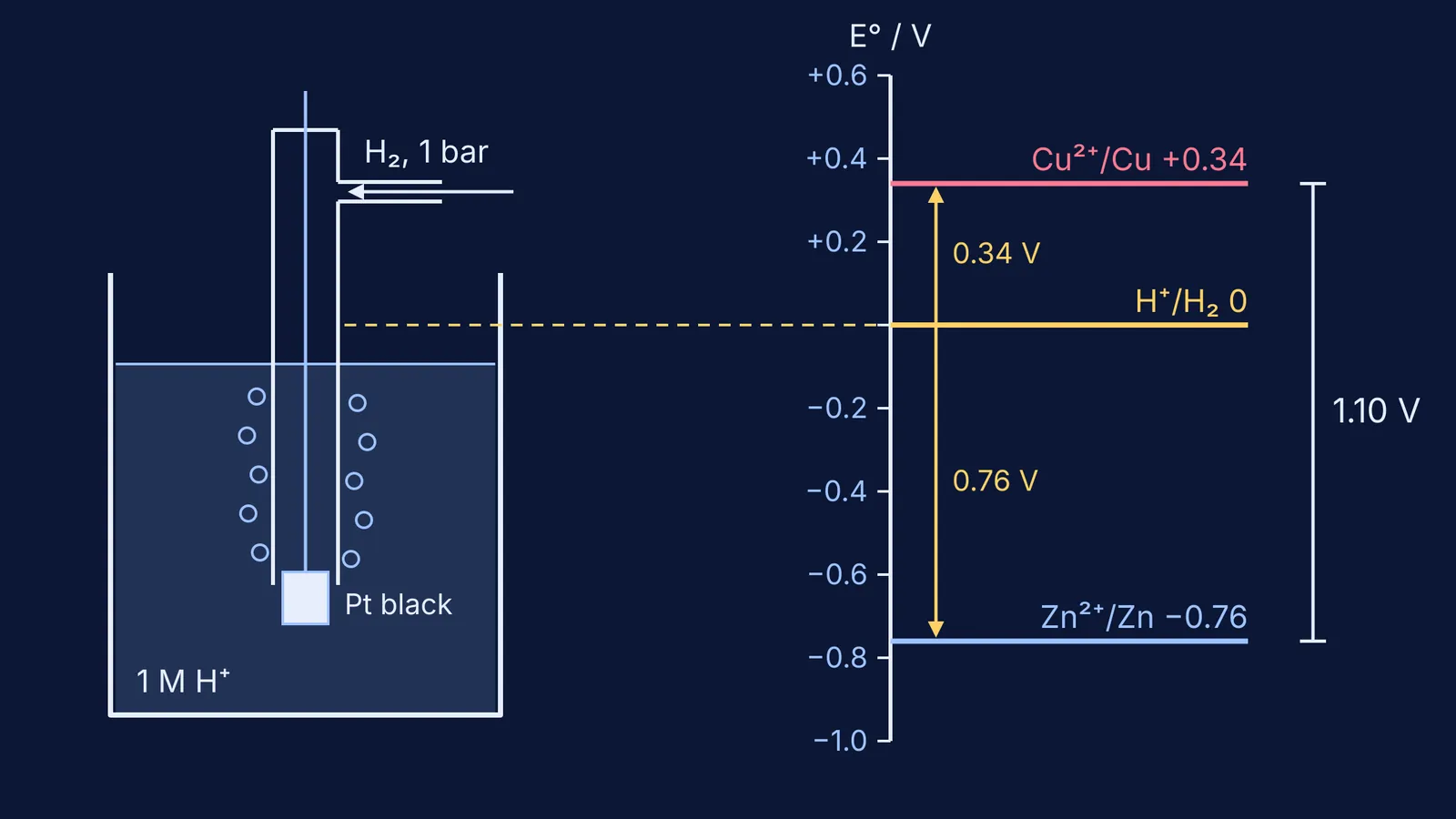
According to NCERT, section 2.2.1, the standard hydrogen electrode consists of a platinum electrode coated with platinum black, dipped in an acidic solution with pure hydrogen gas bubbled through it. The "standard" part is two numbers: hydrogen gas at a pressure of 1 bar and hydrogen ions at a concentration of 1 M. NCERT writes it as Pt(s) | H₂(g) | H⁺(aq), with the half-reaction H⁺(aq) + e⁻ → ½ H₂(g).
Why platinum, and why black? Platinum is used because it is inert and does not react much with hydrogen, as the LibreTexts page on the SHE/Electrochemistry/Electrodes/Standard_Hydrogen_Electrode) explains. Platinum black is a layer of finely powdered platinum: it gives the electrode a much larger surface area and adsorbs hydrogen well (Wikipedia summary of the SHE). That surface catalyses the conversion of H₂ to H⁺ and back (LibreTexts, Petrucci 20.2/20:_Electrochemistry/20.2:_Standard_Electrode_Potentials)). The platinum itself is not used up: NCERT calls it an inert electrode that provides its surface for the reaction and conducts the electrons.
The stricter definition is in Ellgen's thermodynamics text on LibreTexts/17:_Electrochemistry/17.10:_The_Standard_Hydrogen_Electrode_(S.H.E)). The same LibreTexts SHE page also says the electrode is hard to run in practice, because the platinized surface is difficult to prepare and the concentrations are hard to control, and for this reason it calls the SHE a hypothetical electrode. For everyday measurements, chemists use more convenient reference electrodes; see our post on calomel and silver–silver chloride reference electrodes.
Why is the E° of the hydrogen electrode zero?
NCERT puts it plainly: the potential of an individual half-cell cannot be measured. A voltmeter needs two terminals, so all it can ever show is the difference between two half-cells. To give each half-cell its own number, chemists picked one half-cell and agreed to call its potential zero. By convention, the SHE is assigned a zero potential at all temperatures (NCERT).
Think of heights measured from sea level: the zero is agreed, not special. Had chemists chosen another reference, every value in the table would shift by the same amount, and every cell emf, being a difference, would stay the same.
How do you use the SHE to measure E° of zinc and copper?
NCERT's rule is that the SHE goes on the left as the anode (reference), the other half-cell goes on the right, and E°cell = E°right − E°left. Since E°left = 0, the measured emf is E°right, the standard electrode potential of the other half-cell. Here is the worked example, with all values at 298 K from NCERT pages 34 to 37.
Copper: build Pt(s) | H₂(g, 1 bar) | H⁺(aq, 1 M) || Cu²⁺(aq, 1 M) | Cu. The measured emf is 0.34 V, so E°(Cu²⁺/Cu) = +0.34 V.
Read the sign: positive means Cu²⁺ ions get reduced more easily than H⁺. Copper really is the cathode, and electrons flow from the hydrogen side to the copper.
Zinc: build Pt(s) | H₂(g, 1 bar) | H⁺(aq, 1 M) || Zn²⁺(aq, 1 M) | Zn. The emf comes out as −0.76 V, so E°(Zn²⁺/Zn) = −0.76 V.
Read the sign: negative means the cell as written runs backwards. Zinc is oxidised and H⁺ is reduced, so zinc is actually the anode and hydrogen ions can oxidise zinc.
Combine: in the Daniell cell, Zn | Zn²⁺ || Cu²⁺ | Cu, E°cell = 0.34 − (−0.76) = 1.10 V. The hydrogen electrode drops out because both numbers were measured from the same zero.
Step 2 also explains a common exam question: copper does not dissolve in HCl, because H⁺ cannot oxidise it. We cover that in why copper does not liberate hydrogen from acids.
What mistakes do students make with the SHE?
Check yourself against this list:
Writing 1 atm instead of 1 bar. The NCERT chapter uses 1 bar; the Wikipedia article notes that the older normal hydrogen electrode bubbled hydrogen at about 1 atm.
Saying hydrogen's potential "is" zero, as if it were measured. It is assigned zero.
Doubling E° when a half-reaction is multiplied by 2. E° does not depend on how much substance reacts, so the 0.34 V for Cu²⁺/Cu stays 0.34 V.
Forgetting that the zero holds only when H⁺ is at 1 M and H₂ at 1 bar. Change the pH and the hydrogen electrode's potential moves, as we work through in calculating pH from the emf of a hydrogen electrode.
Drawing plain shiny platinum. The coating of platinum black is part of the definition.
If a step here still feels shaky, the Fermi Concept Library has a lesson on each chemistry concept and shows where it sits in the map. When you move on to numericals, the Fermi Problem Library has worked problems with a step-by-step solver that explains the reasoning rather than printing an answer.


