

On this page
The Standard Hydrogen Electrode (SHE) is the theoretical zero of electrochemistry. Just as geographers use sea level as an arbitrary baseline to measure the height of mountains, chemists use the SHE as the 0.00 V baseline to measure electron energy at all temperatures (Wikipedia, 2024). Every standard reduction potential — whether it is the Electrode potentials of 3d metals or the driving force of a commercial battery — is measured against it.
However, the SHE is famously frustrating to use in a real laboratory. It requires bubbling highly flammable hydrogen gas at exactly 1 bar of pressure over a platinised platinum wire. This wire must be immersed in a perfectly maintained acid solution where the activity of the hydrogen ions is exactly 1 (roughly 1 M concentration) (Wikipedia, 2024). Keeping the gas pressure perfectly stable and preventing the acid from evaporating or diluting during a long experiment is difficult, tedious, and sometimes dangerous.
Instead, modern chemists use secondary "reference electrodes" that are safe, self-contained, and perfectly stable. The two most historically and practically significant are the saturated calomel electrode (SCE) and the silver-silver chloride (Ag/AgCl) electrode.
How does a metal-insoluble salt electrode work?
Both the calomel and Ag/AgCl electrodes belong to a class called metal-insoluble salt electrodes. They consist of a pure metal wire coated in a sparingly soluble salt of that same metal. This assembly sits in an internal reservoir of a solution containing the salt's anion.
To see why this makes a great reference, consider the Nernst equation for a general reduction at room temperature: E = E° − (0.0591 / n) log₁₀ Q
Because the metal and its solid salt are both pure phases, their thermodynamic activities are exactly 1. They completely drop out of the reaction quotient Q. The potential of the half-cell depends on only one remaining variable: the concentration of the chloride ions (Cl⁻) in the surrounding solution.
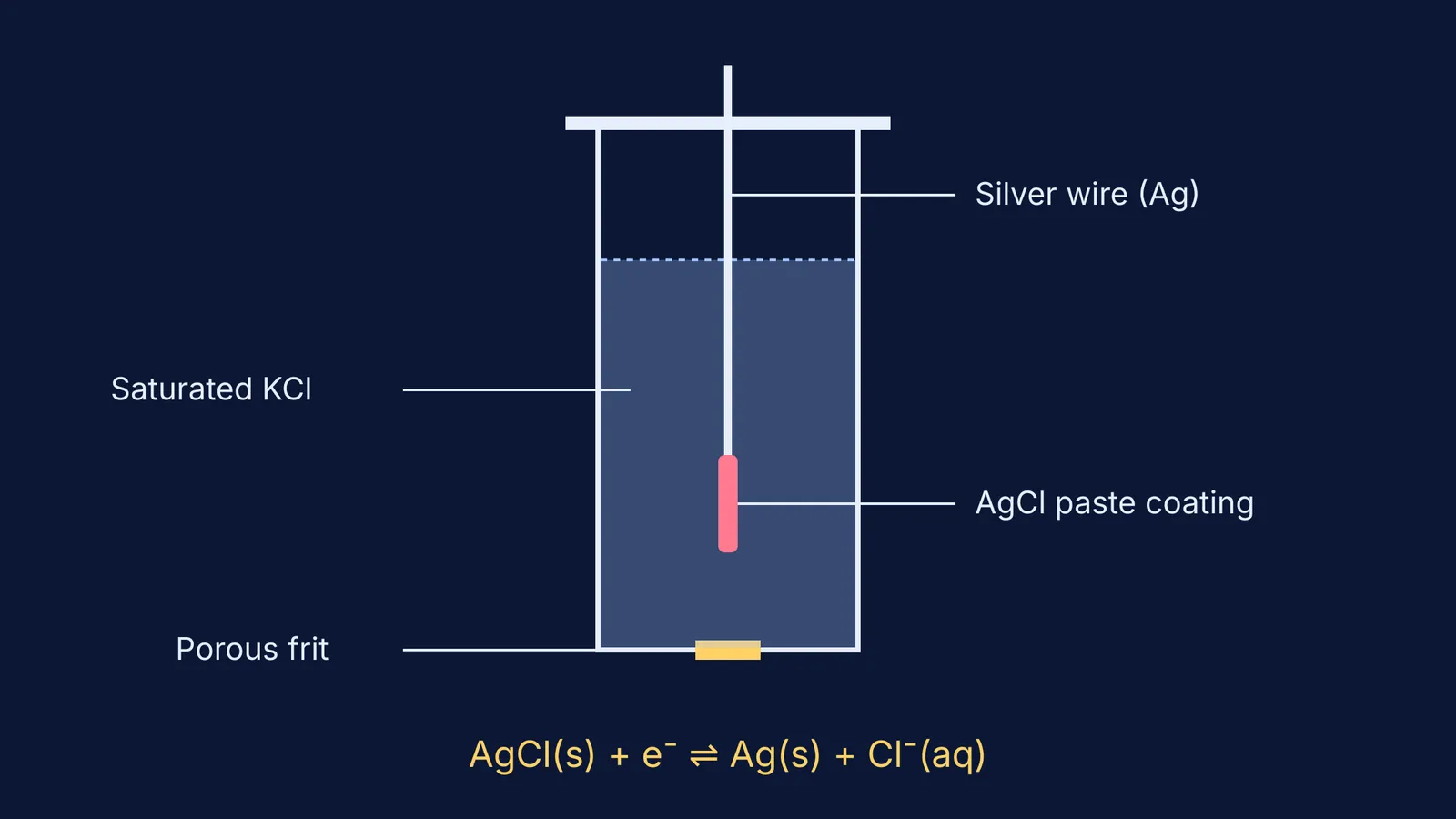
If we fill the electrode body with a saturated solution of potassium chloride (KCl), the chloride concentration is physically locked. If water evaporates, more solid KCl dissolves to replace it; if water enters, the dissolved KCl precipitates out to maintain saturation. Because the concentration is pinned at its maximum limit, the potential of the electrode remains rigidly constant, day after day. A porous frit at the bottom of the tube allows electrical contact with the outside beaker without letting the inner solution mix freely. This simple but ingenious design ensures that measurements stay reliable over long periods.
What is the saturated calomel electrode (SCE)?
For most of the 20th century, the saturated calomel electrode was the undisputed standard of the working laboratory. It consists of a platinum wire making electrical contact with a pool of liquid mercury (Hg) and a thick paste of "calomel", which is mercurous chloride (Hg₂Cl₂).
The reduction half-reaction is: Hg₂Cl₂(s) + 2e⁻ ⇌ 2Hg(l) + 2Cl⁻(aq)
At 25 °C, an SCE filled with saturated KCl has a fixed potential of +0.241 V relative to the Standard Hydrogen Electrode (Wikipedia, 2024). This makes experimental arithmetic incredibly easy. If you measure a cell and find it is +0.500 V against your SCE, you simply add 0.241 V to find its standard potential against the SHE (+0.741 V).
However, the calomel electrode has a fatal flaw. Liquid mercury is highly toxic, and broken glass electrodes are an environmental hazard. Because of this toxicity, the calomel electrode has been phased out of many modern laboratories.
Why did the silver-silver chloride electrode replace calomel?
Today, the silver-silver chloride (Ag/AgCl) electrode has largely replaced the calomel electrode in almost every application, from industrial pH meters to school science labs. It relies on a solid silver wire coated with a grey layer of solid silver chloride, bathed in a reservoir of saturated KCl.
The reduction half-reaction is much simpler: AgCl(s) + e⁻ ⇌ Ag(s) + Cl⁻(aq)
At 25 °C, the potential of a saturated Ag/AgCl electrode is +0.197 V versus the SHE (Wikipedia, 2024).
It contains absolutely no mercury, making it safe to handle and easy to dispose of if broken. Crucially, it is thermally robust. You can use a well-constructed Ag/AgCl electrode in environments up to 300 °C, and its potential will remain predictable and stable (Wikipedia, 2024).
How do you use reference potentials in calculations?
Whenever you calculate standard states — like converting cell EMF to ΔG° and K — the values printed in your textbook are given relative to the SHE. If your laboratory voltmeter gives you a reading against Ag/AgCl, failing to correct for that 0.197 V difference will break your thermodynamic calculations entirely.
If you are setting up electrochemistry equations and struggling to remember which way the potentials shift, the Fermi Concept Library can help you build a concrete mental map. Fermi's AI tutor can draw the specific reference electrode alongside your experimental cell, and explain exactly why the Nernst equation forces the voltage to stay pinned.


