

On this page
The Nernst equation connects the voltage of an electrochemical cell to the concentration of the chemicals inside it. When you apply it to a hydrogen electrode at 25 °C (298 K), the math simplifies beautifully into a direct relationship between potential and pH.
By measuring the electromotive force (EMF) of a cell containing a hydrogen electrode and a known reference, you can calculate the pH of the unknown solution. This principle is the foundation of digital pH meters.
Why does the Nernst equation simplify to E = −0.059 pH?
The reduction half-reaction for a hydrogen electrode is 2H⁺(aq) + 2e⁻ ⇌ H₂(g).
The Nernst equation for this reaction is: E = E° − (RT / nF) ln(P_H₂ / [H⁺]²)
To simplify this, we plug in the standard conditions and constants:
The standard electrode potential (E°) is exactly 0.00 V.
The pressure of hydrogen gas (P_H₂) is kept at 1 bar (or 1 atm).
The number of electrons transferred (n) is 2.
The gas constant (R) and Faraday constant (F) are fixed.
When you convert the natural logarithm (ln) to base-10 (log) and set the temperature (T) to 298.15 K, the term 2.303 RT / F calculates to 0.05916 V according to Wikipedia.
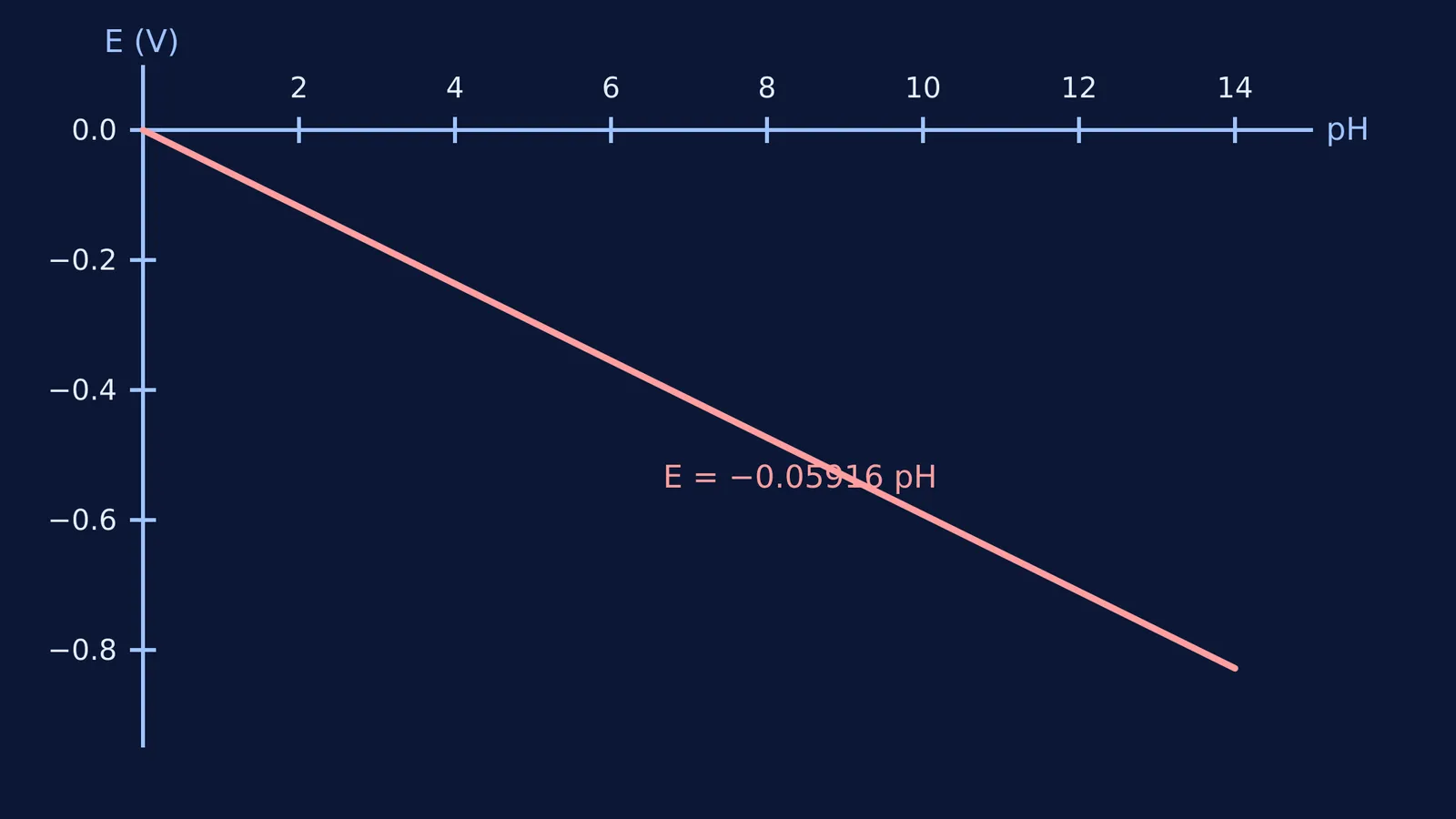
The equation collapses to: E = (0.05916 / 2) log([H⁺]²)
Because log([H⁺]²) = 2 log[H⁺] and pH = −log[H⁺], the 2 cancels out, leaving us with E = −0.05916 × pH. We often round this to E = −0.059 pH in exam problems.
This means a neutral solution at pH 7 produces a potential of approximately −0.414 V.
How do you find the pH of a solution from the cell EMF?
You cannot measure the potential of a single electrode on its own. Instead, you must connect the hydrogen electrode (dipped in the solution of unknown pH) to a reference electrode to form a complete circuit.
The measured cell EMF (E_cell) is the difference between the right (cathode) and left (anode) electrodes: E_cell = E_cathode − E_anode
If you use a Standard Hydrogen Electrode (SHE) as the anode (where E_anode = 0 V) and your test hydrogen electrode as the cathode, the measured voltage is simply the potential of the test electrode: E_cell = E_test − 0 = −0.059 pH
If the voltmeter reads −0.177 V, the pH is −0.177 / −0.059 = 3.
If you need a refresher on the relationships between these standard potentials, the Concept Library breaks down everything from the Nernst equation to the E° values of 3d metals: why copper is positive and Mn²⁺ is stable.
What happens if you use a calomel reference electrode?
In a real lab, keeping a steady supply of hydrogen gas at exactly 1 bar is difficult and dangerous. Instead of a SHE, chemists often use a Saturated Calomel Electrode (SCE) as the reference anode.
The standard reduction potential of an SCE is +0.244 V at 298 K as defined by Wikipedia.
If the SCE is the anode and your hydrogen electrode is the cathode, the cell EMF formula changes: E_cell = E_cathode − E_anode E_cell = (−0.059 pH) − 0.244
To find the pH, you rearrange the formula: pH = −(E_cell + 0.244) / 0.059
For example, if the measured E_cell is −0.539 V: pH = −(−0.539 + 0.244) / 0.059 = 0.295 / 0.059 = 5
This kind of multi-step reasoning is where careless mistakes happen. If you get stuck on a similar problem, the Fermi Problem Library acts as a step-by-step solver that explains the reasoning for each substitution rather than just printing an answer.
How do you set up the calculation step by step?
When you face a Nernst equation pH problem in JEE Main, JEE Advanced, or NEET-UG, follow this order:
Identify the reference electrode: Is it a SHE (0.00 V) or something else like calomel (+0.244 V)?
Assign anode and cathode: Remember that oxidation happens at the anode and reduction at the cathode. The problem statement usually tells you the cell notation.
Write the cell EMF equation: E_cell = E_cathode − E_anode. Substitute −0.059 pH for the hydrogen half-cell.
Solve for pH: Rearrange the equation and divide carefully.
Connecting this to the bigger picture, once you have the cell EMF, you can also link it to thermodynamics, such as moving From cell EMF to ΔG° and K: using −nFE° = −RT ln K. And remember, these simplified formulas assume standard concentrations; dealing with extremes like the pH of 10⁻⁸ M HCl: why water's H⁺ cannot be ignored requires going back to the basics of ionic equilibrium.
If you aren't sure how to set up the cell notation for these calculations, Fermi's AI tutor can work out what you already know and build a plan for the session, writing on a shared board to check your understanding as you go.


