

On this page
Why do some metals react with acids while others do not?
When you drop zinc or iron into dilute hydrochloric acid, bubbles of hydrogen gas escape immediately. But drop a copper wire into the same acid, and nothing happens. The metal just sits there, completely unreactive.
Copper cannot displace hydrogen from dilute acids like dilute HCl or dilute H₂SO₄. To understand why this happens, we have to look at the energy cost of pulling solid metal atoms apart and turning them into aqueous ions in the solution.
Why does copper have a positive standard reduction potential?
In the 3d transition series, copper stands alone. It is the only metal with a positive standard reduction potential (E° = +0.34 V for the Cu²⁺/Cu couple). A positive potential means that copper prefers to stay as a solid metal rather than dissolve into ions, and it is less reactive than hydrogen (which has a defined E° = 0.00 V).
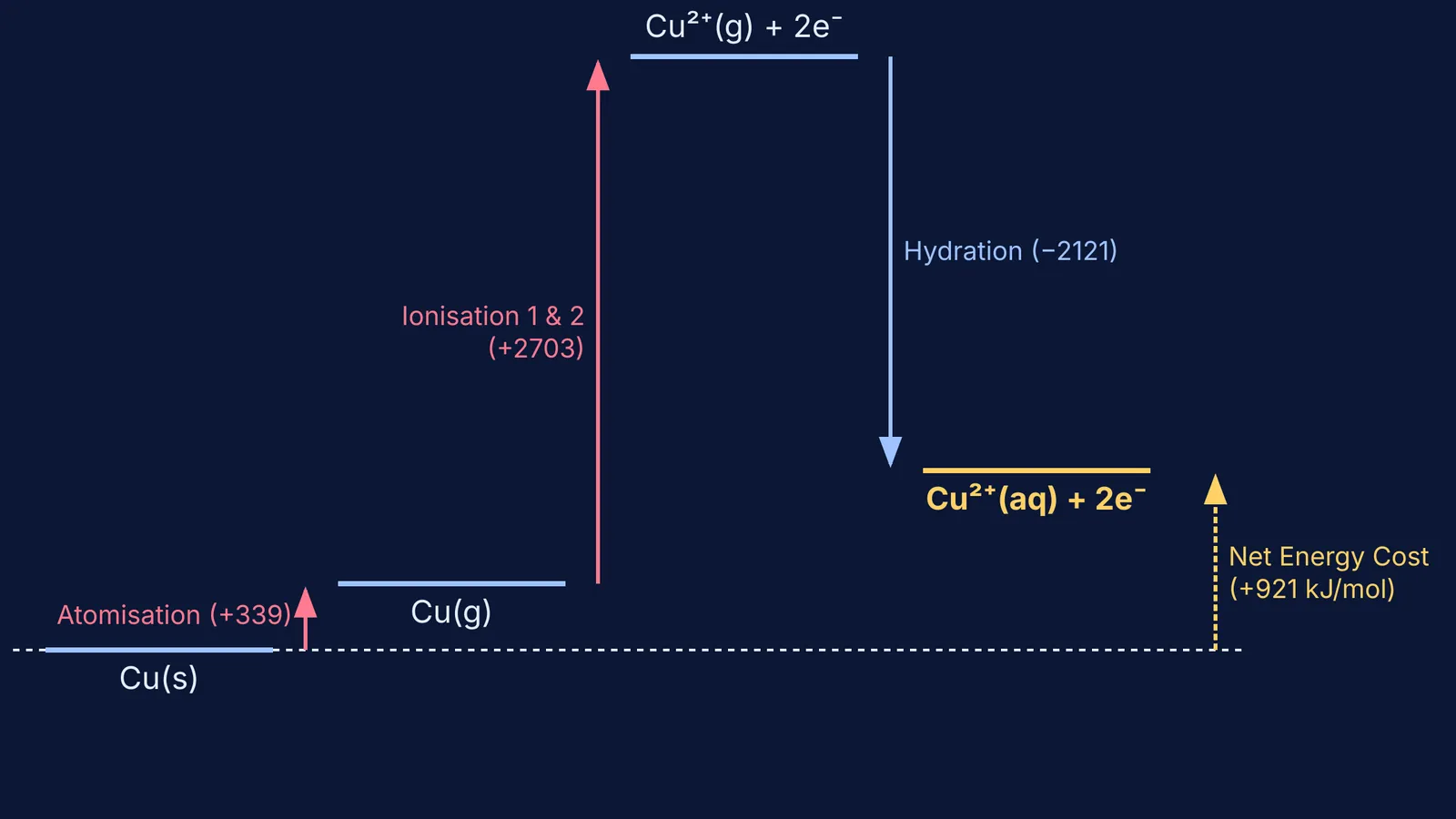
Dissolving a metal into an acid is a three-step energy transaction. According to the NCERT Class 12 textbook, we can break this down for copper:
Enthalpy of Atomisation: First, you have to separate solid copper into gaseous atoms. Because of its strong metallic bonding, this costs a substantial 339 kJ mol⁻¹.
Ionisation Enthalpies: Next, you must strip away two electrons to form a Cu²⁺ ion. The first ionisation costs 745 kJ mol⁻¹, but the second requires a massive 1958 kJ mol⁻¹. This is because the second electron must be removed from a stable, fully filled 3d¹⁰ subshell.
Hydration Enthalpy: Finally, the gaseous Cu²⁺ ions drop into water, releasing energy as they form bonds with water molecules. For copper, this step releases 2121 kJ mol⁻¹ (often written as a negative value of −2121 kJ mol⁻¹).
Why is there a net energy deficit for copper?
The total energy required to atomise and ionise copper is 3042 kJ mol⁻¹ (339 + 745 + 1958). But the energy released by hydration is only 2121 kJ mol⁻¹.
For other metals like zinc, the cost of atomisation is much lower (only 126 kJ mol⁻¹, as listed in NCERT Class 12), so hydration pays the debt. Copper's high atomisation energy and its exceptionally high second ionisation energy make it too "expensive" to oxidise. Therefore, hydrogen ions in the acid cannot pull electrons away from the solid copper atoms.
Because the net energy change is highly unfavourable, copper will only dissolve in oxidising acids, such as concentrated nitric acid (HNO₃) or hot concentrated sulphuric acid (H₂SO₄), where the acid itself acts as the oxidising agent rather than the hydrogen ions doing the work.
How do you use standard potentials to predict reactivity?
Whenever you are asked whether metal A will displace metal B, or if a metal will dissolve in a non-oxidising acid, you should look at the standard reduction potentials.
Negative E°: The metal gives away electrons more easily than hydrogen. It will displace hydrogen from dilute acids (for example, zinc, iron, and magnesium all have negative standard potentials).
Positive E°: The metal holds onto its electrons more tightly than hydrogen. It will not react with dilute acids to release hydrogen gas (for example, copper, silver, and gold).
If you want to build an instinct for these energy cycles, the Fermi Concept Library can help. Its AI tutor breaks down standard potentials into their individual enthalpy components, letting you see exactly where the energy goes. Instead of just memorising that copper is unreactive, you can trace the thermochemical cycle and prove the result to yourself.
You can also explore the Fermi Problem Library to see step-by-step applications of the reactivity series, or look at practical examples like acids and salts in Class 10 and extracting metals.


