

On this page
Leave an iron nail in damp air and it rusts. A gold chain worn through many monsoons still shines, and gold and platinum are the metals your textbook uses as inert electrodes, because they do not take part in the reaction. One number per metal explains why: the standard reduction potential.
Why don't gold and platinum corrode?
Corrosion is a metal being oxidised: it loses electrons to oxygen and forms oxides, as the NCERT Class 12 electrochemistry chapter puts it. For that to happen, oxygen has to pull on the metal's electrons harder than the metal's ions do.
A standard reduction potential (E°) measures how strongly a half-reaction pulls electrons, in volts, against the hydrogen electrode fixed at 0.00 V (NCERT, Unit 2).
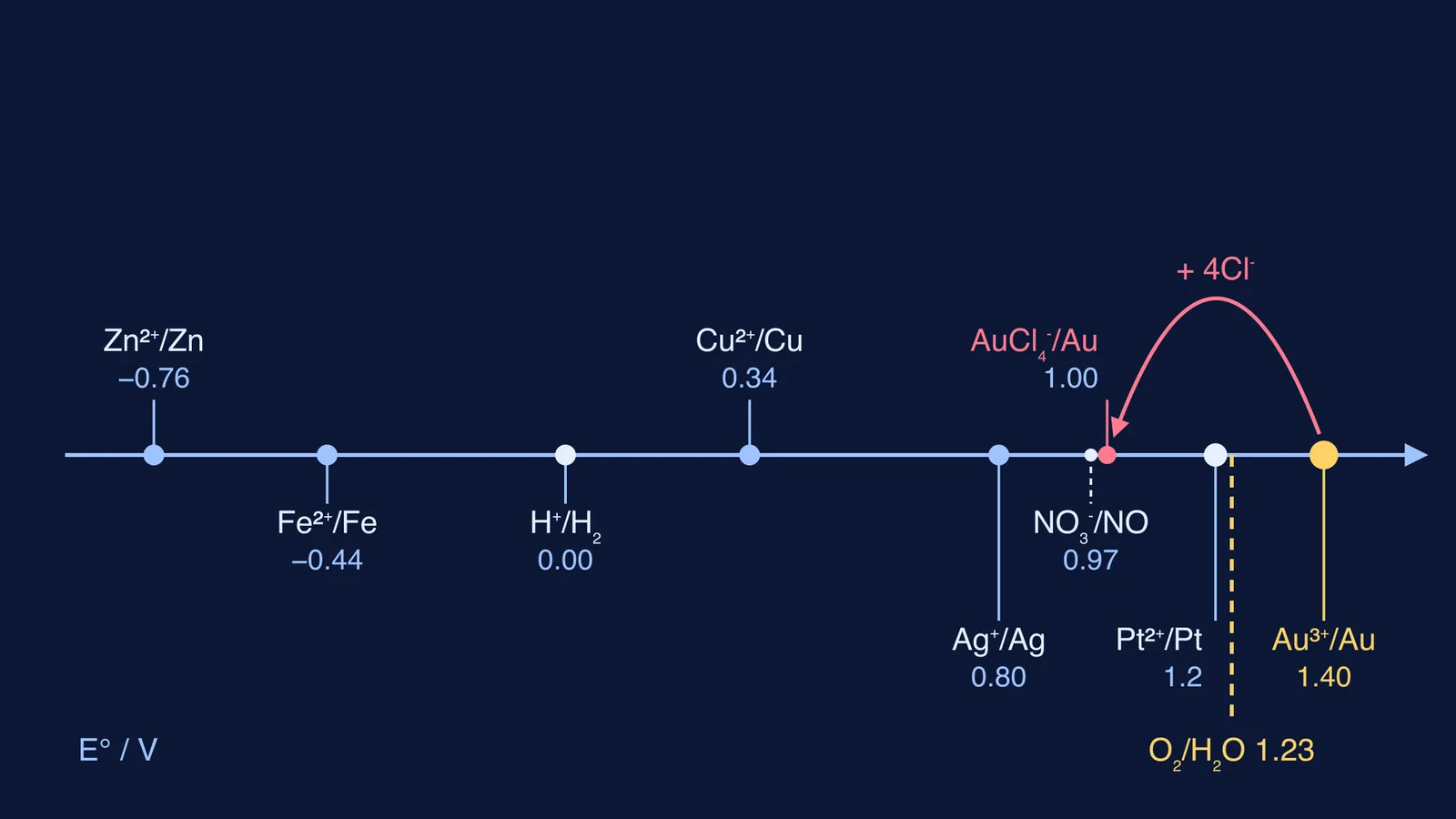
In NCERT's Table 2.1, the gold couple Au³⁺/Au has E° = +1.40 V, while oxygen in acid (O₂ + 4H⁺ + 4e⁻ → 2H₂O) has E° = +1.23 V (NCERT, Table 2.1).
So gold's ions hold electrons more tightly than oxygen does, and oxygen cannot oxidise gold. The hydrogen ions in water, at 0.00 V, have even less chance. Some data tables list Au³⁺/Au at about +1.5 V instead (LibreTexts table of standard reduction potentials); the conclusion is the same.
Platinum's couple Pt²⁺/Pt is listed at about +1.2 V in the same LibreTexts table, almost level with oxygen.
How do you prove it with E°cell? A worked example
A redox reaction can go on its own when E°cell = E°(cathode) − E°(anode) is positive, because ΔG° = −nFE°cell and a negative ΔG° means spontaneous (NCERT, Section 2.3.2). Here the oxidiser is the cathode and the metal is the anode. All values below are from NCERT's Table 2.1 unless stated.
Iron in moist air: E°cell = 1.23 − (−0.44) = +1.67 V. Positive, so iron rusts; NCERT's corrosion section gets the same value.
Gold in moist air: E°cell = 1.23 − 1.40 = −0.17 V. For 4Au + 3O₂ + 12H⁺ → 4Au³⁺ + 6H₂O, twelve electrons move, so ΔG° = −12 × 96487 × (−0.17) ≈ +197 kJ. A positive ΔG° means no reaction.
Gold in water or dilute acid: the oxidiser is now H⁺, so E°cell = 0.00 − 1.40 = −1.40 V.
Platinum in neutral water: applying NCERT's Nernst equation to the oxygen half-reaction lowers its potential by 0.059 V for every pH unit, so at pH 7 it is about 1.23 − 0.059 × 7 ≈ 0.82 V. Against platinum's +1.2 V (LibreTexts), E ≈ 0.82 − 1.2 ≈ −0.4 V.
In 1 M acid the margin vanishes: 1.23 − 1.2 ≈ +0.03 V, too close to call on paper. So a second reason matters: bulk platinum does not oxidise in air at any temperature, and the thin PtO₂ film that forms on its surface breaks down above 500 °C (Wikipedia: Platinum).
Why does aqua regia dissolve gold when single acids cannot?
Aqua regia is concentrated hydrochloric and nitric acids mixed in a 3:1 ratio (LBMA, Aqua regia refining).
Nitric acid alone fails. Nitrate's E° is +0.97 V (NCERT, Table 2.1), so E°cell = 0.97 − 1.40 = −0.43 V. Hydrochloric acid alone fails too, because its only oxidiser is H⁺ at 0.00 V.
The mixture works because chloride changes gold's half-reaction. Gold ions bind four chloride ions to form AuCl₄⁻, and the couple AuCl₄⁻ + 3e⁻ → Au + 4Cl⁻ has E° = +1.00 V (LibreTexts). The gap to nitrate shrinks from 0.43 V to about 0.03 V, still slightly uphill under standard conditions. In concentrated acid, though, chloride keeps removing gold ions as the complex, which lets more gold be oxidised (Wikipedia: Aqua regia).
Platinum follows the same pattern. With chloride, its couple PtCl₄²⁻/Pt drops to +0.73 V (LibreTexts), below nitrate. Platinum resists hydrochloric and nitric acid separately but dissolves in hot aqua regia (Wikipedia: Platinum). Silver is the odd one out: silver chloride is insoluble, so silver stays behind (LBMA). We go through the full reaction in how aqua regia dissolves gold.
Will this metal corrode? A four-step check
For any board or JEE question on whether a metal reacts, using E° values from NCERT's Table 2.1:
Write the metal's reduction half-reaction and look up its E°.
Name the oxidiser actually present: O₂ in acid (+1.23 V), O₂ in neutral water (about +0.82 V), H⁺ (0.00 V) or nitrate (+0.97 V).
Compute E°cell = E°(oxidiser) − E°(metal). Positive means the reaction is possible.
Check what else is in the solution. Ligands such as Cl⁻ lower the metal's potential; a protective film or a slow reaction can stop what is allowed on paper.
If a step feels shaky, the Fermi Concept Library has a lesson for each idea here, from electrode potential to the Nernst equation, with its place in the map. To practise the full calculation, the Fermi Problem Library has worked problems with a step-by-step solver that explains the reasoning rather than printing an answer.
Read more on how corrosion works as an electrochemical cell and what the electrochemical series lets you predict.


