

On this page
Gold survives acids that eat most metals, which is why the mixture that does dissolve it was called "royal water", or aqua regia. Neither acid in it can do the job alone. The reason combines redox, equilibrium and complex formation, which is how JEE and board exams tend to test it.
What is aqua regia?
Aqua regia is three parts concentrated hydrochloric acid (HCl) to one part concentrated nitric acid (HNO₃), according to the University of Illinois Division of Research Safety. As soon as the two acids meet, they react with each other, as the Wikipedia article on aqua regia sets out:
HNO₃ + 3HCl → NOCl + Cl₂ + 2H₂O
2NOCl → 2NO + Cl₂
The Illinois guidance adds that the nitric oxide then oxidises in air to NO₂, a poisonous reddish-brown gas (2NO + O₂ → 2NO₂). Because it keeps breaking down, the guidance says to make small, fresh batches for each use and never to store it in a stoppered bottle, because the bottle may explode.
Why can't nitric acid dissolve gold on its own?
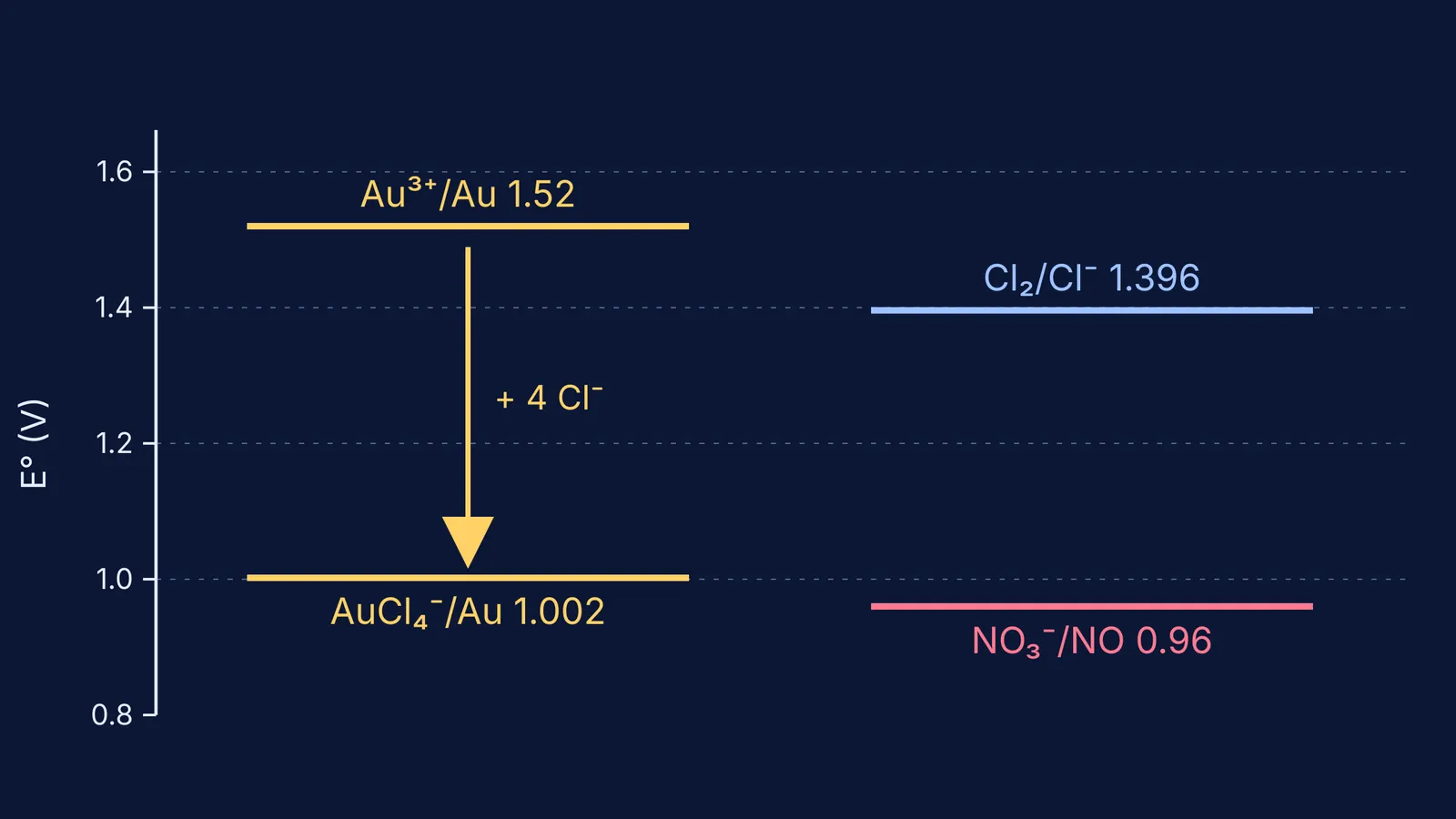
Nitric acid is a strong oxidising agent, but gold is harder to oxidise still. Compare the standard reduction potentials in the LibreTexts table of standard potentials:
Au³⁺ + 3e⁻ → Au: E° = +1.52 V
NO₃⁻ + 4H⁺ + 3e⁻ → NO + 2H₂O: E° = +0.96 V
Cl₂ + 2e⁻ → 2Cl⁻: E° = +1.396 V
AuCl₄⁻ + 3e⁻ → Au + 4Cl⁻: E° = +1.002 V
To oxidise gold, the oxidant's potential needs to be higher than gold's. Nitrate is 0.56 V too low. Hydrochloric acid is no help on its own, because H⁺ is a weak oxidant and Cl⁻ cannot be oxidised further to act as one.
How does chloride pull gold into solution?
Chloride grabs Au³⁺ as it forms and holds it as the square planar tetrachloroaurate ion, AuCl₄⁻. The Royal Society of Chemistry's education article on aqua regia explains that nitric acid converts small amounts of gold to Au³⁺, and chloride from the hydrochloric acid reacts with these ions to form AuCl₄⁻. This takes free gold ions out of solution, so more gold oxidises to replace them: Le Chatelier's principle at work. Overall, as given in the Wikipedia article:
Au + HNO₃ + 4HCl → [AuCl₄]⁻ + NO + H₃O⁺ + H₂O
Check the electrons: gold goes from 0 to +3 and nitrogen goes from +5 to +2. That is three electrons each way, so the equation balances.
How much does chloride change the numbers?
Use the potentials from the LibreTexts table, n = 3 and the 25 °C relation log K = nE°/0.0592.
Without chloride: E°cell = 0.96 − 1.52 = −0.56 V, so log K = 3 × (−0.56)/0.0592 ≈ −28. Practically no gold dissolves.
With chloride: E°cell = 0.96 − 1.002 = −0.04 V, so log K ≈ −2. The reaction is now close to balanced. Concentrated acid and NO escaping as a gas push it forward.
How strongly chloride binds: the 0.52 V drop from 1.52 to 1.002 V gives log β₄ = 3 × 0.518/0.0592 ≈ 26 for Au³⁺ + 4Cl⁻ ⇌ AuCl₄⁻.
Chlorine's part: against free Au³⁺, chlorine is 0.12 V too weak (1.396 vs 1.52). Against AuCl₄⁻ it wins by 0.39 V (1.396 vs 1.002), so the Cl₂ in the mixture attacks gold as well.
The general rule: complex formation lowers a metal's reduction potential, which makes the metal easier to oxidise. That is also why platinum dissolves as [PtCl₆]²⁻. For the Nernst steps, see our guide to cell EMF and the Nernst equation. For naming and bonding in ions like AuCl₄⁻, see coordination compounds: naming, isomerism and crystal field basics.
If the complex-ion idea feels shaky, the Fermi Concept Library gives each chemistry concept its own lesson and its place in the map. To practise the calculation, the Fermi Problem Library has worked problems with a step-by-step solver that explains the reasoning rather than printing an answer.
Where else does aqua regia turn up?
Refiners use it to purify gold, and the RSC article notes this can give gold that is 99.999% pure. The best-known story is from 1940. According to the Linda Hall Library, when Germany invaded Denmark, George de Hevesy dissolved the Nobel medals of Max von Laue and James Franck at Niels Bohr's institute in Copenhagen so they could not be found and confiscated. After the war he precipitated the gold, and the medals were recast from it.
How do you answer "why does aqua regia dissolve gold" in an exam?
A full-mark answer covers four points, usually in three or four lines:
Composition: 3 parts concentrated HCl to 1 part concentrated HNO₃ (per the Illinois safety guidance).
Oxidation: HNO₃, along with the NOCl and Cl₂ the mixture produces, oxidises Au to Au³⁺.
Complexation: Cl⁻ forms AuCl₄⁻, which removes Au³⁺ and pulls the equilibrium forward.
Equation: Au + HNO₃ + 4HCl → HAuCl₄ + NO + 2H₂O (chloroauric acid, as the RSC article names it).
Next, write the same four points for platinum, where the complex is [PtCl₆]²⁻.


