

On this page
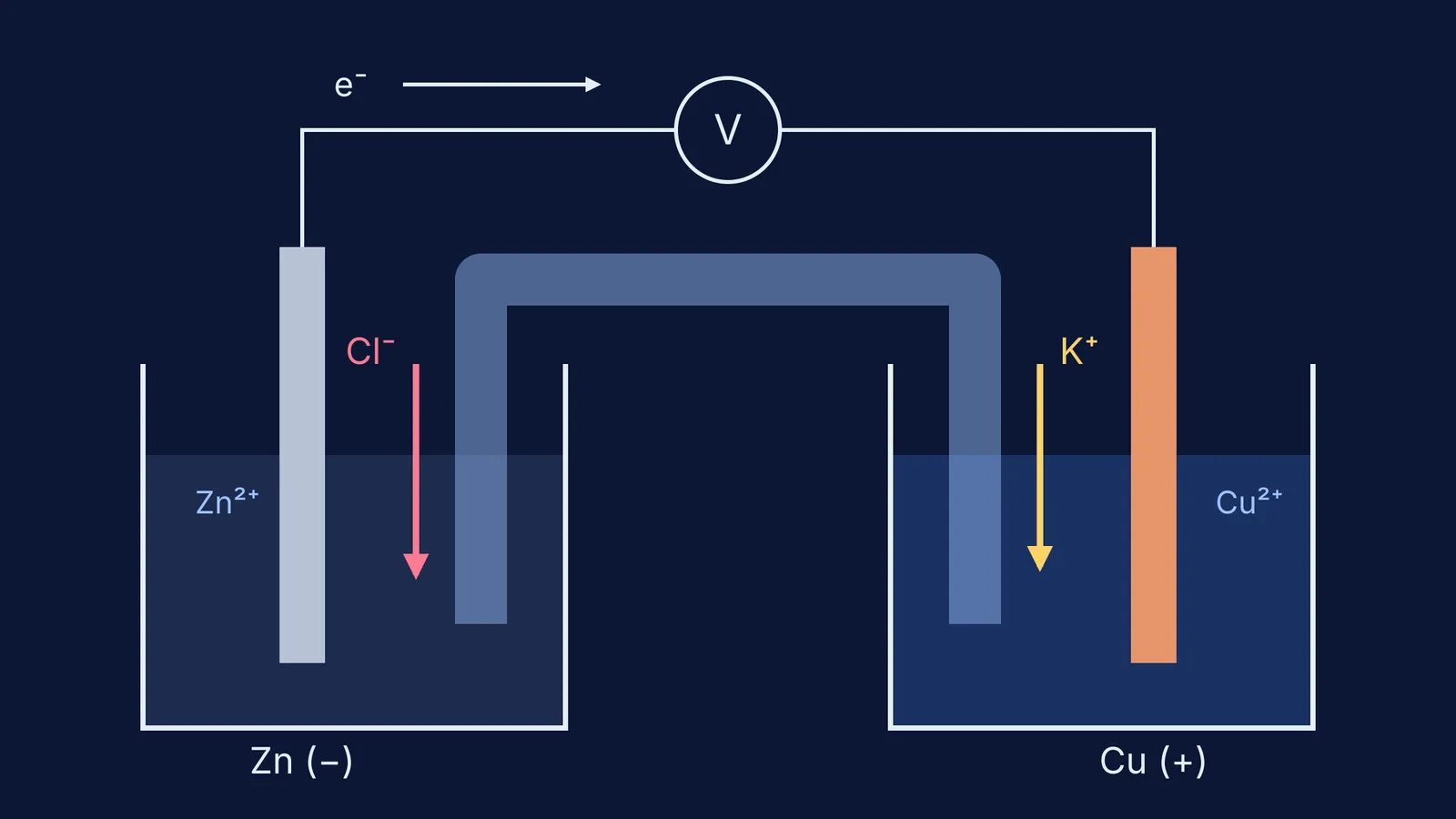
Picture the Daniell cell from your NCERT textbook: a zinc rod in zinc sulphate, a copper rod in copper sulphate, a wire and a voltmeter on top, and an inverted U-tube joining the two beakers. NCERT gives this cell a potential of 1.1 V when both ion concentrations are 1 mol dm⁻³ (NCERT Class 12 Chemistry, Electrochemistry). That U-tube is the salt bridge, and without it the 1.1 V is gone.
Why is a salt bridge needed in a galvanic cell?
A cell needs two paths, not one. Electrons travel through the wire. Inside the cell, ions have to carry the charge back. The salt bridge is that inside path.
Watch the charges as the cell runs. At the anode, zinc atoms become Zn²⁺ ions, so the left beaker gains positive charge. At the cathode, Cu²⁺ ions become copper metal, so the right beaker loses positive charge. LibreTexts' chemistry text puts it simply: the salt bridge "maintains electrical neutrality in both solutions by allowing ions to migrate between them", with anions flowing into the zinc solution and cations into the copper solution (LibreTexts, Voltaic Cells/20%3A_Electrochemistry/20.03%3A_Voltaic_Cells)).
The same page warns that without a salt bridge or a similar connection, "the reaction would rapidly cease because electrical neutrality could not be maintained". A tiny excess of charge is enough to stop more Zn²⁺ leaving the rod or more electrons reaching the copper.
The bridge does a second job too: it keeps the two solutions apart. If Cu²⁺ ions reached the zinc rod, copper would deposit on the zinc directly. The electrons would never travel through your wire.
Why is KCl or KNO₃ used in a salt bridge?
The salt in the bridge must not react with anything in either beaker, and its cation and anion should move at about the same speed.
When two ions cross a boundary between solutions at different speeds, the faster one gets ahead and creates a small extra voltage called the liquid junction potential. This adds an error to the cell reading. BYJU'S notes that K⁺ and Cl⁻ have very similar diffusion coefficients, which keeps this junction potential small (BYJU'S, Salt Bridge).
NCERT's table of limiting molar conductivities shows the numbers: K⁺ is 73.5, Cl⁻ is 76.3 and Na⁺ is 50.1 S cm² mol⁻¹ at 298 K (NCERT Class 12 Chemistry, Table 2.4).
KCl is not always the right choice. The same BYJU'S page notes that KCl is unwise with silver or lead electrodes, because they form a precipitate (AgCl or PbCl₂) that can block the end of the bridge. In those cells, KNO₃ is the usual choice, because K⁺ and NO₃⁻ form soluble salts.
Worked example: how much does each ion carry?
The fraction of the current an ion carries is its transport number. Using the limiting molar conductivities for KCl from NCERT's Table 2.4, which apply to very dilute solutions, so treat the result as an estimate:
Share carried by Cl⁻ = 76.3 / (73.5 + 76.3) = 76.3 / 149.8 ≈ 0.51
Share carried by K⁺ = 73.5 / 149.8 ≈ 0.49
When 1 mol of zinc dissolves, 2 mol of electrons pass through the wire. So about 1.02 mol of Cl⁻ moves into the zinc beaker and about 0.98 mol of K⁺ moves into the copper beaker.
Together those cancel the 2 mol of charge the reaction creates, and the work is split almost equally between the two ions. Now try NaCl: Na⁺ carries 50.1 / 126.4 ≈ 0.40 and Cl⁻ about 0.60. That uneven split gives a larger junction potential, which is one reason KCl is preferred over NaCl when a precise reading matters.
What does the voltmeter show when the salt bridge is removed?
It drops to zero. Lifting out the bridge breaks the only path for ions between the beakers, so the circuit is open and no current can flow. BYJU'S also notes that no current flows without a salt bridge. With the circuit open, the reaction stops. Put the bridge back and the reading returns, because the zinc and the copper ions are still there to react.
The zero does not mean zinc has stopped wanting to reduce copper ions. The reaction is still spontaneous. It just has no complete circuit. NCERT also notes that when both electrodes dip into the same electrolyte, no salt bridge is needed, because the ions already share one solution.
If a cell's voltage still confuses you, three of our explainers go further: why a galvanic cell eventually stops, how calomel and Ag/AgCl reference electrodes work, and a simulation of how cell voltage changes with concentration.
To practise salt-bridge and EMF questions, the Fermi Problem Library has worked problems with a step-by-step solver that explains the reasoning rather than just printing an answer. If you need the basics of electrode potential first, start with the electrochemistry lessons in the Fermi Concept Library.


