

On this page
When you change the ion concentrations in a zinc–copper cell, the voltage moves only a little, and always in a direction you can predict. The Nernst equation tells you how far it will move before you touch the slider. Below is a short routine for using any galvanic-cell simulation as a prediction test, with worked numbers you can check against the screen.
What does the Nernst equation say about concentration?
At 25 °C, the Nernst equation is E = E° − (0.0592 V/n) log Q, where n is the number of electrons transferred and Q is the reaction quotient (OpenStax Chemistry 2e, section 17.4). E° is the voltage under standard conditions: 1 M solutions, 1 bar and 298 K (OpenStax Chemistry 2e, section 17.3).
Take the Daniell cell: Zn(s) + Cu²⁺(aq) → Zn²⁺(aq) + Cu(s). Section 17.3 lists standard reduction potentials of +0.34 V for Cu²⁺/Cu and −0.7618 V for Zn²⁺/Zn, so E° = 0.34 − (−0.7618) ≈ 1.10 V. Two electrons move, so n = 2. The solid metals drop out of Q, leaving Q = [Zn²⁺]/[Cu²⁺].
That gives you one line for this cell: E = 1.10 − 0.0296 log ([Zn²⁺]/[Cu²⁺]). If cell notation still feels shaky, start with our walkthrough of cell notation, EMF and the Nernst equation.
How do you predict the voltage before moving the slider?
Treat the simulation as a test of your reasoning, not just a display. For each setting:
Write Q with products on top: [Zn²⁺]/[Cu²⁺].
Say the direction out loud: if Q goes up, E goes down.
Work out log Q, multiply it by 0.0296 and subtract the result from 1.10.
Set the concentrations, read the voltmeter and compare.
If you are off by more than about 0.01 V, find the step that went wrong before you move on.
Here are five settings worked from the equation above, using the OpenStax standard potentials (concentrations in mol/L):
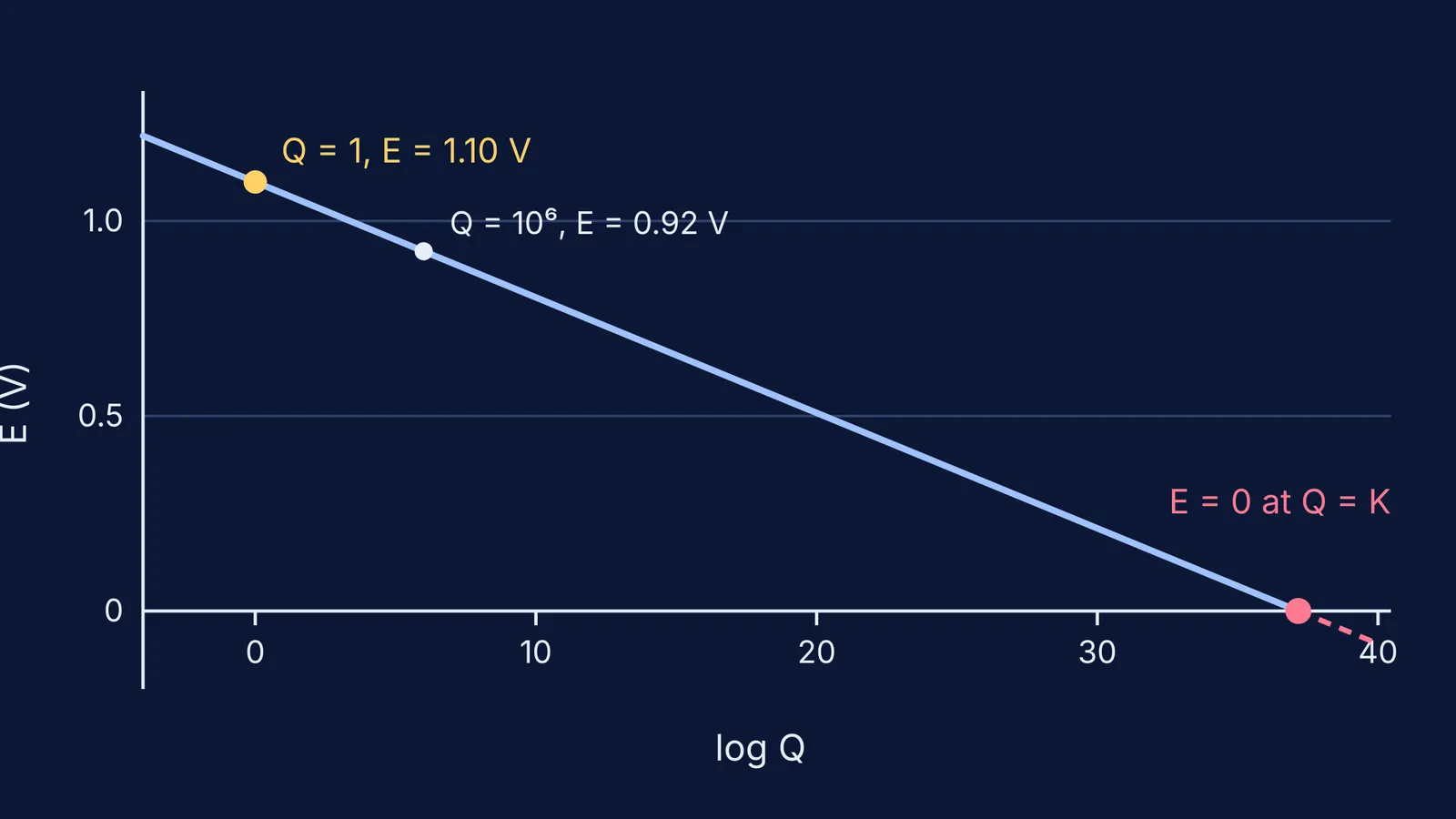
Zn²⁺ 1.0, Cu²⁺ 1.0: Q = 1, E = 1.10 V
Zn²⁺ 0.10, Cu²⁺ 1.0: Q = 0.1, E = 1.10 + 0.03 = 1.13 V
Zn²⁺ 1.0, Cu²⁺ 0.10: Q = 10, E = 1.10 − 0.03 = 1.07 V
Zn²⁺ 1.0, Cu²⁺ 0.0010: Q = 1000, E = 1.10 − 0.089 = 1.01 V
Zn²⁺ 1.0, Cu²⁺ 0.0000010: Q = 10⁶, E = 1.10 − 0.178 = 0.92 V
Why does the voltage barely change?
The concentration term sits inside a logarithm. It is tempting to expect that halving [Cu²⁺] will cut the voltage sharply, but the simulation shows that it does not. The voltage is set mainly by E°, which depends on the chemistry of the two electrodes. Concentration only nudges the voltage up or down from that value.
The direction still matters. Adding reactant (Cu²⁺) or removing product (Zn²⁺) raises E slightly. Building up product or using up reactant lowers it. It is Le Chatelier's principle, shown on a voltmeter.
When does a cell's voltage reach zero?
A cell's voltage reaches zero at equilibrium, when Q equals the equilibrium constant K. OpenStax gives E° = (0.0592 V/n) log K at 25 °C (OpenStax Chemistry 2e, section 17.4). Put that into the Nernst equation and E = (0.0592 V/n) log (K/Q), which is zero exactly when Q = K.
For the Daniell cell, log K = 2 × 1.10 / 0.0592 ≈ 37, so K is about 10³⁷. The voltage reaches zero only when [Zn²⁺] is about 10³⁷ times [Cu²⁺], which means the copper ions are essentially used up. No slider goes that far, so a zinc–copper simulation shows the voltage sagging slowly but never reaching zero. To see how E°, ΔG° and K fit together, read from cell EMF to ΔG° and K.
To watch a cell run down, use a concentration cell: the same metal and ion on both sides, so E° = 0. OpenStax works a zinc concentration cell with 0.10 M and 0.50 M solutions and gets +0.021 V; once it reaches equilibrium, both sides are 0.30 M and the cell potential is 0.000 V (OpenStax Chemistry 2e, section 17.4). With equal concentrations, no net reaction is left to drive a current. For more examples, see concentration cells and their EMF.
What mistakes does a simulation catch?
Each of these gives a reading that does not match your prediction, which is why you predict first:
Q upside down: [Cu²⁺]/[Zn²⁺] makes the voltage move the wrong way.
Forgetting n: using 0.0592 instead of 0.0592/2 doubles every correction.
Mixing logs: 0.0592 goes with log base 10, not ln.
Solids in Q: Zn(s) and Cu(s) never appear in it.
Changing E°: E° is fixed for the cell. Only E changes with concentration.
The Fermi Simulation Lab has interactive simulations for ideas that are easier to see than to read, so you can use the same predict-then-check routine on other topics. If the reaction quotient itself is the gap, the Fermi Concept Library has a lesson for each concept.
Choose one setting, write down your prediction before you move the slider, and use the voltmeter to check your work.


