

On this page
A galvanic cell produces electrical energy from a spontaneous chemical reaction. But if you leave it running, the voltage gradually drops. Eventually, the cell goes "dead."
Why does a galvanic cell stop working when EMF becomes zero?
The short answer is that the underlying chemical reaction has reached thermodynamic equilibrium.
When a cell is freshly made, it has a high concentration of reactants and a low concentration of products. Because the system is far from equilibrium, there is a strong "push" for the reaction to go forward. This push is what we measure as the electromotive force (EMF) or cell potential (E_cell).
As the reaction runs, electrons flow through the external wire. Inside the cell, reactants are consumed to form products. This shifts the chemical balance, reducing the driving force until the system finally settles into equilibrium.
How does the Nernst equation explain a dead cell?
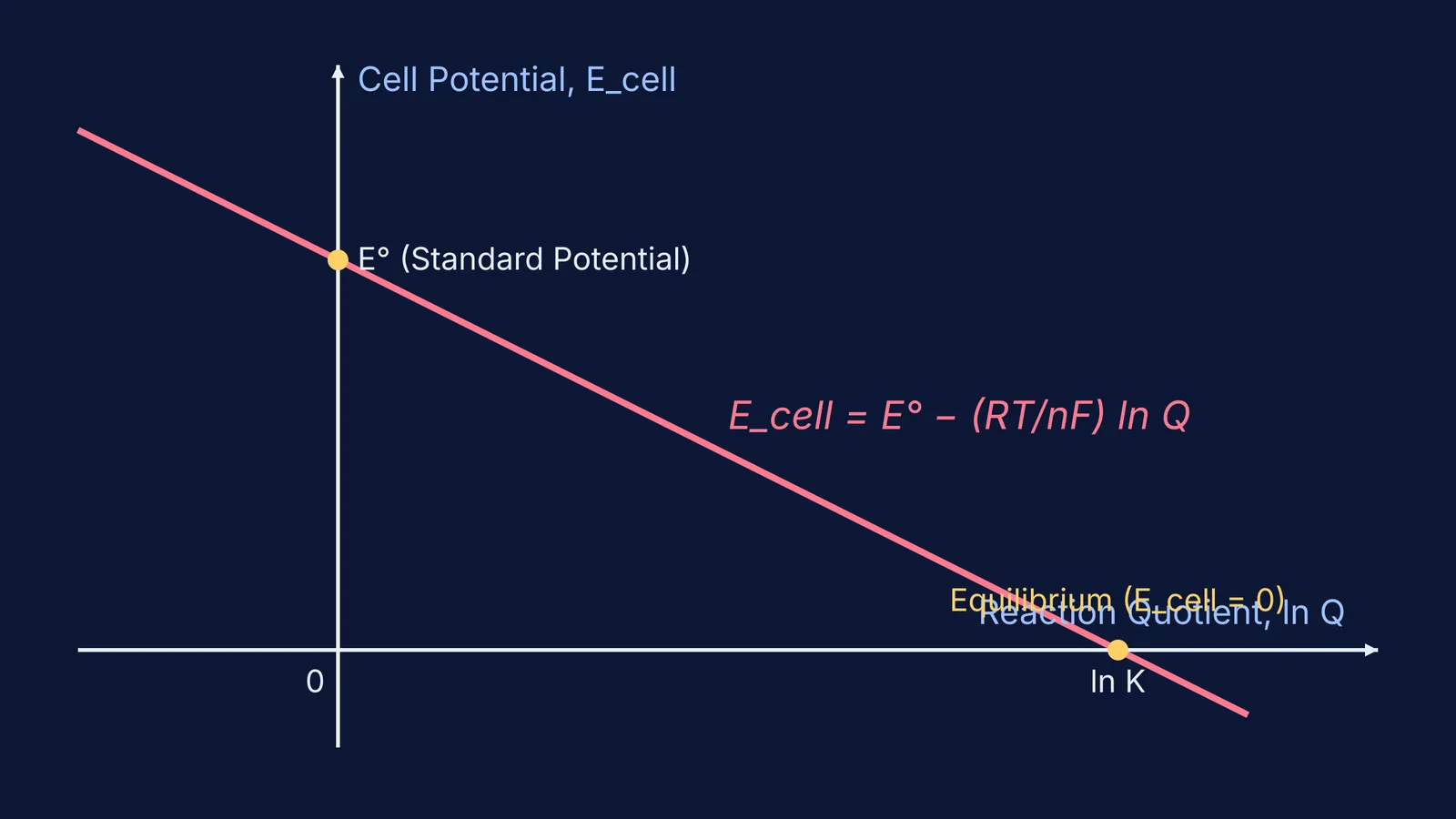
To see exactly why the voltage drops, we look at the math. The Nernst equation describes the cell potential as a function of the reaction quotient (Wikipedia). According to this relationship, the cell potential at any moment is:
E_cell = E° − (RT / nF) ln Q
Here, E° is the standard potential (a fixed number for the cell), R is the gas constant, T is temperature, n is the number of electrons transferred, and F is Faraday's constant.
The key variable is Q, the reaction quotient, which is the ratio of product concentrations to reactant concentrations. When the cell starts, Q is small. But as the cell operates and creates more products, Q gets larger.
As Q increases, its natural logarithm (ln Q) also increases. Because this growing term is subtracted from the standard potential (E°), the overall cell potential (E_cell) steadily goes down.
What happens when EMF reaches zero?
The reaction keeps going until Q grows large enough to equal the equilibrium constant, K. At this exact moment, the term we are subtracting, (RT / nF) ln K, becomes exactly equal to E°.
When you subtract a number from itself, you get zero. Therefore, the cell potential becomes zero (E_cell = 0).
At this point, there is no longer any potential difference between the two electrodes. Without a potential difference, there is no force to push electrons through the wire, and the current stops.
Worked example: How do you find the equilibrium constant?
We can use the fact that E_cell = 0 at equilibrium to find the equilibrium constant (K) for a cell reaction. Let's look at the classic Daniell cell, which uses zinc and copper.
Identify the standard potential: The standard cell potential (E°) for the zinc-copper cell is 1.10 V at 298 K (25 °C) (Wikipedia).
Set up the equilibrium condition: At equilibrium, we know that E_cell = 0 and Q = K.
Use the simplified Nernst equation: At 298 K, the term (RT/F) simplifies to a constant, and we often switch to base-10 logarithms. The equation becomes: 0 = E° − (0.059 / n) log K
Plug in the numbers: For the Daniell cell, two electrons are transferred (Zn to Zn²⁺ and Cu²⁺ to Cu), so n = 2. 0 = 1.10 − (0.059 / 2) log K
Solve for K: 1.10 = 0.0295 log K, log K = 1.10 / 0.0295 = 37.3, K = 10^37.3
This massive equilibrium constant tells us that the reaction goes almost entirely to completion before the cell potential reaches zero and the battery goes dead.
How does Gibbs free energy change when the cell stops?
We can also look at this through the lens of useful work. The electrical work a cell can do is tied to its Gibbs free energy change (ΔG) by the equation ΔG = −nFE_cell.
When the EMF (E_cell) hits zero, the free energy change also becomes zero (ΔG = 0). In thermodynamics, a ΔG of zero is the strict definition of equilibrium. The system has reached its lowest possible energy state under those conditions, meaning it has no more free energy left to drive an electric current. To see how these constants link up at standard conditions, you can calculate from cell EMF to ΔG° and K.
If you are setting up electrochemistry problems for the JEE or NEET, keeping track of how Q and E° change the voltage can be tricky. When you need to clear up the rules of equilibrium, the Fermi Concept Library has a lesson for every concept in chemistry, showing exactly how these ideas fit together in the wider map.


