On this page
Most students in India have seen tulsi and neem. Fewer know what is actually inside them. The answer is a set of molecules that biologists call secondary metabolites, and once you can name them and spot their functional groups, a chunk of Class 11 biology and organic chemistry starts to fit together.
This post is about plant chemistry only. It is not health advice.
What are secondary metabolites?
Your NCERT Class 11 Biology textbook, Chapter 9 (Biomolecules) draws the line clearly. Primary metabolites, such as amino acids, sugars and fatty acids, have known roles in normal physiology. Secondary metabolites are the thousands of other compounds found in plant, fungal and microbial cells, such as alkaloids, flavonoids, essential oils, pigments, scents and gums.
The same chapter notes that we do not yet understand the role of every secondary metabolite in the organism that makes it, that many are useful to people, and that some have ecological importance. Its Table 9.3 groups them into classes such as pigments, alkaloids, terpenoids, essential oils, toxins, lectins, drugs and polymeric substances. Tulsi and neem are good examples of two of those classes.
What compounds are in tulsi?
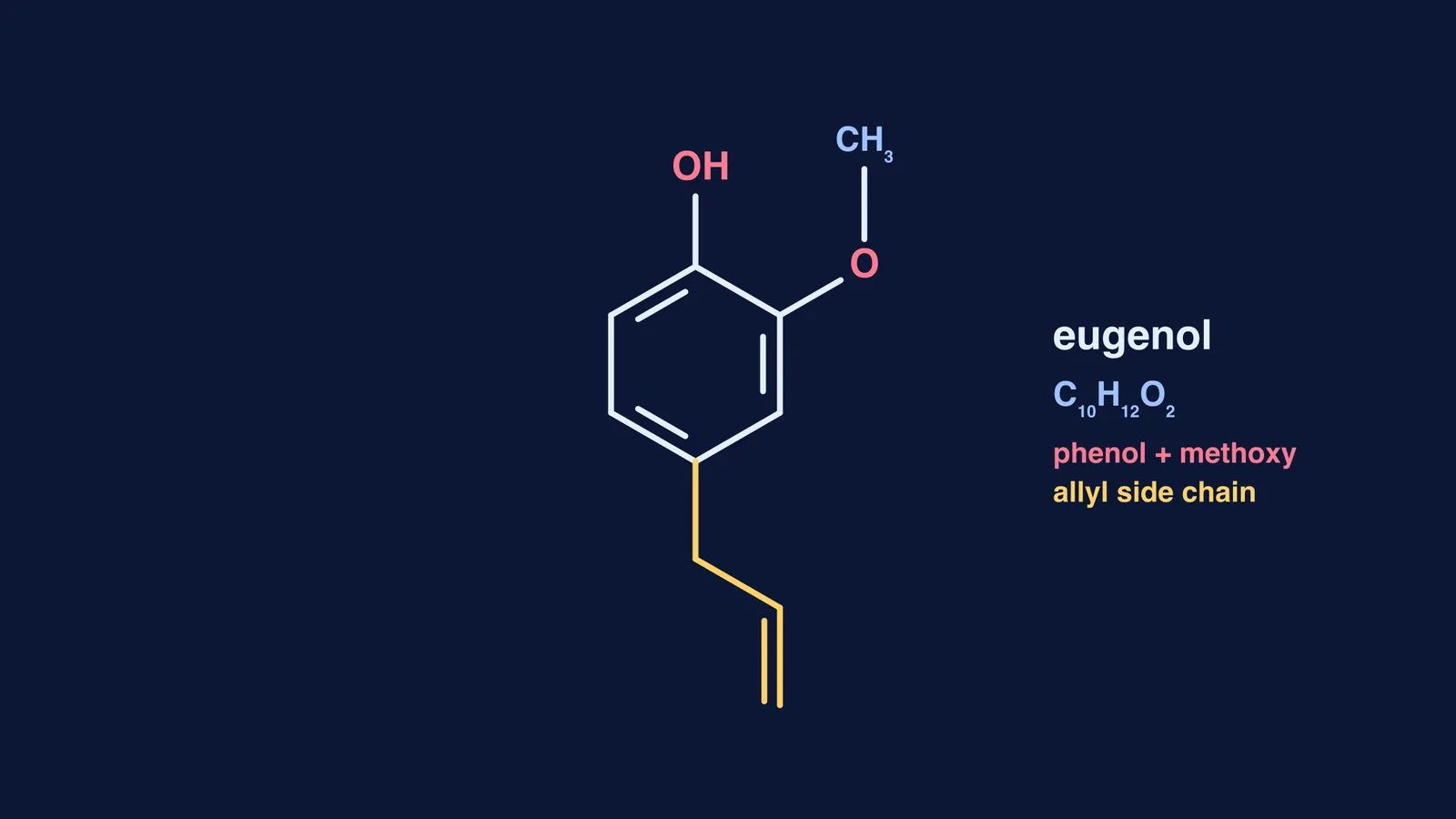
Tulsi (*Ocimum sanctum*, also called *Ocimum tenuiflorum*) is best known for its aromatic leaf oil. A 2010 review in Pharmacognosy Reviews names eugenol (1-hydroxy-2-methoxy-4-allylbenzene) as the active constituent found to be largely responsible for the effects reported in studies of the plant. The same review lists other compounds in the leaf oil, including carvacrol, linalool, caryophyllene and ursolic acid, with phenolic compounds such as rosmarinic acid and apigenin.
Eugenol has the molecular formula C10H12O2, according to PubChem.
How much eugenol a plant has is not fixed. A 2025 study in Molecules on tulsi grown in Nepal found eugenol made up 32.15-34.95% of the essential oil in samples harvested in winter and autumn, and concluded that the harvesting season clearly influenced the oil's chemical composition. A 2014 review by Marc Maurice Cohen reports that purple Krishna tulsi has a higher phenolic content than white Vana tulsi.
What compounds are in neem?
Neem's (*Azadirachta indica*) best-known compounds belong to a different class: terpenoids. A 2015 genome and metabolite study in PeerJ describes azadirachtin, salannin and nimbin as complex tetranortriterpenoids and the major active principles of neem seed. It also notes that more than 150 bioactive compounds have been isolated from neem tissues.
Where they sit matters. The same PeerJ study measured azadirachtin at about 5,000 times higher concentration in the seed than in the leaves.
Azadirachtin is a large molecule, with the formula C35H44O16 on PubChem. Compare that with eugenol's 10 carbons and you can see why these are counted as two very different families.
Why do plants make these compounds?
The clearest answer comes from insects. A 2017 review in Frontiers in Plant Science describes azadirachtin as a limonoid that acts as an antifeedant and repellent, and as an insect growth regulator because it is structurally similar to the insect moulting hormones called ecdysones. The review also notes that neem seeds contain about 40% oil, with azadirachtin as its major active ingredient. That is the basis of neem-based biopesticides, and a neat example of the ecological importance NCERT mentions.
How do you classify a plant compound in an exam?
Here is a four-step routine you can use for any named plant compound, worked through for eugenol.
Name the plant and the part. Tulsi, leaf oil.
Place it in a class from NCERT Table 9.3. Eugenol is part of an essential oil.
Read the structure for functional groups. From its IUPAC name, 2-methoxy-4-prop-2-enylphenol, eugenol has a phenol (-OH on a benzene ring), an ether (the methoxy group, -OCH3) and an alkene (the allyl side chain).
Link structure to a property you can test. The phenolic -OH is weakly acidic, which you can connect to the phenol reactions in your chemistry syllabus.
Now try the same routine on neem: seed, terpenoid (limonoid), a much larger oxygen-rich skeleton, and a known effect on insect feeding. If you can do this for two plants, you can do it for the curcumin and vinblastin examples in the same NCERT table.
If step 3 is where you get stuck, the Fermi Concept Library covers every concept in chemistry and biology, each with its own lesson and its place in the map. For practice questions, the Fermi Problem Library has worked problems with a step-by-step solver that explains the reasoning rather than printing an answer.
Next time you pass a neem tree, pick one compound and run it through the four steps.