

On this page
Your tooth enamel is the hardest substance in the human body, built to withstand a lifetime of chewing and grinding. It gets its formidable strength from a crystalline mineral called calcium hydroxyapatite, written chemically as Ca₁₀(PO₄)₆(OH)₂. While this mineral is incredibly tough and does not naturally dissolve in water, it has one major weakness that threatens its structural integrity: acid.
Our mouths are home to many bacteria that form a sticky film over our teeth known as dental biofilm or plaque. When you eat fermentable carbohydrates, such as sugars and starches, acidogenic bacteria like *Streptococcus mutans* feed on the leftovers. As they break down the sugar for energy, they produce organic acids—such as lactic, acetic, and propionic acids—as a by-product. This acid rapidly lowers the pH of your mouth, creating a hostile environment for your teeth.
Why does tooth decay start below pH 5.5?
In chemistry, neutral pH changes with temperature, but a healthy mouth typically rests near a neutral pH of 7.0. However, as bacteria in the biofilm produce acid, the local pH at the tooth surface drops significantly.
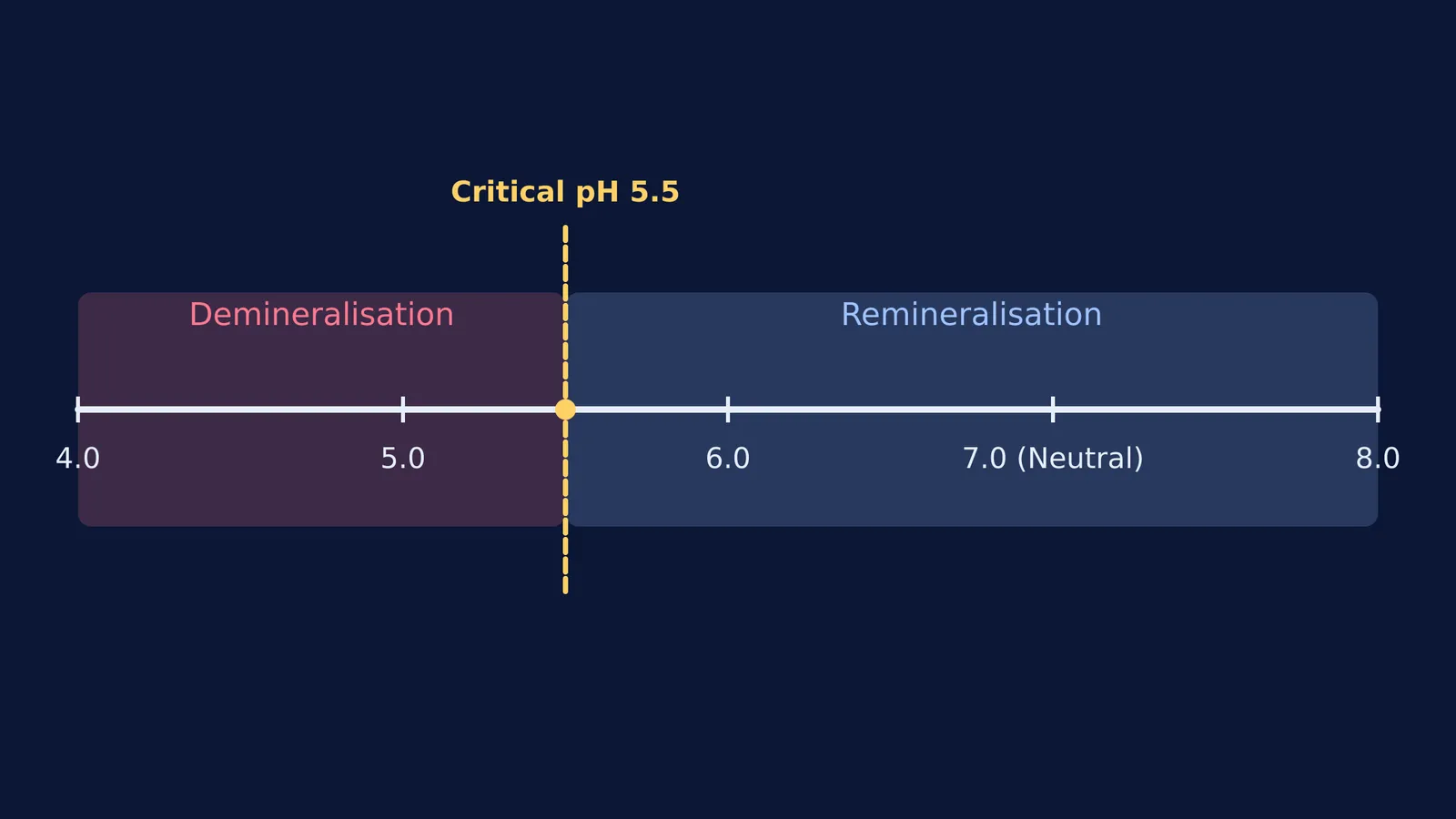
For human tooth enamel, the "critical pH" is approximately 5.5 1. Below this threshold, the concentration of hydrogen ions (H⁺) in the fluid surrounding the tooth becomes high enough to pull phosphate and hydroxyl ions directly out of the calcium hydroxyapatite crystals. The chemical structure literally breaks apart, releasing calcium and phosphate into your saliva. This mineral loss is called demineralisation, and it marks the very beginning of tooth decay.
Interestingly, research indicates that lactic acid can produce faster enamel mineral loss than other acids at the same pH, revealing that the specific type of acid matters just as much as the acidity level 1.
What determines the critical pH?
While 5.5 is the commonly cited threshold 1, it is not a universal constant. The exact critical pH depends heavily on the concentration of calcium, phosphate, and fluoride already present in your saliva. If your saliva is heavily saturated with calcium and phosphate ions, the enamel can withstand slightly more acidic conditions before it begins to dissolve.
Conversely, if your mouth lacks these essential minerals, demineralisation can begin at a higher pH. This dynamic equilibrium explains why different people have different susceptibilities to cavities, even if they consume similar amounts of sugar.
How does your body fight back?
Fortunately, your mouth has a natural, built-in defence mechanism. Saliva acts as a chemical buffer, gradually neutralising the acid and raising the pH back above 5.5. Saliva also provides clearance by washing away lingering food particles and bacteria.
Once the environment is no longer highly acidic and becomes supersaturated with minerals again, the calcium and phosphate ions floating in your saliva can re-enter the porous enamel. They rebuild the hydroxyapatite structure in a process called remineralisation. A cavity only forms when the frequency and duration of acid attacks mean the rate of demineralisation outweighs the rate of remineralisation over time.
If you find yourself stuck on the chemical equations behind demineralisation or how acid-base equilibria work, the Fermi Concept Library has a lesson for every concept in chemistry, showing how solubility and pH fit into the map.
How can you protect your enamel?
Knowing that your enamel softens below pH 5.5 gives you a huge advantage in protecting your teeth. Here is how the chemistry of decay informs everyday routines:
Rinsing immediately: After eating sugary or starchy foods, rinsing your mouth with water dilutes the acid and physically washes away some of the leftover food, helping to restore a neutral pH faster.
Waiting before brushing: Because enamel softens below pH 5.5, the mechanical action of a toothbrush immediately after eating sweets can scrub the vulnerable minerals away. Waiting allows your saliva to buffer the pH and remineralise the surface.
Using basic toothpaste: Most toothpastes are slightly basic (alkaline). This helps neutralise the excess acid produced by bacteria, stopping demineralisation in its tracks. Additionally, fluoride in toothpaste accelerates remineralisation at the apatite surface, providing extra defence against future acid attacks.


